

Uruguay doesn’t make a lot of noise, but it’s been putting in serious work on the trade front.
The country has spent the last several years locking in economic agreements across Asia, Europe, and North America , and the numbers back that up. Agricultural goods like soybeans, beef, and dairy make up the bulk of its exports, while newer deals are pulling in foreign investment for renewable energy projects.
It’s a small country of roughly 3.5 million people, but it’s playing a longer game than most of its neighbours.
Key Takeaways
Uruguay’s been making serious moves on the trade front. The country signed onto the EU-MERCOSUR Free Trade Agreement, which cuts tariffs on 95% of traded goods between the two blocs , a deal expected to add around 1.5 percentage points to Uruguay’s GDP. That’s not a trivial number for an economy of its size.
The momentum didn’t stop there. In November 2025, Uruguay received an invitation to join the Comprehensive and Progressive Agreement for Trans-Pacific Partnership, better known as the CPTPP. Membership would open preferential trade terms with a string of Pacific Rim economies, giving Uruguayan exporters yet another set of markets to compete in.
China is already a cornerstone of that export picture. Bilateral trade between the two countries hit US$6.59 billion in 2024, up 25% from the previous year, driven largely by agricultural goods. This relationship has deep roots , Uruguay was the first MERCOSUR member to sign onto China’s Belt and Road Initiative back in 2018, laying the groundwork for the stronger commercial ties the two countries enjoy today.
Foreign investors are paying attention too. In September 2025, foreign direct investment rose by US$476.8 million, pointing to real confidence in Uruguay’s financial and manufacturing sectors. Taken together, these developments paint a picture of a small country that’s been unusually deliberate about building economic relationships across multiple continents at once.
What Makes Uruguay One of Latin America’s Most Strategically Positioned Traders
A big part of that is MERCOSUR, the regional trade bloc that gives Uruguay preferential access to markets across South America. Alongside that, the country runs twelve free trade zones, which together account for over 30% of its exports and more than 4% of GDP. Businesses operating in these zones pay no corporate taxes and face no import duties, which makes them genuinely attractive to international companies looking for a stable, low-barrier base in the region.
Uruguay is also pushing outward in a big way. The EU-MERCOSUR trade agreement, once ratified, would open up significant access to European markets, while Uruguay’s application to join the Comprehensive and Progressive Agreement for Trans-Pacific Partnership, known as the CPTPP, signals a clear interest in deeper ties with Asia and the Pacific. Talks around closer economic cooperation with China are also underway, reflecting a deliberate effort to spread trade relationships rather than rely too heavily on any single partner.
For a country of just 3.4 million people, that’s a remarkably broad reach, and it doesn’t happen by accident. Uruguay’s approach to trade mirrors its broader values: openness, pragmatism, and a firm belief in doing things on its own terms. The United States has also recognized Uruguay’s value, establishing the Trade and Investment Framework Agreement in 2007 to strengthen investor protections and facilitate bilateral trade.
What Uruguay Actually Gets From Its China Strategic Partnership
Uruguay’s strategic partnership with China puts some concrete advantages on the table. Chinese buyers are now offering preferential access for Uruguayan agricultural exports, which matters a lot for a country where beef, soybeans, and dairy make up a significant chunk of foreign income. Processed goods are also getting a warmer reception in Chinese markets, which is a step up from selling raw commodities at lower margins.
The deal also pulls in Chinese investment toward clean energy, digital finance, and manufacturing , sectors Uruguay has been trying to develop for years. That kind of investment diversifies the economy beyond its traditional reliance on agriculture, giving the country more legs to stand on when commodity prices dip. The two countries formalized this momentum by signing 19 cooperation agreements covering investment and trade during the partnership talks.
China Trade Benefits Explained
Trade between Uruguay and China has grown fast. In 2024, bilateral trade reached US$6.59 billion , a 25% increase from the previous year.
Agricultural exports have driven much of that growth. Beef, soybeans, pulp, and dairy are Uruguay’s main exports to China, with beef standing out in particular. Around 40% of Uruguay’s total beef exports go to Chinese markets, making China by far the country’s largest single buyer.
The trade relationship also worked in Uruguay’s favour financially in 2024. Uruguay sold more to China than it bought, ending the year with a US$50 million surplus. For a country of 3.4 million people, maintaining that kind of balance with the world’s second-largest economy carries real weight. Uruguay joined the Belt and Road Initiative in 2018, becoming the first MERCOSUR member to sign a Memorandum of Understanding with China under the programme.
Key Cooperation Areas Gained
Trade numbers only tell part of the story. Uruguay’s relationship with China stretches into areas that touch everyday life and shape long-term growth.
The Port of Montevideo is being expanded with Chinese investment, strengthening its role as a major entry point for South Atlantic shipping. Payment systems are being modernised to make cross-border transactions easier for businesses. Electric buses sourced from China are already running in Montevideo, and both countries are collaborating on clean energy research. Researchers from Uruguay and China are also working together in areas like biomedicine and advanced manufacturing.
One of the less visible but genuinely useful outcomes is skills development. Joint training programs, business exchanges, and academic partnerships are giving Uruguayans practical tools to work in industries that didn’t exist a generation ago.
These aren’t just agreements collecting dust. They translate into real projects, real jobs, and real knowledge transfer for a country of just 3.4 million people navigating an increasingly competitive global economy. The partnership was further cemented when over 10 cooperation documents covering investment and trade were signed during President Orsi’s state visit to China.
Strategic Investment Opportunities
Getting a serious partnership off the ground takes more than goodwill, it takes money, infrastructure, and a clear plan. Uruguay’s 2023 agreement with China covers all three.
Chinese investment is going into farming, renewable energy, and technology. That means concrete projects: electric bus assembly, green hydrogen research, and digital tools that help farmers track crops and manage resources. These commitments are backed by 19 cooperation agreements signed in 2026, so there’s a paper trail.
The deal also opens doors to payment systems that make cross-border transactions faster and cheaper. For Uruguayan businesses, that matters, less friction means more trade.
Uruguay has always guarded its political independence carefully, and this arrangement appears to respect that. Better roads, stronger digital networks, and access to larger markets don’t come without trade-offs, but the structure here gives Uruguay room to set its own pace. That’s not nothing. The memorandum signed in Beijing also establishes a permanent working mechanism to keep collaboration structured and ongoing between both sides.
How the Mercosur-EU Free Trade Agreement Reshapes Uruguay’s Export Market?
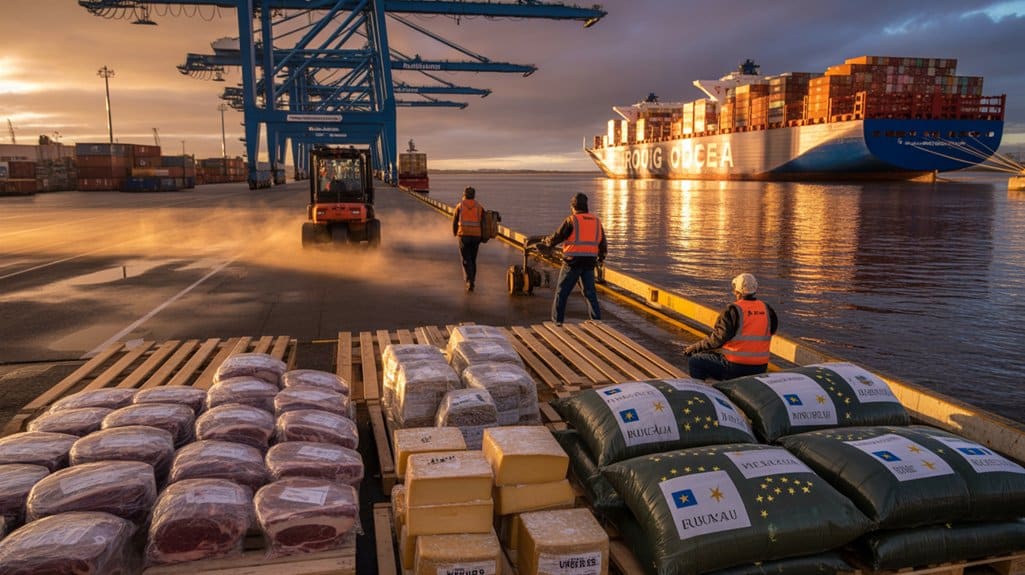
Uruguay’s farmers, ranchers, and factory owners are about to get a serious leg up. The EU-Mercosur trade deal strips away duties on 95% of goods coming from Mercosur countries, including 83% of agricultural imports, meaning Uruguayan beef, dairy, and manufactured products land on European shelves at far more competitive prices. That’s a market of over 700 million people suddenly much more within reach.
The numbers back up the excitement. Economists estimate the deal could push Uruguay’s GDP up by 1.5 percentage points and grow exports by roughly 4%. For a small country that leans heavily on what it grows and raises, those figures translate into real jobs and better wages, not just abstract statistics on a government report. This milestone comes after 25 years of negotiations between the two blocs finally concluded in December 2024.
Tariff Elimination Trade Benefits
When two massive trading blocs shake hands on a deal, the ripple effects can reach even the smallest farms and factories. The Mercosur-EU agreement reshapes how Uruguay does business with Europe in some pretty concrete ways.
Tariffs work like entry fees at a gate , the lower the fee, the more goods pass through without friction. Under this deal, Mercosur cuts 93% of tariffs on European imports, and the EU drops 91% on goods coming from Mercosur countries. For Uruguayan producers, those numbers translate into real savings at both ends of the transaction.
European machinery previously carried duties of between 12% and 20%, costs that made imported equipment noticeably more expensive for local manufacturers and farmers. Those costs shrink significantly under the new terms. On the other side of the ledger, Uruguayan beef, poultry, and agricultural goods gain stronger footing on European shelves, where market access has historically been tight.
The agreement opens a free trade area spanning nearly 300 million people across South America and Europe, creating a vast new landscape of business opportunity for companies of all sizes.
Key Export Sectors Impacted
Several of Uruguay’s biggest export sectors are set to benefit directly from the Mercosur-EU trade agreement. Soybeans lead the pack at $1.92 billion in 2025 value, followed closely by beef at $1.83 billion, with forestry at $557 million and dairy at $521 million rounding out the top four. Together, total goods exports have hit $13.49 billion , the highest figure in a decade.
| Sector | 2025 Value | EU Growth |
|---|---|---|
| Soybeans | $1.92 billion | Strong demand |
| Beef | $1.83 billion | +65.3% |
| Forestry | $557 million | Expanding |
| Dairy | $521 million | Rising |
| Total Goods | $13.49 billion | Decade high |
Beef tells a particularly striking story, with EU-bound exports growing 65.3% , a figure that reflects genuine market demand rather than a short-term spike. Reduced tariffs are a big part of that, since lower entry costs make Uruguayan products more price-competitive on European shelves. That matters for small and mid-sized farms too, not just the large commercial operations that typically dominate export trade.
Uruguay’s agricultural base has also been shifting toward practices that keep soil productive over the long term, which supports consistent output without exhausting the land. Combined with updated processing and logistics technology, producers across these four sectors are better placed than before to meet European buyer standards and volume requirements. Uruguay’s trade reach extends well beyond Europe, as the country currently exports to 158 export partners across a range of product categories.
GDP and Employment Growth
Trade deals can sound like dry business , but this one is putting real money into Uruguay’s economy and real jobs on the table. Projections show a GDP boost of up to 1.5 percentage points, alongside an estimated 0.5% increase in employment across sectors.
To put that in plain terms:
- GDP could grow by up to 1.5 percentage points
- 0.5% more jobs expected across sectors
- The EU already holds 46% of Uruguay’s foreign investment stock
- Tariffs drop on 91-92% of exports over 15 years
- Lower trade barriers make Uruguay a more attractive destination for business investment
That existing investment relationship with the EU matters here. It means the groundwork is already laid , this deal builds on a financial connection that’s been growing for years, rather than starting from scratch. When tariffs fall on the bulk of Uruguayan exports, businesses on both sides have more reason to move, and that typically filters down into hiring. Analysts also anticipate a 1% improvement in real wages as expanded trade activity drives stronger demand for labor across key export sectors.
How Uruguay Is Breaking Into the Trans-Pacific Partnership
Uruguay has been quietly working its way into one of the world’s biggest trade clubs. In November 2025, the country received a formal invitation to join the Comprehensive and Progressive Agreement for Trans-Pacific Partnership , a bloc whose members collectively account for around 15% of global GDP.
Getting there took years of groundwork. Back in late 2022, President Lacalle Pou laid out Uruguay’s intentions at a seminar in Tokyo, setting off a period of preparation that included joining the Patent Cooperation Treaty in 2024, which brought the country’s intellectual property framework closer to the standards CPTPP members expect.
The path wasn’t entirely smooth. Neighbors Argentina and Brazil pushed back, preferring that trade negotiations happen through Mercosur , the regional bloc Uruguay belongs to , rather than individual countries cutting their own deals. Uruguay held its ground, arguing that pursuing its own agreements was a matter of national economic interest.
That decision is now paying off. Uruguay becomes the first new economy to receive a CPTPP membership invitation since the bloc was established, giving its exporters , particularly beef producers , direct, preferential access to markets stretching across the Pacific Rim, from Japan to Canada to Australia. For a small country of roughly 3.5 million people whose economy depends heavily on agricultural exports, that kind of access matters a great deal. Admission to the bloc requires unanimous agreement from all existing CPTPP signatories, meaning Uruguay’s invitation reflects a broad consensus among member nations.
Which Sectors Are Driving Uruguay’s Export Growth Across All Three Partnerships?
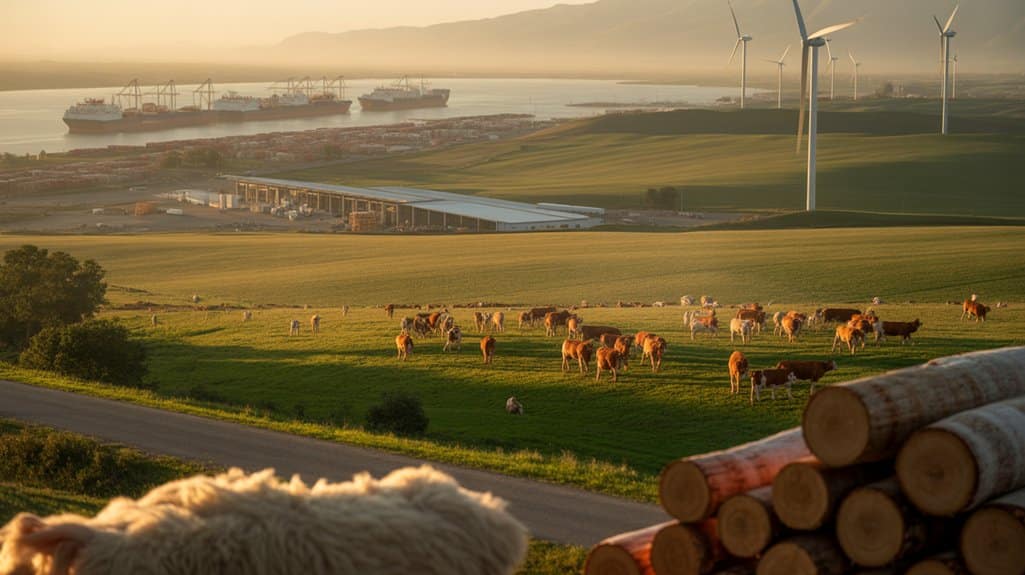
A few key industries are doing most of the work when it comes to Uruguay’s export performance across its major trade relationships.
Beef remains the standout, bringing in USD 2.637 billion in 2023-24. Uruguay’s cattle sector has long been the backbone of its economy, and the numbers back that up. Cellulose and forestry products also posted strong gains through 2024, driven largely by UPM’s second pulp mill, which came online and significantly expanded production capacity. Soybeans round out the top earners, with agricultural commodities still accounting for a large share of what Uruguay sells abroad.
Away from the fields, pharmaceuticals and electronics manufacturing grew between 13 and 24 percent, showing that Uruguay is quietly building an industrial base that goes beyond farming. On the services side, exports reached a decade-high of USD 13.49 billion in 2025, reflecting the growth of sectors like software development, financial services, and tourism.
The broader picture is that Uruguay isn’t leaning entirely on any single product or market. Cattle ranches, pulp mills, tech firms, and service providers are all contributing, which makes the economy more stable when one sector hits a rough patch. These aren’t abstract figures , they represent real businesses and workers trading with partners across the Pacific, Europe, and beyond. The services sector dominates the domestic economy as well, accounting for 66.3% of GDP and employing 72.3% of the active population, underscoring how deeply embedded service-driven activity has become across the country.
Why Foreign Direct Investment Is Accelerating Into Uruguay Right Now?
Foreign investment into Uruguay has been picking up, and the numbers back that up. In September 2025, FDI rose by $476.8 million after a dip the previous quarter , the kind of rebound that tells you investors still see real value here.
The money is flowing into some specific areas. Financial and insurance activities take the biggest slice, pulling in 32.2% of all incoming investment. Manufacturing comes in second at 26.2%, with real estate and agriculture also claiming solid shares. These aren’t random choices , they reflect sectors where Uruguay has built genuine capacity over time.
Part of what keeps drawing investors is how the country is set up. Uruguay ranks 29th out of 184 countries on the Index of Economic Freedom, which essentially measures how predictable and open a country’s economy is. For anyone putting serious money somewhere, that kind of ranking means their investment is less likely to get caught up in sudden policy shifts or legal uncertainty.
Yes, FDI figures have moved around from year to year , that’s true almost anywhere. What stands out with Uruguay is that the overall interest hasn’t faded. Stability and openness are the two qualities investors keep coming back to, and Uruguay has maintained both consistently enough to hold its place as one of Latin America’s more reliable destinations for foreign capital. Looking at the broader picture, FDI reached 3,121.7 USD mn in 2024, reinforcing the country’s upward trajectory as a destination for sustained international investment.
How Uruguay’s 2025, 2030 Trade Agenda Positions It Against Regional Competitors?
Building a solid trade policy is not something that happens overnight, and Uruguay knows that better than most. Its 2025, 2030 agenda is a deliberate, step-by-step effort to carve out a stronger position in South America , not by outspending its neighbors, but by playing smarter.
One of the clearest examples of this is Uruguay’s push for lower tariffs within MERCOSUR. By advocating for reduced trade barriers, Uruguay gives its businesses more room to compete rather than hiding them behind protectionist walls. That kind of openness tends to attract serious trading partners.
Money is also being put to work in concrete ways. Through FOCEM , the regional fund that MERCOSUR member states use to reduce economic gaps , Uruguay has pulled in over $49 million for infrastructure projects. Better roads, logistics, and connectivity directly lower the cost of doing business, which matters when you’re competing with larger economies like Brazil and Argentina.
Uruguay’s energy situation is another quiet advantage. The country generates the vast majority of its electricity from renewable sources, which keeps energy costs relatively stable and makes it a more predictable place to invest. Pair that with its long track record of institutional stability , low corruption, consistent legal frameworks , and you have a country that businesses can actually plan around.
On the public services side, Uruguay has been rolling out digital health tools, including telemedicine and electronic medical records, which modernize the system without requiring massive new spending. These aren’t flashy moves, but they build the kind of foundation that supports a productive workforce.
Tying it all together, Uruguay has embedded the UN’s 2030 Sustainable Development Goals directly into its national budget process. That means development priorities aren’t just political talking points , they’re funded commitments. For a small country competing in a tough region, that kind of disciplined planning is what separates ambition from results. Reinforcing that global outlook, Uruguay XXI and SPIRIT Slovenia signed a memorandum of understanding at Expo Osaka 2025 to strengthen trade and investment ties between the two nations.
References
- https://behorizon.org/china-uruguay-relations/
- https://www.taylortailored.co.uk/geopolitics/beijings-new-south-america-foothold-why-uruguay-is-the-next-leverage-point
- https://www.plataformamedia.com/en/2026/02/03/china-and-uruguay-agree-to-deepen-strategic-partnership/
- https://www.uruguayxxi.gub.uy/en/news/article/mercosur-y-union-europea-firmaron-acuerdo-de-libre-comercio-que-potenciara-la-proyeccion-internacional-de-uruguay/
- https://moderndiplomacy.eu/2026/02/11/uruguays-historic-pivot-amidst-great-power-competition/
- https://www.ecija.com/en/news-and-insights/uruguay-fue-aceptado-en-el-tratado-transpacifico-el-acuerdo-comercial-que-reune-el-15-del-pbi-mundial/
- https://gedeth.com/blog/2026/02/25/uruguay-investment-opportunities-2026/
- https://www.youtube.com/watch?v=w9tclTN65wo
- https://www.nicolasdemodena.com/blog/uruguay-in-2026-the-best-country-in-latin-america-to-invest-in-real-estate/
- https://www.govinfo.gov/content/pkg/CPRT-111SPRT50518/html/CPRT-111SPRT50518.htm