
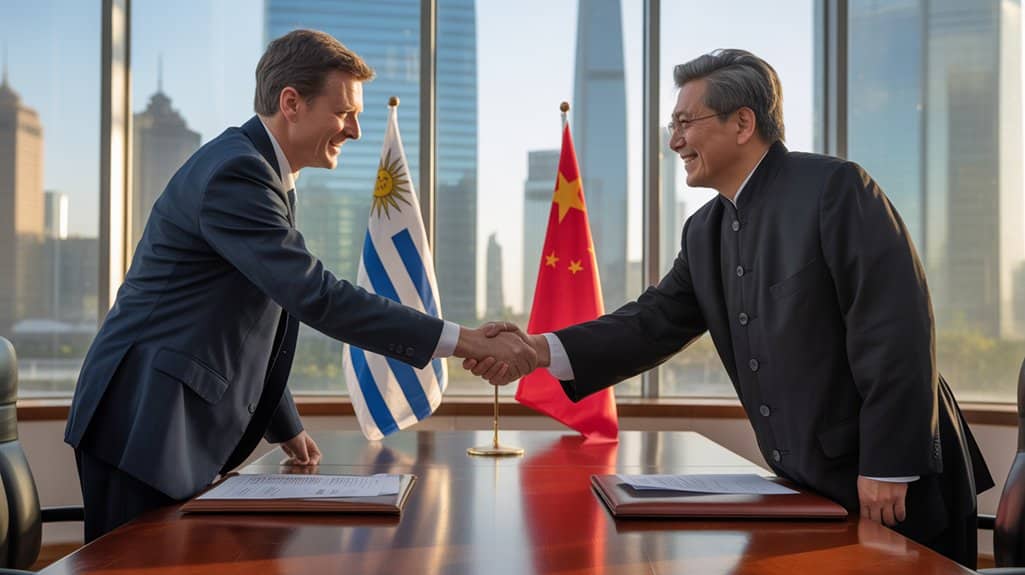
Uruguay’s making a strategic play for Chinese investment as President Yamandú Orsi leads a massive delegation to Beijing. The 150-person group represents the country’s largest economic mission to China, signaling just how seriously Uruguay takes this relationship.
The timing isn’t coincidental. Uruguay needs to diversify its economic partnerships beyond traditional markets, and China offers exactly what the small South American nation requires: capital, technology, and access to massive consumer markets.
The two countries have already formalized their commitment through more than 30 bilateral agreements spanning agriculture, renewable energy, and infrastructure development. These agreements aren’t just diplomatic paperwork. Uruguay’s beef and agricultural products have found eager buyers in China’s growing middle class, while Chinese companies see opportunities in Uruguay’s renewable energy sector.
The country generates nearly all its electricity from clean sources, making it an attractive partner for Chinese firms focused on green technology investments. Uruguay’s approach differs from other Latin American countries that have embraced Chinese investment.
The nation maintains balanced relationships with both the United States and China, avoiding the either-or mentality that has complicated diplomacy elsewhere in the region. This pragmatic stance allows Uruguay to benefit from Chinese capital while preserving its traditional Western alliances.
The delegation’s size reflects the breadth of sectors seeking Chinese partnerships. Representatives from agriculture, manufacturing, technology, and energy companies joined government officials, creating opportunities for direct business-to-business connections that often prove more valuable than high-level diplomatic meetings alone.
China’s interest in Uruguay extends beyond immediate trade benefits. The country serves as a gateway to the broader Mercosur trade bloc, which includes Brazil, Argentina, and Paraguay. Investments in Uruguay can facilitate Chinese access to this much larger regional market of over 290 million people.
Key Takeaways
President Orsi brought Uruguay’s biggest diplomatic team ever to China in February 2026, walking away with more than 30 signed deals covering everything from trade to major investments. This wasn’t just another diplomatic handshake tour – the two countries formally upgraded their relationship to what diplomats call a “comprehensive strategic partnership,” which basically means they’re now working together across the board: building infrastructure, developing clean energy projects, boosting agricultural trade, and modernizing digital banking systems.
The Chinese money flowing into Uruguay targets some pretty significant projects. They’re expanding the Port of Montevideo to handle more cargo, setting up factories to build electric buses right in Uruguay, and funding research into green hydrogen – a clean fuel that could become a major export for the country. These aren’t small-scale investments; they’re the kind of projects that reshape how a country’s economy works.
What makes Uruguay attractive to Chinese investors isn’t just its location. The country has maintained stable democratic institutions for decades and earned investment-grade credit ratings from major agencies, making it a safe bet for long-term projects. For Chinese companies looking to establish themselves in South Atlantic markets, Uruguay offers a reliable foothold without the political risks they might face elsewhere in the region.
This China strategy fits into Uruguay’s bigger economic picture. The country has historically depended too heavily on a few trading partners, which leaves it vulnerable when those relationships hit bumps. By bringing in Chinese investment and creating new jobs through these partnerships, Uruguay’s government aims to spread its economic risks while giving its workforce new opportunities in emerging industries.
Orsi’s Beijing Visit: What Uruguay and China Agreed To
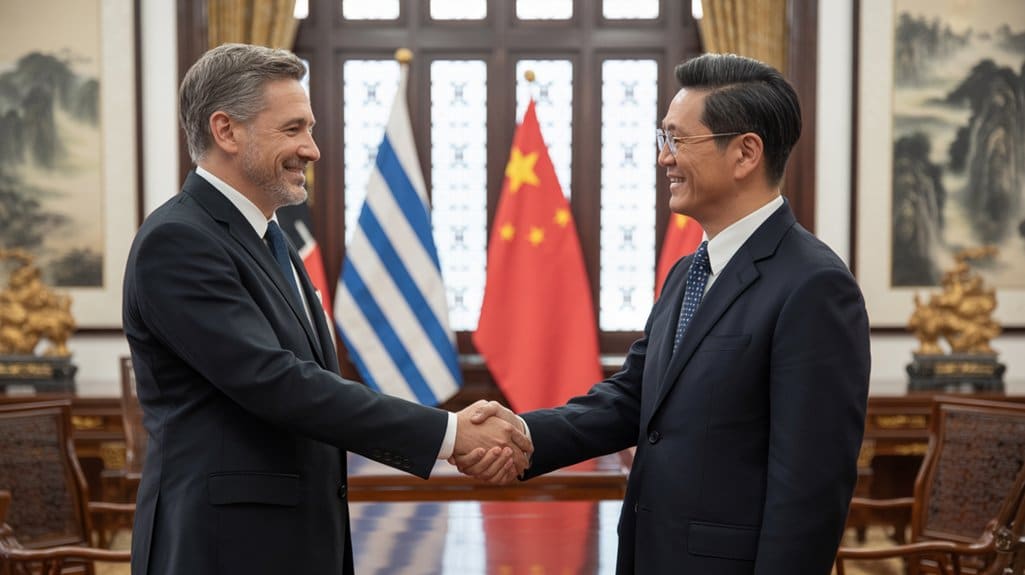
Uruguay’s President Yamandú Orsi brought his country’s largest diplomatic delegation ever to China in early February 2026, reshaping how the two nations work together. The week-long visit culminated when Orsi met President Xi Jinping at the Great Hall of the People on February 3, marking 38 years since the countries first established formal relations.
Both leaders agreed to upgrade their partnership to what diplomats call a “comprehensive strategic partnership” – essentially meaning they’ll coordinate more closely across multiple areas rather than just trade. The delegations signed more than 30 agreements spanning agriculture, infrastructure projects, clean energy technology, and digital banking systems. New investment deals opened doors for electric vehicle manufacturing and green hydrogen development, both emerging industries where Uruguay sees growth potential.
Orsi confirmed Uruguay’s support for the one-China policy, which recognizes Beijing’s position on Taiwan. China reciprocated by backing Uruguay’s bid to lead the Group of 77, an organization representing developing nations at the United Nations. This exchange reflects how smaller countries like Uruguay often navigate relationships with major powers by offering diplomatic support in exchange for economic opportunities.
The agreements position Uruguay to reduce its economic dependence on traditional partners while tapping into China’s massive market. For a country of 3.5 million people, securing access to investment capital and new export markets represents a significant shift in foreign policy strategy. The partnership will also strengthen people-to-people exchanges through educational and cultural programs designed to deepen mutual understanding between the two nations.
Uruguay-China Trade Deal: Meat Exports and Market Diversification
While diplomatic handshakes grabbed headlines during President Orsi’s Beijing visit, the real action happens in cold storage warehouses loading Uruguayan beef onto ships bound for China.
Uruguay shipped $860 million worth of beef to China in 2025, up 14% from the year before. Chinese consumers can’t get enough of Uruguay’s grass-fed cattle, which graze on some of the world’s best pastureland. With 60% of the country covered in grassland, each animal gets nearly two acres to roam, space that shows up as exceptional quality on dinner plates.
The trade math tells an even more compelling story. Uruguay can export 324,000 tons of beef to China without penalties, yet the country hasn’t come close to filling that quota. Brazil and Argentina aren’t so lucky, they pay brutal 55% tariffs once they hit their limits. This gives Uruguay massive room to grow its market share.
Smart ranchers and agricultural exporters are already looking beyond frozen beef. They’re pushing into high-value products like premium cuts and processed foods, tapping into China’s growing appetite for quality over quantity. The numbers back up this strategy, Uruguay’s total agricultural exports to China are worth billions annually, with plenty of untapped potential still on the table. Orsi brought along senior agriculture officials and Gaston Scayola, president of Uruguay’s National Meat Institute, to cement these expanding trade relationships.
China-Uruguay Collaboration on AI, Green Tech, and Clean Energy
Beyond the beef exports and handshake diplomacy, something more futuristic is brewing between Uruguay and China. The two nations are working together on artificial intelligence projects, with Uruguay supporting China’s technology governance proposals at the United Nations. They’re building digital systems that make cross-border payments simpler and setting up 5G networks using open technical standards.
Environmental technology has become a major focus of their partnership. Chinese companies are planning to set up electric bus manufacturing plants in Uruguay. They’re also looking into green hydrogen research, which makes perfect sense given Uruguay’s renewable energy setup, the country already generates most of its electricity from wind and solar power.
The partnership extends to clean energy projects across multiple sectors. The countries signed over ten cooperation agreements covering investment promotion and joint research facilities. Uruguay’s location in South America gives it natural advantages for green technology manufacturing, opening up real possibilities for the country’s economy to evolve beyond its traditional agricultural exports. Both nations agreed to strengthen cooperation in maritime transport and logistics, leveraging Uruguay’s geographical position as a regional logistics hub.
Why Institutional Stability Drives Uruguay’s Investment Pitch
Technology partnerships and green energy projects grab the spotlight, but smart investors dig deeper when choosing where to park their capital. They want to know one thing: will the rules stay the same tomorrow?
Uruguay delivers that certainty like few other countries in Latin America. Governments here don’t wake up and decide to rewrite the playbook. This reliability comes from something pretty unusual, politicians from different parties actually agree on the big economic stuff. When power changes hands, it feels more like passing a baton than flipping the table.
The numbers back this up. Uruguay sits at 15th place worldwide on the democracy index, making it one of just three full democracies in the Americas. The constitution treats foreign money the same as local money. Companies can move their cash and profits in and out without jumping through hoops.
Wall Street’s watchdogs have taken notice. Standard & Poor’s, Moody’s, and Fitch all stamp Uruguay with investment-grade ratings. Their reasoning? The institutions work, and the government knows what it’s doing.
Chinese investors scouting Latin America see this foundation as gold. Flashy opportunities come and go, but the boring stuff, like knowing your contract will mean the same thing in five years, that’s what protects serious money over time. Uruguay ranked as the most transparent country in the Americas in 2024, which translates directly into lower costs for foreign companies doing business here.
Geopolitical Shift: Uruguay’s China Engagement Amid U.S.-Latin America Tensions
Uruguay’s growing partnership with China comes as Washington struggles to maintain its grip on Latin America. President Orsi’s February 2026 trip to Beijing enjoys backing from across Uruguay’s political spectrum, a clear sign that even countries with strong democratic traditions are willing to bet on closer Chinese relations.
This marks part of a wider trend across the region. Xi Jinping talks about creating an “equal and orderly multipolar world,” which basically means giving smaller countries more options beyond the traditional U.S.-led system. For Uruguay, a nation of 3.4 million people sandwiched between regional giants Brazil and Argentina, having multiple powerful partners makes strategic sense.
The unanimous domestic support for Orsi’s China visit tells its own story. When politicians from opposing parties agree on foreign policy, it usually means the benefits are too obvious to ignore. China has become Uruguay’s second-largest trading partner, buying everything from soybeans to beef, while offering infrastructure investments that come with fewer strings attached than traditional Western aid packages. A 150-member Uruguayan delegation accompanied President Orsi on the trip, underscoring just how significant these economic ties have become for the country’s export sectors.
Contested U.S. Regional Influence
As tensions build between the United States and Latin America, Uruguay is breaking away from old patterns. President Orsi’s planned February 2026 meeting with President Xi marks a clear departure from the country’s traditional alignment with Washington’s regional priorities. China sees Uruguay as a valuable entry point into South Atlantic markets, while Uruguay wants to reduce its economic dependence on any single partner.
Several concrete changes show this strategic pivot taking shape. The Port of Montevideo expansion under China’s Belt and Road Initiative positions the country as a key logistics center for Chinese operations in the region. Uruguay has also signed a comprehensive strategic partnership that includes recognizing Beijing’s one-China policy, a stance that puts it at odds with U.S. diplomatic positions.
The small South American nation has stepped up its participation in multilateral forums that challenge Western-led initiatives. Uruguay now actively supports the China-Latin America and Caribbean community, building relationships that bypass traditional hemispheric organizations dominated by Washington. Uruguay’s assumption of the rotating chair of the Group of 77 and China demonstrates its growing role in Global South leadership platforms.
Most telling is Uruguay’s push for a direct trade deal with China, despite rules requiring regional consensus through Mercosur. This move shows how far the country will go to chart its own economic course, even when it means breaking with neighbors who prefer collective bargaining. The trade negotiations signal Uruguay’s willingness to prioritize bilateral opportunities over regional unity when the two conflict.
Democratic Alignment With Beijing
Democratic nations often fear that deepening ties with China means sacrificing their core values, but Uruguay’s experience tells a different story. This small South American country of 3.5 million people has built a robust partnership with Beijing while keeping its democratic foundations intact.
What makes Uruguay’s approach stand out is the cross-party consensus behind it. Both the center-left Broad Front and the center-right National Party support closer ties with China, a level of political agreement that’s unusual in most democracies. This unity emerged after China became Uruguay’s largest trading partner, purchasing over 20% of the country’s exports, particularly soybeans and beef.
Uruguay joined China’s Belt and Road Initiative in 2018 and has welcomed Chinese companies like UPM to invest in major infrastructure projects, including a $3 billion pulp mill. The country has also opened its doors to Chinese technology firms while maintaining its commitment to international law and UN principles. President Luis Lacalle Pou’s administration continues the same China-friendly policies as his predecessor from the opposing party.
The country’s democratic institutions remain strong throughout this partnership. Uruguay consistently ranks among the top democracies in Latin America according to Freedom House, and its press freedom scores haven’t declined despite closer China ties. The parliament actively debates Chinese investments, and civil society groups can freely voice concerns about environmental or labor standards.
Uruguay’s strategy shows that smaller democracies can engage major powers like China without compromising their political systems. The key lies in maintaining institutional checks and balances while pursuing mutually beneficial economic relationships. The partnership also explores collaboration in emerging fields like green development, the digital economy, and clean energy.
Multipolar World Order Emerges
President Yamandú Orsi’s arrival in Beijing in early 2026 came at a pivotal moment for South American diplomacy. His visit represented the first time a regional head of state had traveled to China since U.S.-Venezuela relations deteriorated sharply. The timing wasn’t coincidental, Uruguay has long walked a diplomatic tightrope, balancing relationships with major powers while protecting its sovereignty.
The two leaders outlined four key areas for cooperation during their meetings. First, they committed to building what they called an “equal, orderly multipolar world”, essentially a global system where smaller countries like Uruguay can make independent decisions without pressure from superpowers. Second, both nations reaffirmed their commitment to United Nations principles as international tensions continue rising. Third, they agreed to strengthen coordination through international organizations to keep diplomatic channels open. Finally, they pledged to work together on issues affecting developing nations, particularly those in the Global South.
Uruguay’s approach reflects a broader trend among democratic countries seeking to chart their own foreign policy course. The country has maintained this independent stance despite growing friction between Washington and several Latin American governments. Montevideo’s decision to deepen ties with Beijing through what officials called a “comprehensive strategic partnership” illustrates how regional powers increasingly base their international relationships on economic needs rather than Cold War-era loyalties. The two nations signed over 10 cooperation documents covering various sectors of bilateral collaboration.
This shift reveals how smaller nations navigate today’s complex geopolitical landscape. Uruguay’s leaders recognize that their country’s agricultural exports, technology partnerships, and investment opportunities depend on maintaining good relations with multiple major powers simultaneously.
How China’s Five-Year Plan Opens Export Opportunities for Uruguay
China’s newly launched 15th Five-Year Plan creates a roadmap that could reshape trade between the world’s second-largest economy and smaller nations like Uruguay. The blueprint focuses on upgrading supply chains by integrating technology into everyday products, which creates new opportunities for Uruguayan businesses.
Export numbers reveal the growing relationship between these countries. Uruguay shipped $3.493 billion worth of goods to China in 2025, marking a nearly 12 percent increase from the previous year. Beef sales alone jumped 16 percent, and China now purchases 26 percent of everything Uruguay sells abroad.
The plan prioritizes early spending to accelerate projects. Trade-in subsidies have already reached businesses. This approach benefits Uruguay by expanding markets for agricultural products while bringing in Chinese technology like solar panels and electric vehicles that are changing local markets. Chinese new energy vehicles now represent one-third of all passenger vehicles sold in Uruguay.
President Orsi’s Vision: Elevating Uruguay-China Strategic Partnership
Building economic frameworks takes more than statistics and trade figures. President Orsi brought a clear vision to Beijing: strengthen ties through strategic alignment that respects each nation’s path. His approach emphasizes investment opportunities that create mutual benefits.
The February 2026 visit saw Orsi outline four key priorities. First, open markets that welcome innovation without heavy restrictions. Second, technology partnerships allowing knowledge to flow freely between nations. Third, environmental projects that improve lives while protecting nature. Fourth, fair agreements where both sides gain meaningful advantages.
This comprehensive strategic partnership enhances Uruguay’s global position. Orsi views China as a partner rather than a patron. The relationship encourages independent decision-making while building prosperity. Uruguay’s citizens can expect more job opportunities and better economic prospects through these arrangements.
The partnership maintains Uruguay’s democratic values and market-driven economy. Trade agreements focus on sectors where Uruguay has natural advantages, particularly agriculture and renewable energy. China’s investment in Uruguay’s infrastructure projects provides capital for development while creating local employment. The Port of Montevideo expansion under the Belt and Road framework will position Uruguay as a logistics hub serving as a South Atlantic entry point.
Both countries recognize the importance of balanced cooperation. Uruguay retains its sovereignty in domestic policy decisions while accessing larger markets for its products. Chinese companies gain access to South American markets through Uruguay’s strategic location and established trade relationships with neighboring countries.
References
- https://socialistchina.org/2026/02/10/china-and-uruguay-pledge-closer-bilateral-and-multilateral-cooperation/
- https://www.uruguayxxi.gub.uy/en/news/article/uruguay-advances-its-international-integration-with-an-official-mission-to-china/
- https://moderndiplomacy.eu/2026/02/11/uruguays-historic-pivot-amidst-great-power-competition/
- https://un.china-mission.gov.cn/eng/zgyw/202602/t20260203_11850201.htm
- https://www.dailymotion.com/video/x9z2i6q
- https://www.globaltimes.cn/page/202602/1354998.shtml
- https://www.youtube.com/watch?v=G5mYhTulLXE
- https://news.cgtn.com/news/2026-02-03/China-Uruguay-release-joint-statement-announcing-elevation-of-ties-1KsYkUVqK6k/index.html
- https://www.bilaterals.org/?orsi-xi-jinping-sign-cooperation
- https://behorizon.org/china-uruguay-relations/