
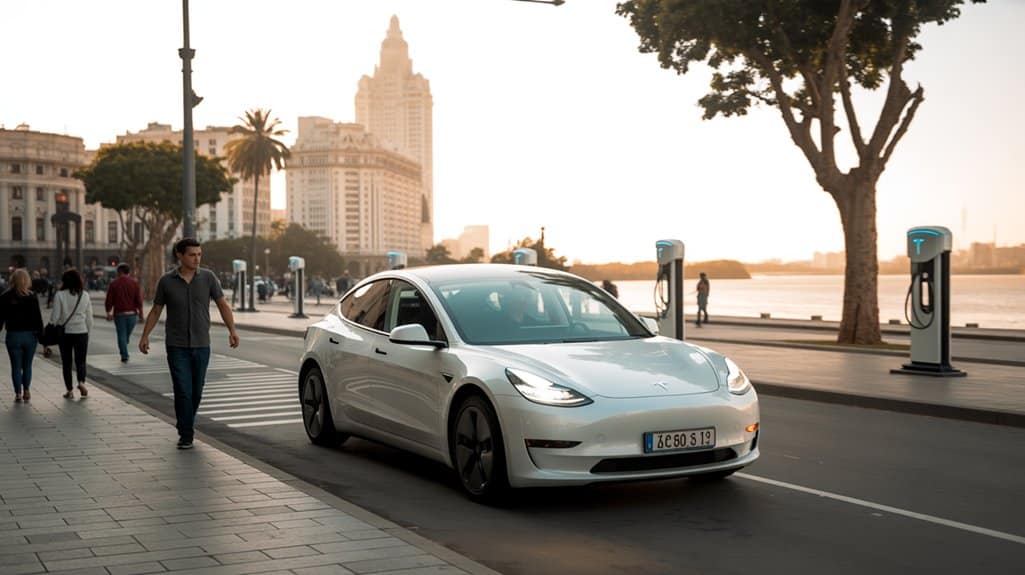
Uruguay’s electric vehicle revolution catches many by surprise. This small South American country has achieved something remarkable – electric cars now represent 30% of all new vehicle sales, a figure that puts most of its neighbors to shame.
The numbers tell a clear story. Argentina manages just 2% electric vehicle market share, while Brazil sits at 3.4%. Chile, often considered the region’s sustainability leader, reaches only 8%. Uruguay’s achievement becomes even more impressive when you consider the country’s population of 3.5 million people – roughly the size of Los Angeles.
Three key factors drive this transformation. The government eliminated import taxes on electric vehicles in 2017, making them price-competitive with traditional cars. Tax breaks extend to buyers too – electric vehicle owners pay no annual circulation tax for their first five years.
Meanwhile, the country built a reliable charging network with over 300 public stations, ensuring drivers can travel anywhere without range anxiety.
Uruguay’s electricity grid provides another advantage. Renewable sources generate 98% of the country’s power, meaning electric vehicles here truly run clean. Wind farms dot the countryside, while hydroelectric plants harness river power. Solar installations round out the mix.
When Uruguayans plug in their cars, they’re tapping into one of the world’s cleanest electrical systems.
The transformation happened faster than anyone predicted. Electric vehicle sales jumped from virtually zero in 2020 to nearly one-third of the market by 2024. Chinese automakers like BYD and Great Wall Motor recognized the opportunity early, establishing dealerships and service centers across major cities.
European brands followed, creating healthy competition that keeps prices reasonable.
Real-world results prove the strategy works. Montevideo’s air quality improved measurably over the past three years. Fuel imports dropped by 12%, saving the country millions in foreign currency.
Even skeptical taxi drivers embraced electric vehicles after discovering lower operating costs – electricity costs about 60% less than gasoline per kilometer traveled.
Uruguay’s success offers lessons for larger countries struggling with transportation emissions. Smart policy design matters more than market size. Consistent government support beats sporadic incentives.
Building charging infrastructure before demand peaks prevents bottlenecks later. Most importantly, aligning electric vehicle adoption with clean electricity generation multiplies environmental benefits.
Key Takeaways
Uruguay’s electric vehicle revolution has taken Latin America by surprise, capturing nearly 28% of the country’s auto market in Q3 2025. Sales figures tell the story best, over 5,000 EVs sold in just six months represents a staggering 124% jump from the previous year.
The government made EVs affordable by scrapping the 23% import duty and eliminating internal taxes entirely. This policy shift dropped EV prices by 20-30%, while the Subite Programme sweetens the deal with direct cash rebates for buyers. What seemed like an expensive luxury became accessible to middle-class families almost overnight.
Uruguay’s energy grid gives the country a massive advantage over its neighbors. With 97% of electricity coming from wind, solar, and hydroelectric sources, every EV charged runs on clean power. Drivers know their cars produce virtually zero emissions while the country maintains its economic momentum without compromising environmental goals.
Charging infrastructure grew rapidly to support the EV boom. State utility company UTE installed over 300 public charging stations by May 2025, with ambitious plans for 70 fast-chargers and charging points every 50 kilometers along major highways. Range anxiety, which plagues EV adoption elsewhere, barely registers as a concern for Uruguayan drivers.
Chinese manufacturers reshaped the competitive landscape completely. BYD alone commands 52% of Uruguay’s EV market, leaving traditional automakers scrambling to catch up. Chinese brands understood the local market dynamics better than established players, offering the right combination of price, features, and reliability that Uruguayan consumers wanted.
Uruguay’s Path to 27.97% EV Market Penetration
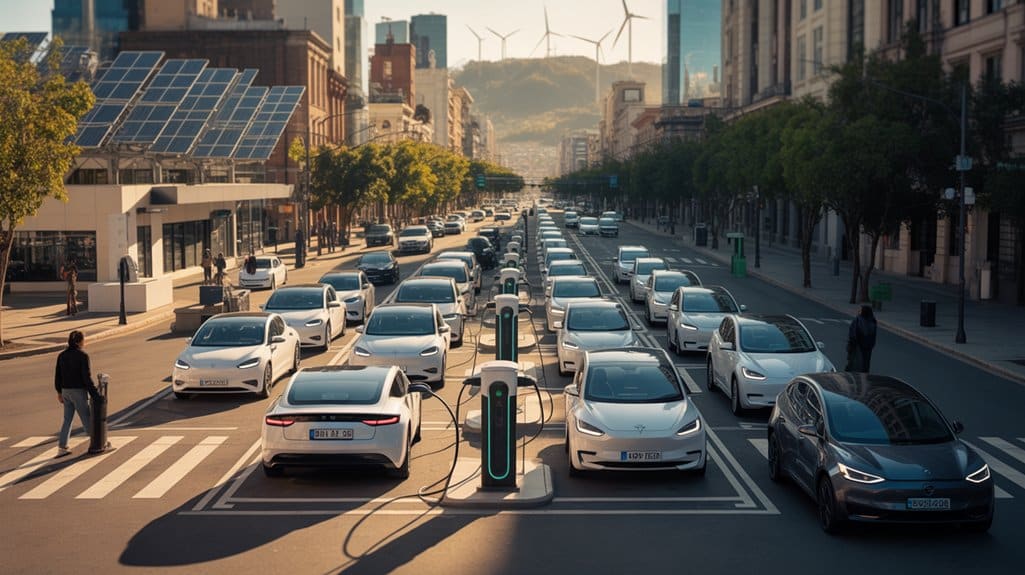
Uruguay’s Path to 27.97% EV Market Penetration
Uruguay has quietly positioned itself as Latin America’s electric vehicle frontrunner, with EVs accounting for 27.97% of new vehicle sales in Q3 2025. Put simply, every fourth light vehicle sold runs purely on electricity, a significant milestone for regional clean transport.
Sales data tells the story of rapid growth. The country registered 3,100 new electric vehicles during the third quarter, representing a threefold increase from 2024. By October, electric cars and SUVs made up 25% of all new vehicle purchases, doubling the previous year’s figure. The first half of 2025 saw over 5,000 EV sales, marking a 124% jump compared to the same period in 2024.
This shift goes beyond environmental awareness alone. Uruguayans are making practical choices about how they get around. The country generates over 97% of its electricity from wind, solar, and hydroelectric sources, which means charging an EV produces virtually no carbon emissions. Chinese manufacturers have made electric driving financially viable by offering affordable models that compete directly with traditional gas-powered cars on price. Even high-end and commercial vehicle segments have embraced electrification, with luxury brands like BMW and Mercedes posting record EV registrations.
The Tax Breaks and Subsidies Behind Uruguay’s EV Boom
One in every four cars rolling through Montevideo’s streets runs on electricity, thanks to a package of government incentives that stack up to make EVs genuinely competitive with gas cars. The most significant break eliminates Uruguay’s standard 23% import duty on electric vehicles – a five-year policy that immediately drops prices to match conventional cars at the dealership.
The savings don’t stop at the border. Electric vehicle buyers completely avoid the Specific Internal Tax that adds thousands to gas car purchases. The Subite Programme provides direct cash rebates, putting money back in buyers’ hands rather than asking them to wait for tax season credits. Professional drivers get the biggest boost: $5,000 per electric vehicle for public transport operators, while taxi and ride-share drivers can tap into a dedicated $500,000 fund.
Even powering these vehicles costs less. UTE, Uruguay’s state electricity company, cuts charging rates in half during nighttime hours when demand drops. This off-peak pricing makes plugging in at home cheaper than stopping at gas stations, especially as global fuel prices climb. The country is building Latin America’s first highway corridor fully serviced by EV chargers, with expansion of charging availability already underway along the route.
Building Out Uruguay’s Nationwide Charging Network
Uruguay’s charging network hit 300 public stations by May 2025, yet electric car sales are outpacing the installation of new charging points. The state utility UTE has mapped out a solution: positioning charging stations every 50 kilometers along the country’s main highways.
This strategy addresses a critical gap. Drivers currently face long stretches without charging options on intercity routes, which limits electric vehicle adoption outside Montevideo and other urban centers. UTE’s highway corridor approach ensures no driver gets stranded with a depleted battery during longer trips.
Private companies are building their own networks alongside UTE’s efforts. These firms focus on ultra-fast charging technology that can power up a vehicle in 20-30 minutes rather than several hours. The speed difference matters for commercial drivers and families on road trips who can’t wait around for slow charging. eOne plans to install 18 additional chargers in high-demand locations during the first half of 2024 to strengthen the country’s charging infrastructure.
Investors see potential in this charging infrastructure boom. The government offers tax incentives for companies that install charging equipment, while growing electric vehicle sales guarantee steady customer demand. Local energy experts predict the charging market will triple in size over the next three years as more Uruguayans switch from gasoline-powered cars.
Current Infrastructure Coverage Gaps
While over 300 public charging stations now dot the country from coast to coast, the network reveals a pattern many motorists know all too well: the chargers aren’t always where drivers need them most.
Charging station distribution shows clear imbalances across Uruguay:
- Urban centers and major highways host most chargers, leaving rural areas underserved
- High-density neighborhoods face surprising gaps despite rapid electric vehicle growth
- Most locations offer just one or two connectors, creating bottlenecks during peak hours
Urban charger accessibility varies dramatically even in populated areas. The network depends mostly on 22 kW AC chargers, fine for overnight charging but slow for quick stops. Highway travelers encounter different problems, with very few DC fast chargers above 50 kW available. Long-distance trips require careful planning, as inter-departmental routes still lack reliable charging options. All stations use Type 2 connectors compliant with UNIT standards, ensuring compatibility across the fleet.
UTE’s Strategic Expansion Plan
UTE, Uruguay’s state electricity company, is rolling out a comprehensive electric vehicle charging network across the country. Their plan focuses on building infrastructure quickly while making sure the system can grow as more people buy electric cars. The company had already installed over 300 charging stations in every department by May 2025, giving them control of 363 out of 460 total charging points nationwide as of July 2025.
The company is being smart about where they put new chargers, going after busy locations where people actually drive. They’re adding seventy new fast-charging units throughout 2025 to fill in the gaps where coverage is weakest. These aren’t your standard home chargers either , they’re installing ultra-fast stations that can charge most electric vehicles in less than half an hour.
Working with Chinese tech giant Huawei has sped things up considerably. The company provided Montevideo with its first 600-kilowatt charging station in November 2024, showing how partnerships between government utilities and private companies can solve infrastructure problems that neither could tackle alone. The station’s dynamic load distribution system allows it to efficiently manage power between multiple dispensers, maximizing the number of vehicles that can charge simultaneously. UTE’s whole approach comes down to making electric vehicle ownership practical for regular Uruguayans, so people can drive anywhere in the country without worrying about running out of power.
Private Sector Investment Opportunities
Building out a nationwide charging network requires more than government effort alone, and Uruguay’s leaders recognize this reality. They’ve created an open marketplace where businesses can compete and innovate. Private partnerships are already reshaping the charging landscape.
Several major investments are underway. Evergo and Ventus have committed $5 million to install 240 chargers over three years. eOne plans to build 100 fast chargers within 12 months, with multiple stations launching in 2024. Huawei contributed Uruguay’s first ultra-fast charger, which delivers up to 480 kilowatts of power.
The government supports these ventures through loans between $100,000 and $1 million. New charging stations appear regularly at shopping centers and along major highways. The country has strategically positioned chargers every 50 km to enhance accessibility for electric vehicle drivers. Electric vehicle adoption outpaces public infrastructure development, creating clear market opportunities for entrepreneurs willing to invest in charging solutions.
This gap between vehicle sales and available chargers represents a genuine business opportunity rather than just a logistical challenge. Private companies can establish profitable operations while helping Uruguay achieve its electric mobility goals.
Market Leaders Shaping Uruguay’s EV Landscape
Chinese automakers have completely reshaped Uruguay’s car market since late 2024. BYD dominates with 52% market share, though other brands are catching up fast. Affordable electric vehicles changed what buyers want almost overnight.
Dongfeng and JAC took second and third place throughout 2025, proving that competitive pricing gets results. Chevrolet managed to become runner-up with their Spark EUV model despite selling for just one month – clear evidence that Uruguayans want electric cars they can actually afford.
Established car companies can’t keep pace with these changes. Volvo stands alone with Chevrolet as the only traditional brands making the top ten. Chery’s sales jumped 106.6% compared to the previous year, while Deepal and Changan also posted strong growth numbers.
Open competition delivers real benefits for car buyers. When manufacturers fight for market share, people get more choices at better prices – exactly what’s happening in Uruguay’s electric vehicle market right now. The country’s market share milestones demonstrate remarkable acceleration, jumping from 5% in March 2024 to 20% by July 2025.
Uruguay’s EV Success as a Regional Blueprint
Uruguay’s electric vehicle success has caught the attention of governments across Latin America. The country’s experience provides a clear template for neighbors who want to shift toward cleaner transportation without disrupting their economies.
Three specific elements make Uruguay’s strategy worth copying. The government eliminated import duties on electric vehicles, which dropped prices by roughly 20-30% compared to traditional cars. Public and private investors built charging stations along major highways and in urban centers, giving drivers confidence they won’t get stranded. Local dealerships partnered with Chinese manufacturer BYD to bring affordable electric models that cost less than $25,000.
These policies work because they address real consumer concerns about price and practicality. Uruguay’s small population of 3.5 million people initially seemed like a disadvantage for attracting automaker investment. The opposite proved true – the compact market allowed for faster infrastructure rollout and quicker policy implementation than larger countries typically manage.
Regional governments studying Uruguay’s model now see that emissions reduction doesn’t require sacrificing economic growth. The country maintained its free-market principles while steering consumer behavior through smart incentives rather than heavy-handed mandates. This balance appeals to politicians who need to satisfy both environmental advocates and business communities. The broader region experienced a 55% year-over-year sales increase in Q3 2025, demonstrating growing momentum for electric vehicle adoption across Latin America.
Why Uruguay’s EV Charging Gap Offers Investor Upside
Uruguay’s electric vehicle market reveals a clear mismatch between ambition and infrastructure. The country has only 300 charging stations to serve a rapidly expanding fleet of electric cars and trucks, creating bottlenecks that savvy investors can turn into profitable ventures.
This shortage isn’t just an inconvenience, it’s holding back broader EV adoption across the country. Drivers worry about finding charging points during longer trips, and businesses with electric fleets struggle to keep vehicles operational. The gap between supply and demand has reached a tipping point where action becomes necessary.
| Investment Area | Opportunity Size |
|---|---|
| Ultra-fast charging points | 100+ locations needed |
| REIF project financing | US$50 million available |
| Loan ranges per project | US$100,000, US$1 million |
| Strategic locations | Malls, highways, logistics hubs |
Uruguay’s government recognizes these constraints and responds with concrete financial incentives. New energy vehicle projects qualify for reduced import tariffs and corporate tax breaks that can significantly improve project returns. The Renewable Energy Investment Fund (REIF) has earmarked US$50 million specifically for charging infrastructure, with individual project loans ranging from US$100,000 to US$1 million.
Shopping centers represent prime real estate for charging stations since customers typically spend 30-90 minutes inside, enough time for meaningful battery charging. Highway corridors connecting Montevideo to Punta del Este and the Brazilian border see heavy traffic but lack adequate charging coverage. Logistics hubs around the Port of Montevideo need stations to support the growing number of electric delivery trucks serving the capital. The port is already testing Uruguay’s first autonomous charging station for heavy vehicles, demonstrating the practical application of advanced charging technology in commercial settings.
Companies that move quickly can establish dominant positions in these high-traffic locations before competition intensifies. The combination of government backing, available financing, and clear market demand creates conditions where infrastructure investments can generate steady returns while supporting Uruguay’s transition away from fossil fuel dependence.
References
- https://www.riotimesonline.com/uruguay-leads-latin-america-in-electric-vehicle-adoption/
- https://www.realestate-in-uruguay.com/blog/uruguay-ev-market-leader-infrastructure-opportunity/
- https://en.mercopress.com/2025/12/01/uruguay-leads-latin-america-in-electric-car-sales
- https://cleantechnica.com/2026/02/04/latin-america-ev-sales-report-over-100000-units-sold-in-q4/
- https://www.statista.com/outlook/mmo/electric-vehicles/uruguay
- https://www.mobilityportal.eu/en/notes/electrico-precios-flotas-uruguay
- https://ember-energy.org/latest-updates/over-a-quarter-of-new-cars-sold-so-far-this-year-are-electric-as-emerging-markets-reshape-the-global-ev-race/
- https://cryptorank.io/news/feed/f2fd3-byd-surges-in-uruguay-with-evs
- https://www.focus2move.com/uruguayan-vehicles-market/
- https://news.cgtn.com/news/2026-02-01/How-China-Uruguay-green-partnership-is-reshaping-mobility-1Kp7CE4aWFW/p.html