
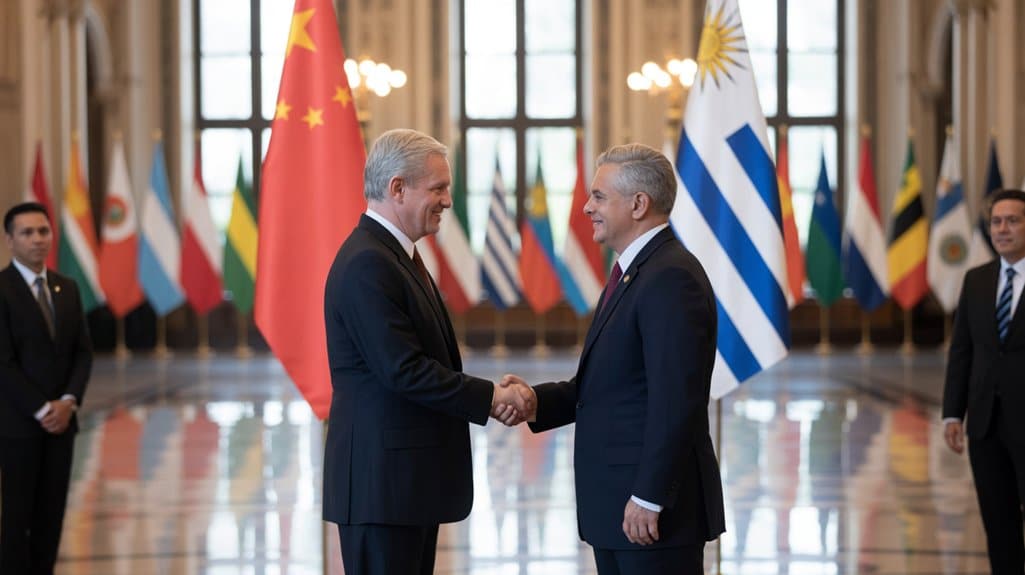
In February 2026, China’s President Xi Jinping and Uruguay’s newly elected President Yamandú Orsi met to discuss their shared vision of global power distribution. Their handshake represented more than diplomatic courtesy, it signaled Uruguay’s strategic positioning in what both leaders called a “multipolar world,” where influence spreads across multiple centers rather than concentrating in Washington or Beijing alone.
Uruguay has long navigated between larger powers with remarkable skill. This South American nation of 3.4 million people sits strategically between Brazil and Argentina, two regional giants that could easily overshadow it. Instead of picking sides, Uruguay has consistently chosen pragmatic partnerships that serve its national interests. The country maintains strong ties with the United States while simultaneously deepening economic relationships with China, which became Uruguay’s largest trading partner for agricultural exports in recent years.
The meeting between Xi and Orsi builds on this tradition of balanced diplomacy. China views Uruguay as a gateway to South America’s agricultural markets and a reliable partner that doesn’t demand ideological alignment. Uruguay sees China as an alternative to traditional Western markets, offering competitive prices for beef, soybeans, and wool without the political strings that sometimes accompany relationships with other major powers.
Orsi’s embrace of multipolarity reflects Uruguay’s historical approach to international relations. The country has often punched above its weight in global affairs, hosting peace negotiations, serving on UN Security Council rotations, and maintaining neutrality during regional conflicts. This latest partnership with China follows the same playbook: maximizing economic opportunities while preserving political independence.
The practical implications extend beyond trade statistics. Uruguay’s ports could become key nodes in China’s Belt and Road infrastructure projects, connecting Asian markets with South American producers more efficiently. Agricultural technology transfers might help Uruguayan farmers increase productivity, while Chinese investment could modernize the country’s logistics networks.
This alignment matters because it demonstrates how middle powers can leverage great power competition to their advantage. Uruguay isn’t choosing between the United States and China, it’s choosing both, extracting benefits from their rivalry while maintaining its sovereignty.
Other small nations watching this partnership might find a template for their own diplomatic strategies in an increasingly fragmented global order.
Key Takeaways
President Orsi brought 90 companies with him to China, and together they signed more than 25 deals that let Uruguay make its own economic choices without outside pressure. This trip shows how smaller countries can build partnerships that work for them, not just the big powers.
The timing matters because the U.S. has long expected South American countries to follow its lead on trade and politics. Uruguay’s move signals that countries in the region want more options when it comes to their economic future. They’re not necessarily turning away from old partnerships, but they’re adding new ones that give them more flexibility.
Uruguay made history by becoming the first MERCOSUR country to join China’s Belt and Road Initiative. MERCOSUR is the trade bloc that includes Brazil, Argentina, Paraguay, and Uruguay. By joining this Chinese infrastructure program, Uruguay now has what diplomats call a “comprehensive strategic relationship” with China – fancy words for a deep partnership covering everything from roads to technology.
The numbers tell the story of this growing relationship. Trade between the two countries hit $6.59 billion in 2024, showing that Uruguay is serious about diversifying where it does business. That’s significant money for a country of just 3.5 million people, and it means Uruguay isn’t putting all its economic eggs in one basket.
This partnership proves that small nations don’t have to pick just one major power to work with. Uruguay is showing other countries that they can chart their own course in global trade, even when bigger nations might prefer they stick to older arrangements. The world is becoming less centered around any single dominant power, and Uruguay’s China strategy demonstrates how countries can benefit from this shift.
China and Uruguay Deepen Ties: What the February 2026 Summit Delivered
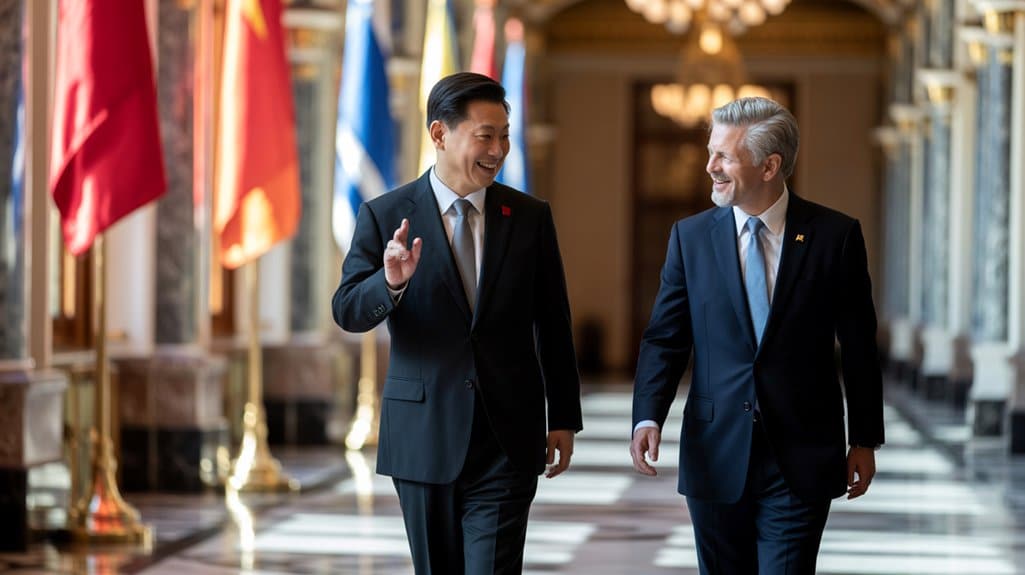
President Yamandú Orsi landed in Beijing on February 3rd, 2026, leading Uruguay’s largest-ever delegation to China. More than 90 companies traveled alongside cabinet ministers and business leaders during this five-day diplomatic mission focused on expanding trade relationships and building stronger economic partnerships.
The visit produced tangible outcomes that go beyond typical diplomatic exchanges. Both governments agreed to sign over 25 bilateral agreements spanning customs technology improvements and major infrastructure development. The centerpiece of these deals involves a 500kV electrical transmission project, the most significant infrastructure investment between the two countries since they established formal diplomatic relations.
Foreign Minister Mario Lubetkin emphasized how the delegation represented Uruguay’s key economic sectors, including commerce, education, and environmental industries. This broad representation reflects both nations’ commitment to moving past preliminary discussions toward implementing practical cooperation agreements that will reshape their bilateral relationship. Uruguay’s strengthening relations with China come as the country simultaneously pursues early ratification of the Mercosur-EU agreement, highlighting its strategy of diversifying trade partnerships.
Why Uruguay Matters to China’s Latin America Strategy
Since 2013, China has recognized Uruguay as much more than a minor South American trade partner. The country sits at the crossroads of Brazil and Argentina, giving Beijing access to two of the continent’s largest economies. This positioning creates opportunities throughout the region.
| Strategic Value | Partnership Level | Regional Impact |
|---|---|---|
| First MERCOSUER BRI signatory | Comprehensive strategic | Access to major markets |
| Defies U.S. pressure | Top diplomatic classification | Alternative development path |
| Rail network modernization | Infrastructure investment | Economic diversification |
| Port facility expansion | Manufacturing collaboration | Expanded Chinese presence |
Uruguay’s decision to join the Belt and Road Initiative in 2018 marked a turning point. No other MERCOSUR country had taken this step, making Uruguay a pioneer in the trade bloc. The move came despite vocal opposition from Washington, which had warned against deeper ties with Beijing.
The partnership goes beyond simple trade agreements. Chinese companies are rebuilding Uruguay’s aging railway system and developing port facilities along the Atlantic coast. These projects create jobs while giving China new shipping routes and manufacturing bases. Other developing nations watch closely, seeing Uruguay as proof they can chart their own course without depending solely on traditional Western partners. China is also a major buyer of Uruguayan soybeans and pulp, strengthening the economic foundation of the bilateral relationship.
12 China-Uruguay Agreements: From Beef Exports to AI Collaboration
Uruguay’s growing partnership with China extends far beyond the infrastructure projects and diplomatic positioning that brought the two nations together. Their agreements now span multiple sectors, creating new opportunities for both countries.
Beef certification gets a major upgrade through enhanced traceability systems that track cattle from farm to plate. This isn’t just bureaucratic paperwork , it’s about proving to Chinese consumers that Uruguayan beef meets strict quality and safety standards. Better tracking means easier market access.
Digital trade platforms are linking Uruguay’s VUCE system with China’s Single Window, making it simpler for businesses to handle export paperwork and customs procedures. What used to take weeks of form-filling now happens with a few clicks.
The countries are also collaborating on green energy projects, including a massive $6 billion hydrogen facility planned for Paysandú. This represents one of the largest foreign investments in Uruguay’s history.
Technology partnerships cover AI development, smart agriculture systems, and communication networks. Chinese companies like Huawei, ZTE, and COSCO Shipping already have established operations throughout Uruguay. Direct Chinese investment reached $214 million by 2023, according to official figures.
These partnerships give Uruguay access to new markets while helping China secure reliable food supplies. The arrangement works because each country brings something the other needs , Uruguay has high-quality agricultural products and renewable energy potential, while China offers capital, technology, and a massive consumer market. Bilateral trade between the two nations reached $6.59 billion in 2024, marking a 25% increase from the previous year.
Uruguay Chairs G77 With Beijing’s Backing: the 2026 Global South Alliance
On January 14, 2026, Uruguay assumed leadership of the G77, representing 134 developing nations at the United Nations. Foreign Minister Mario Lubetkin received the chairmanship from Iraq during ceremonies in New York, marking a significant moment for this South American nation of just 3.4 million people.
Beijing immediately signaled its backing for Uruguay’s new role. China, which holds observer status in the G77 as the world’s second-largest economy, emphasized shared priorities with Montevideo: promoting fair representation in international forums, strengthening cooperation among developing countries, and countering unilateral policies that bypass multilateral institutions.
Uruguay’s agenda centers on three core areas: reducing global inequality, advancing peaceful conflict resolution, and addressing climate change impacts on vulnerable nations. The country positions itself as a neutral mediator, drawing on its diplomatic tradition of bridge-building between opposing parties rather than aligning with major power blocs.
This approach reflects Uruguay’s historical foreign policy strategy. The nation has consistently maintained diplomatic relations across ideological divides, hosting peace talks and serving on UN committees despite its small size. Uruguay’s economy depends heavily on agricultural exports, making it sensitive to trade policies and climate patterns that affect many G77 members.
The chairmanship gives Uruguay unprecedented influence in global discussions. The G77 controls significant voting power in UN General Assembly resolutions and shapes development policy debates. Through this platform, Uruguay can amplify concerns of smaller developing nations that often struggle to influence decisions dominated by major powers. The group represents over 80% of the world’s population, underlining its critical voice in fostering inclusive dialogue.
This leadership role demonstrates how middle powers can leverage multilateral institutions to punch above their weight diplomatically. Uruguay’s presidency offers the Global South a chance to present unified positions on economic inequality, climate finance, and international governance reform.
How This Partnership Challenges US Influence in South America
China’s growing economic presence in Uruguay puts Washington’s traditional regional dominance in an uncomfortable spot. Orsi’s Beijing visit coming right after US moves in Venezuela shows how South American politics are changing fast.
Four ways this partnership reshapes US influence:
- New trade routes open up as China now buys 26% of Uruguay’s exports, giving the country less reason to depend on US and Canadian markets
- Building projects get fresh funding through Belt and Road money that doesn’t come from the World Bank or Inter-American Development Bank
- Small countries gain more room to maneuver when they can play major powers against each other in diplomatic negotiations
- Other Mercosur members take notice since Uruguay becomes the first in the trade bloc to join China’s global infrastructure program
The numbers back up Uruguay’s strategy. China became the country’s second-largest trading partner within a decade, while US trade stayed relatively flat. Chinese loans for ports and railways don’t come with the same political strings that American aid often carries.
This isn’t about forcing Uruguay to pick Team China over Team USA. The country’s leaders are smart enough to know that having multiple big partners gives them better deals and more leverage in negotiations. Other small Latin American nations are watching closely to see how this balancing act works out. The visit includes cabinet ministers and representatives from over 70 companies focused on creating new opportunities in the Chinese market.
References
- https://www.fmprc.gov.cn/eng/xw/zyxw/202602/t20260203_11850201.html
- https://news.cgtn.com/news/2026-01-31/What-to-expect-from-Uruguayan-president-s-state-visit-to-China-1Ko63ocG82Q/index.html
- http://en.brnn.com/n3/2026/0203/c414872-20422111.html
- https://english.news.cn/20260203/1fbe3be5ade6414e9b3947af476dac02/c.html
- https://tribune.com.pk/story/2590534/chinas-xi-urges-uruguay-to-back-orderly-multipolar-world-as-ties-deepen
- http://newyork.china-consulate.org/eng/xw/202602/t20260203_11850201.htm
- https://www.chinadailyhk.com/article/628256
- https://www.globaltimes.cn/page/202602/1354590.shtml
- https://www.youtube.com/watch?v=WK_97VGF_J8
- https://canalsolar.com.br/en/Uruguay-Mercosur-EU-China/