
Uruguay scored 76 out of 100 on Transparency International’s 2024 index, which sounds impressive until you realize it still means nearly a quarter of the country’s interactions involve some level of corruption, though that’s apparently good enough for 13th place globally and first in Latin America. The ranking puts Uruguay ahead of the United States, which sits at 23rd, and far beyond regional neighbors like Brazil and Argentina. What makes this small nation different comes down to something unexpected.
Key Takeaways
- Uruguay scored 76 out of 100 in Transparency International’s 2024 Corruption Perceptions Index, ranking 13th globally among 180 countries.
- Uruguay significantly outperforms the regional average of 42 points, far exceeding neighbors like Argentina, Brazil, Venezuela, Nicaragua, and Haiti.
- The country improved 34 points from a 1997 score of 41.40, reflecting decades of institutional investment and accountability mechanisms.
- Uruguay’s independent judicial system actively prosecutes corruption cases including bribery, money laundering, and embezzlement with specialized offices.
- Low corruption levels attracted USD 3.42 billion in foreign direct investment in 2023, enhancing credibility for international investors.
Uruguay’s Top Ranking in the 2024 Corruption Perceptions Index
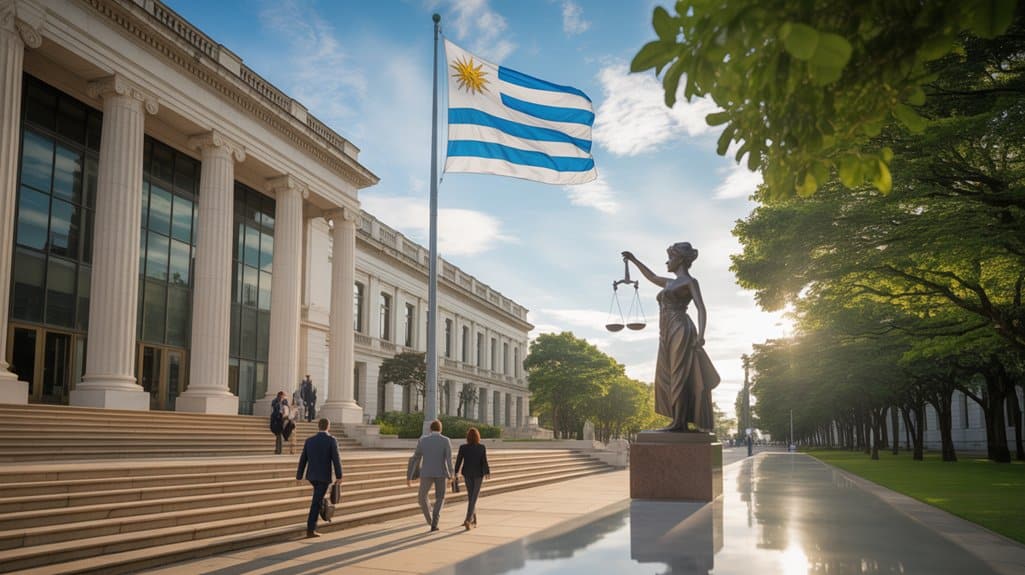
Uruguay, a small South American nation sandwiched between regional giants Brazil and Argentina, managed to score 76 out of 100 on the 2024 Corruption Perceptions Index, which places it at 13th globally out of 180 countries and marks a three-point improvement from its 73 score in 2023. The ranking puts Uruguay ahead of Canada, which sits at 15th, and the United States at 28th, which says something about corruption trends in developed nations. The country’s ascent from 16th place demonstrates steady governance effectiveness that contrasts sharply with regional neighbors, where two-thirds of Latin American countries saw their scores drop. Uruguay’s performance reflects measurements of bribery, embezzlement, and general institutional integrity, compiled from multiple expert assessments and surveys that track public sector corruption across nearly two hundred countries. The index operates on a scale where 0 indicates maximum perceived corruption and 100 represents no perceived corruption at all.
How Uruguay Compares to Canada and the United States
When it comes to measuring public sector corruption in the Western Hemisphere, the 2024 rankings produced what might seem like an unlikely result, with Uruguay sitting at 13th place globally while Canada landed at 15th and the United States settled significantly lower at 28th, a gap that reflects some troubling patterns in how developed economies are managing institutional integrity. Uruguay’s resilience stands in sharp contrast to Canadian challenges, including judicial transparency concerns that dropped the country’s score by one point, and the more dramatic U.S. decline of four points driven by political polarization and failures in prosecuting corruption cases. Under President Luis Lacalle Pou’s term, Uruguay achieved an average score of 73.4 points, outperforming previous administrations and demonstrating the country’s commitment to evolving anti-corruption strategies. The comparative scenery reveals:
- Uruguay scored 76 points, Canada 75, and the United States just 65
- Uruguay ranks 15 places higher than the United States
- All three countries experienced different trajectories, with Latin American dynamics favoring Uruguay’s stability
The Score That Sets Uruguay Apart in the Americas
The 2024 Corruption Perceptions Index handed Uruguay a score of 76 out of 100, which might not sound particularly earth-shattering until you realize that it represents the highest mark ever achieved by any country in the Americas, a designation that includes heavyweights like Canada and the United States who typically dominate these sorts of rankings. Canada managed a 75, falling just short, while the regional average sits at a rather depressing 42, meaning Uruguay scored 34 points higher than the typical American nation. This corruption perception gap reflects decades of investment in public institutions and civic engagement channels, which Uruguay has maintained since joining the Open Government Partnership in 2011, creating accountability mechanisms that most neighboring countries struggle to implement consistently. The country’s trajectory becomes even more striking when considering that Uruguay scored just 41.40 points in 1997, marking a transformation of nearly 35 points over less than three decades.
Democratic Institutions That Resist Polarization and Populism
While most countries in Latin America have spent the past two decades lurching between populist firebrands who promise to burn everything down and establishment politicians who defend systems nobody trusts anymore, Uruguay has managed to maintain a political culture where moderation is not treated as a character flaw. This democratic resilience stems from several structural advantages that bolster institutional trust:
- Compulsory voting ensures broad participation rather than just the angriest voices showing up
- Runoff elections force candidates to appeal beyond their base, rewarding coalition-builders over demagogues
- A Futures Committee institutionalizes long-term thinking instead of governing by Twitter poll
Political leaders respect opponents as legitimate rivals, not existential threats, which turns out to be surprisingly effective at preventing democratic backsliding when combined with actual consequences for breaking norms. The country’s large middle class and low inequality levels create a society where sound public policies can take root without the extreme wealth gaps that fuel political radicalization elsewhere in the region.
Transparency Policies and Open Government Initiatives Since 2008

Uruguay’s commitment to transparency took formal shape in 2008 with Law No. 18.381, which established a legal framework requiring public institutions to open their records to citizens and submit to annual compliance measurements through a National Transparency Index. Three years later, the country joined the Open Government Partnership, an international initiative that pushed Uruguay to formalize its transparency efforts into structured four-year Action Plans, the latest extending through 2029, complete with digital platforms where ordinary citizens can actually participate in shaping these policies. What makes these reforms notable, beyond the usual government promises about openness, is that they created concrete mechanisms like the Unit for Access to Public Information to monitor whether agencies are actually following through, rather than just issuing aspirational statements and hoping for the best. In 2017, the UAIP received 4,323 access requests from citizens seeking public information, demonstrating active public engagement with transparency mechanisms.
Access to Public Information
Since 2008, when Uruguay’s parliament unanimously approved the Access to Public Information Law (Ley de Acceso a la Información Pública N°18.381), the country has built one of Latin America’s most comprehensive frameworks for government transparency, which is notable considering how many regional neighbors treat public information requests as inconvenient suggestions rather than legal obligations. The law established that public information means essentially anything originating from or held by governmental bodies, with limited exceptions for legitimate secrets. The Unit for Access to Public Information manages implementation through transparency education and coordinates the National Transparency Index, measuring agencies across these dimensions:
- Information disclosure quality and accessibility
- Efficiency of public information request processes
- Archive management and institutional recognition
This framework fosters public engagement while civil society organizations actively monitor compliance, creating accountability that actually functions. The index was incorporated into Uruguay’s 2018-2020 open government action plan following input from civil society during the plan’s creation process.
Open Government Partnership Membership
Among the eight founding nations that launched the Open Government Partnership in September 2011, Uruguay was not present, but the country wasted little time joining the initiative as one of 38 countries committed to participation during the organization’s expansion phase that same year, positioning itself as an early adopter rather than a cautious observer in Latin America’s sometimes halfhearted engagement with transparency initiatives. Since then, Uruguay has developed six sequential action plans addressing open government reforms through commitments focused on public participation, open data, and inclusion, with AGESIC serving as the coordinating agency that keeps the machinery running. Montevideo joined the local government cohort in 2022, implementing its own 2023-2025 action plan that brings citizen engagement principles down to the municipal level, where government actually touches residents’ lives most directly. Cities have emerged as critical spaces for fostering openness and transparency, with local perspectives proving essential for addressing the urban challenges that affect residents’ daily experiences.
The Role of an Independent Judicial System in Fighting Corruption
While many Latin American countries struggle with politicized courts that bend to whoever holds power at the moment, Uruguay has managed to build a judicial system that actually operates the way civics textbooks say it should, with constitutional guarantees of independence that are respected in practice rather than just written down and ignored. This independence creates real judicial accountability, which translates into effective corruption deterrence through:
- Active prosecution of bribery, money laundering, and embezzlement cases
- Specialized prosecutor offices handling private corruption offenses
- Collaboration with oversight bodies like JUTEP to monitor asset declarations
The system moves slowly, sure, but it maintains transparency and fairness throughout the process, which matters more than speed when you’re trying to root out entrenched corruption without trampling on anyone’s rights. Uruguay’s approach includes receiving technical guidance from UNODC to strengthen its legal framework for addressing private sector corruption.
Uruguay’s Three-Point Jump While Regional Neighbors Declined

While Uruguay climbed three points to reach an impressive 76 on the 2024 Corruption Perceptions Index, moving from 16th to 13th place globally, most of its neighbors managed to either stagnate or slide backward, which is not exactly the kind of regional solidarity anyone was hoping for. Argentina held steady at a mediocre 37 points while simultaneously passing legislation that made public information harder to access, Brazil struggled along at 34, and the bottom tier of Venezuela at 10, Nicaragua at 14, and Haiti at 16 painted a picture of a region where Uruguay’s success looked less like typical progress and more like a remarkable exception. The contrast became even sharper when considering that Uruguay’s improvement happened during a presidential transition, the very sort of political upheaval that typically gives corruption plenty of room to flourish, yet the country somehow managed to tighten its standards instead. Uruguay’s ranking also surpassed traditional heavyweights like Canada at 15th and the United States at 28th, suggesting that the country’s anti-corruption machinery has reached a level of sophistication that outperforms even wealthy developed nations in the Americas.
Score Improvement Against Trends
Uruguay managed to increase its Corruption Perceptions Index score by three points in 2024, rising from 73 to 76, which is noteworthy enough on its own but becomes significantly more impressive when considering that most of its regional neighbors saw their scores either stagnate or decline during the same period. The country’s score consistency stems from decades of institutional groundwork, not sudden reforms, and reflects sustained public participation that keeps government officials accountable. Three factors distinguish Uruguay’s trajectory:
- Transparent elections that bolster rather than undermine democratic norms
- Open data initiatives that actually function instead of existing as bureaucratic window dressing
- Independent oversight mechanisms with real enforcement power
While neighboring countries struggle with elite capture and institutional erosion, Uruguay demonstrates that anti-corruption efforts require patience, structural commitment, and genuine citizen engagement. The nation’s long-standing public information access policies, implemented since 2008, have created a foundation for citizen oversight that strengthens accountability across government institutions.
Regional Decline Comparison Analysis
The broader Latin American picture in 2024 looked grim enough that Uruguay’s three-point jump to 76 seemed almost anomalous, the kind of statistical outlier that makes analysts double-check their spreadsheets. While Uruguay climbed three places in global rankings, Chile dropped one point to 63, Brazil fell two points to 35, and Mexico plummeted five points to 28, losing fourteen ranking positions in the process. These corruption trends painted a region moving backward, with two-thirds of Latin American countries experiencing score decreases as institutional integrity weakened and organized crime tightened its grip on public affairs. The regional stability that governments often tout in their press releases appeared increasingly fictional, with the average Latin American CPI score declining to 42, a number that highlights just how exceptional Uruguay’s performance actually was. Uruguay’s achievement becomes even more remarkable when considering it now outperforms Canada’s 75 points, previously regarded as the Western Hemisphere’s gold standard for clean governance.
Outperforming Major Global Economies in Transparency
With a Corruption Perceptions Index score of 76 out of 100 in 2024, this South American nation of just 3.4 million inhabitants now ranks 13th globally among 180 countries, which puts it ahead of economic powerhouses like Germany, Japan, and the United Kingdom in terms of perceived transparency, a somewhat remarkable achievement for a country that most individuals would struggle to locate on a map. Uruguay’s transparency initiatives demonstrate what functioning institutions can accomplish when properly maintained, outpacing nations with vastly larger economies and bureaucracies.
The gap becomes clear when comparing scores:
- Uruguay: 76 points, 13th place globally
- Germany: Lower score despite its industrial prowess
- Japan and UK: Both trailing behind
This performance reflects genuine global cooperation in anti-corruption standards, not merely regional dominance, which suggests size and wealth don’t guarantee clean governance. Uruguay also outperformed Canada and Barbados, two nations traditionally recognized for their strong governance frameworks, amid broader regional declines in transparency.
A Model for Developing Nations Achieving High Standards

Among developing nations seeking to improve governance standards, few examples prove as instructive as this small South American country that managed to build transparency mechanisms comparable to wealthy Scandinavian states, which is particularly notable given that Uruguay accomplished this without the massive tax revenues or centuries-old bureaucratic traditions that typically accompany such institutional maturity. The governance models developed there demonstrate that effective anti-corruption strategies don’t require exceptional wealth, just sustained political will and citizen engagement that actually means something beyond symbolic gestures. What makes Uruguay’s approach replicable, ironically enough, is precisely what most countries find impossible to replicate, the alteration of political competition itself rather than superficial adjustments to ethics codes that politicians routinely ignore anyway, combined with investigative journalism that possesses real independence instead of serving as amplification devices for whichever faction controls state resources. The country’s Transparency and Public Ethics Committee provides institutional oversight that functions independently from executive pressure, creating accountability structures that survive changes in political leadership.
Electoral Integrity and Peaceful Power Transitions
Uruguay’s November 2024 presidential elections demonstrated what many Latin American countries struggle to achieve, with an 89.4% voter turnout in the runoff and a losing candidate who conceded immediately without disputing results or claiming fraud. The transition from the outgoing administration to the opposition victor proceeded through established institutional channels, proving that democratic transfers of power can actually function as designed rather than devolving into constitutional crises or street protests. This seamless handover reflects decades of cultivated political norms and transparent electoral institutions that have made contested outcomes, which plague neighboring countries with alarming regularity, virtually nonexistent in Uruguay’s political arena. The elections also resulted in increased female legislative representation, with women now holding 27.9% of seats in parliament.
November 2024 Presidential Elections
On November 24, 2024, Yamandú Orsi of the center-left Frente Amplio coalition won Uruguay’s presidential runoff election, defeating Álvaro Delgado of the incumbent National Party in what turned out to be, for those hoping for dramatic dysfunction, a disappointingly orderly transfer of power. The electoral fairness demonstrated throughout the process included approximately 89% voter turnout with no significant incidents reported, which frankly makes for boring international headlines but excellent governance outcomes. Uruguay’s political stability remained intact despite contentious debates over pension reforms and crime prevention policies that actually mattered to voters. The transition featured:
- Peaceful acceptance of results by losing candidates
- Constitutional compliance to runoff procedures when no candidate secured 50% initially
- Clear parliamentary representation with Frente Amplio gaining 48 of 99 House seats
Orsi and running mate Carolina Cosse together received 49.8% of the votes, narrowly defeating the right-wing Partido Nacional’s 45.8%. Democracy functioning properly remains Uruguay’s least exciting achievement.
Seamless Government Transition Process
While other Latin American nations periodically schedule their political drama around election cycles with contested results, accusations of fraud, and constitutional crises that generate headlines, Uruguay’s 2024 electoral process unfolded with the administrative efficiency of a well-managed postal service, which is to say it worked exactly as designed and nobody particularly noticed. President Lacalle Pou handed power to Yamandú Orsi following a two-round system that required majority support, and the transition occurred without theatrical protests or emergency court hearings. Electoral transparency remained consistently high throughout, with independent judicial oversight preventing the interference that destabilizes neighboring democracies. The newly elected parliament, featuring 63.6% first-term members, convened punctually on February 15, 2025, demonstrating that government accountability functions best when institutions operate as intended rather than as bargaining chips. This institutional stability reflects Uruguay’s stable party system, which has captured nearly 95% of votes since 1971, ensuring continuity in democratic governance even as administrations change hands.
How Citizen Trust Protects Against Corruption

The foundation of effective anti-corruption efforts rests on a deceptively simple premise that governments often overlook, which is that citizens who trust their institutions are far more likely to participate in holding those institutions accountable. This relationship creates what researchers call a virtuous cycle, where trust enables citizen authorization and engagement, which in turn strengthens accountability mechanisms that prevent corruption from taking root. Uruguay demonstrates this dynamic through several interconnected factors:
- High social trust correlates directly with citizens’ willingness to report corruption and monitor public officials
- Transparent government practices bolster confidence that citizen participation actually matters
- Regular anti-corruption audits signal institutional commitment, encouraging continued civic engagement
When individuals believe their involvement produces real results, they stop being passive observers and become active watchdogs, making corruption considerably harder to sustain. However, research from Brazil’s federally randomized anti-corruption program reveals that the impact of audits depends on whether corruption is uncovered, as detecting and reporting corruption could unintentionally erode the very institutional trust these programs aim to protect.
What Uruguay’s Ranking Means for Foreign Investment and Development
Credibility in governance translates almost directly into dollars when it comes to foreign investment, and Uruguay’s position as Latin America’s least corrupt nation has created a measurable advantage that shows up in both the quantity and quality of capital flowing into the country. Foreign partnerships with U.S., European, and regional investors brought USD 3.42 billion in FDI during 2023, with foreign ownership reaching 49.6% of GDP, concentrated heavily in technology, finance, and manufacturing sectors that demand regulatory predictability. The investment advantages extend beyond simple capital flows, attracting sophisticated operations in fintech and global services that wouldn’t risk establishing regional headquarters in environments where bribes determine outcomes. Uruguay’s fourteen Free Trade Zones and transparent legal framework make it a practical choice for businesses seeking regional market access without the usual complications. The country’s renewable energy infrastructure, with over 97% of energy generation from clean sources, has become a key driver attracting foreign capital to the energy and infrastructure sectors.
References
- https://www.uruguayxxi.gub.uy/en/news/article/uruguay-tops-americas-in-transparency-according-to-2024-corruption-perceptions-index/
- https://nearshoreamericas.com/uruguay-leads-latam-in-transparency-venezuela-remains-corruption-most-corrupt/
- https://www.guruguay.com/uruguay-corruption-index/
- https://hir.harvard.edu/uruguays-democracy-a-model-for-stability-in-latin-america/
- https://www.latinamericareports.com/uruguay-ranked-least-corrupt-country-in-the-americas/10654/
- https://www.steptoe.com/en/news-publications/2024-Anti-Corruption-Rankings-Highlight-Ongoing-Corruption-Risks-in-LATAM-Insights-from-Transparency-Internationals-CPI-and-TRACEs-Bribery-Risk-Matrix.html
- https://www.theglobaleconomy.com/rankings/herit_corruption/Latin-Am/
- https://www.transparency.org/en/countries/uruguay
- https://en.wikipedia.org/wiki/Corruption_in_Uruguay
- https://www.statista.com/statistics/809887/latin-america-countries-corruption-perception-index/