
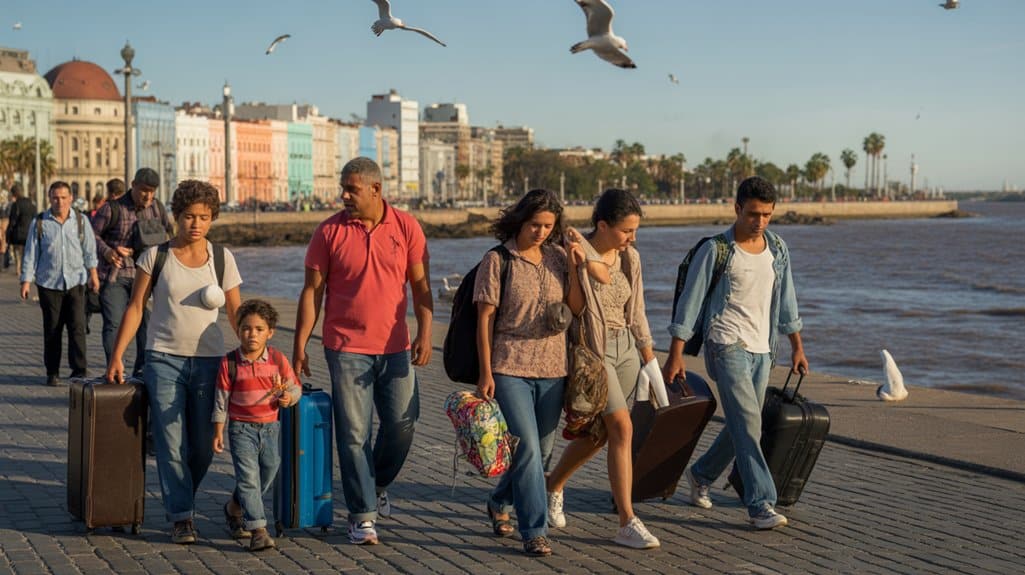
Uruguay saw an unprecedented wave of Cuban families arrive in 2025, fundamentally changing migration patterns across South America. Government offices processed over 2,000 residency applications in the first quarter alone, transforming neighborhoods throughout Montevideo and smaller cities.
The families arriving aren’t temporary visitors. They’re establishing permanent lives by enrolling their children in local schools and integrating into existing communities. This large-scale settlement creates practical challenges that extend beyond simple housing and employment.
Professional credentials present the biggest obstacle for many newcomers. Cuban doctors, engineers, and teachers often find their qualifications don’t transfer directly to Uruguay’s regulatory system. The country requires additional certification processes that can take months or years to complete, leaving skilled professionals working in entry-level positions while they navigate bureaucratic requirements.
Montevideo’s Cordón and La Comercial neighborhoods show the most visible changes, with new Cuban-owned businesses opening alongside established Uruguayan shops. Local schools report enrollment increases of 15-20% in areas with high Cuban settlement, stretching resources and requiring additional Spanish-language support programs despite both countries sharing the same language.
The scale of this migration reflects broader economic pressures in Cuba and Uruguay’s relatively stable political environment compared to other South American destinations. Unlike previous waves that often continued to other countries, data from Uruguay’s National Immigration Office indicates most Cuban families view their move as permanent rather than transitional.
Key Takeaways
Cuba’s economic collapse has pushed families to their breaking point, with residents enduring 20-hour blackouts daily while earning just $400 per month. These conditions have triggered an unprecedented wave of migration to Uruguay, where Cubans face no visa requirements for tourist entry.
The migration surge has transformed into permanent settlement rather than temporary relocation. Uruguay processed over 2,000 residency applications since May 2024, with the majority coming from Cuban families who chose to stay permanently in Montevideo and other cities across the country.
School enrollment data reveals the depth of this demographic shift. Cuban children now fill 1,541 seats in Uruguayan classrooms as of 2024, representing a sevenfold increase that signals families are putting down roots rather than planning return trips to the island.
Uruguay’s Residency by Rooting Program streamlines the legal transition for these migrants. The program cuts through bureaucratic delays, allowing families to secure documentation within weeks while gaining immediate access to healthcare, education, and work authorization that would take months or years in other countries.
What’s Driving Record Cuban Migration to Uruguay in 2025?
Cuba’s 2025 crisis stems from a perfect storm of economic collapse that’s making daily life nearly impossible for ordinary families. Power grids fail for over 20 hours each day, leaving refrigerators useless and forcing people to cook by candlelight. Workers take home around 10,000 pesos monthly, that’s roughly $400 when you factor in money sent by relatives living overseas.
Basic necessities have disappeared from store shelves. Pharmacies sit empty while food markets offer little beyond overpriced rice and beans. Families spend entire days hunting for bread or milk that may never arrive. The peso has lost most of its purchasing power, making even simple items unaffordable for people earning government salaries. A single chicken costs $150 while a carton of eggs runs $116, putting protein sources completely out of reach for average Cuban workers.
This economic meltdown triggered the largest population exodus in Cuban history. Official data shows the island lost 18 percent of its residents between 2022 and 2023, nearly two million people who packed whatever they could carry and left everything behind. Young professionals, skilled workers, and entire families continue streaming out through Mexico, Nicaragua, and direct flights when they can afford them.
Uruguay presents an attractive alternative because of its stable democracy, growing economy, and relatively straightforward residency process. The country accepts Cuban migrants without requiring tourist visas, and its social services provide healthcare and education access. Unlike the dangerous overland journey to the US border, reaching Montevideo involves a simple flight connection through Panama or Mexico City.
Why Cubans Are Gaining Uruguayan Citizenship Faster Than Other Groups
Uruguay’s citizenship path takes just three years of residency, half the time most South American countries require. This streamlined process makes Cuban integration remarkably efficient compared to other destinations.
The straightforward approach offers clear advantages. Flexible residency options through investment, marriage, or business formation get applicants started quickly. Minimal documentation requires only criminal records, passport, marriage certificate if applicable, and application form. No language tests or complex cultural requirements slow down the process. One-year processing after meeting the three-year residency threshold delivers results fast.
Cubans leaving behind a system requiring five years plus bureaucratic hurdles find Uruguay’s direct path refreshingly simple. The entire journey, from establishing residency to holding a Uruguayan passport, wraps up in four years total. Uruguay has positioned itself as a stable destination for migrants seeking better opportunities amid regional challenges.
How Cuban Families Are Changing Uruguay’s Schools and Neighborhoods
Since 2018, classrooms across Uruguay have quietly transformed. Cuban children now occupy desks in public schools, with enrollments jumping sevenfold to 1,541 students by 2024. Venezuelan families remain the only group sending more children to Uruguayan schools.
Teachers and administrators find themselves managing educational resources they hadn’t planned for. These demographic changes ripple through neighborhoods as families establish roots and alter community dynamics. Housing markets respond to increased demand, particularly in areas where migrant families concentrate.
Parent meetings and local gatherings now include new voices as community composition shifts. Working parents face credential recognition hurdles while schools struggle to accommodate students in already packed classrooms. These families’ emphasis on education gradually transforms Uruguay’s social landscape, one enrollment at a time. Between 2022 and 2024, Uruguay granted residency to 6,608 Cubans, representing a 72% increase year-over-year.
The impact reaches well beyond enrollment statistics. Schools adapt teaching methods and resource allocation while neighborhoods witness cultural blending that reshapes daily life. What started as a migration trend now represents a fundamental shift in how Uruguayan communities function and grow.
Why Most Cuban Migrants in Uruguay Work Below Their Credentials
Doctors stock shelves in grocery stores. Engineers cut hair in barbershops. Teachers serve coffee in cafés. These scenes play out daily across Uruguay as Cuban migrants navigate a labor market that doesn’t recognize their qualifications.
The mismatch between skills and employment stems from practical barriers that force immediate survival choices. Professional licensing in Uruguay requires extensive documentation and can take six months or longer to process. Families arriving with limited savings can’t afford to wait – they need income within weeks, not months.
Uruguay’s job market compounds the challenge. The country’s unemployment rate sits at 8.1%, creating fierce competition for formal positions even among local workers. Skilled jobs become particularly scarce when the overall economy struggles to generate employment opportunities.
Asylum seekers face an additional hurdle. While their cases wind through the immigration system, many discover that formal employers hesitate to hire workers whose legal status remains unresolved. This bureaucratic limbo pushes qualified professionals toward informal work that operates outside official channels. Nearly 22% of workers lack social security registration in their main job, reflecting how widespread informal employment has become across Uruguay’s labor market.
Economic pressure from Cuba intensifies these decisions. Families back home depend on remittances to survive shortages of basic goods and infrastructure failures. When relatives endure power outages exceeding twenty hours daily, the urgency to send money trumps career considerations.
Self-employment emerges as the most viable path forward. Street vendors, house cleaners, and handymen can start earning immediately without credentials or extensive paperwork. The informal economy absorbs these workers quickly, offering financial stability that formal employment can’t match under current circumstances.
This credential waste represents both individual hardship and broader economic inefficiency, as Uruguay loses access to skilled labor while qualified professionals remain underemployed.
Where Cuba’s 22,000 New Arrivals Are Settling Across Uruguay
Most of Uruguay’s newly arrived Cubans have settled in Montevideo, drawn by job opportunities and established support networks that ease their transition. The numbers tell a compelling story through school enrollment data, Cuban students in the capital increased by 388% between 2018 and 2022 as families established permanent roots.
The residency program that began in May 2024 shows similar geographic clustering. Officials have processed over 2,000 applications across the country, yet the bulk of these requests come from Montevideo and nearby urban centers. This concentration makes practical sense for new arrivals who need immediate access to employment, services, and communities that speak their language and understand their experience. Many migrants have opened small businesses, contributing to the local economy while earning income to support their families.
Montevideo Concentrates Most Cubans
Uruguay’s capital city draws Cuban newcomers more than anywhere else in the country. Montevideo’s integration programs have welcomed over 10,000 legal Cuban residents, creating the largest Cuban population of any Uruguayan department. The 2023 census shows Cubans make up the third-largest foreign community nationwide, and most settle in the capital.
Several practical factors explain why Cubans choose Montevideo. The city serves as Uruguay’s economic hub, so most jobs are located there. Organizations like Uruvene have built strong support systems – they helped 942 Cubans navigate life in Uruguay during 2025 alone. Immigration offices in the capital process documents more quickly than in smaller cities. Cuban families also find comfort in growing neighborhoods where they can speak Spanish and maintain cultural connections. The influx may affect rents, schools, and labor markets as the city adapts to accommodate the growing Cuban community.
This clustering effect caught researchers’ attention in the 4Mi Cities study, which tracked Montevideo’s growing migrant communities during 2024 and 2025. The pattern shows how new arrivals often gravitate toward places where others from their home country have already established roots and support systems.
Schools Show Geographic Distribution
Public school enrollment tells us exactly where Cuban families are making their homes across Uruguay. The 1,541 Cuban students now in public schools marks a 388% increase since 2018. This data reveals something important: families are choosing to settle well beyond Montevideo, establishing themselves in communities from one end of the country to the other.
You’ll find Cuban children in classrooms from border towns to coastal communities, which shows us these aren’t temporary stops but real family relocations. Towns like Paysandú, Colonia, and Fray Bentos started as entry points but became permanent homes for many of these families. The numbers speak for themselves – enrollment has jumped sevenfold in just five years.
School records give us a clearer picture than border crossing statistics ever could. They show us where families actually decide to stay, work, and build their futures. This geographic spread across Uruguay’s regions demonstrates that Cuban migrants are choosing to put down roots rather than treat the country as a stepping stone to somewhere else. Uruguay’s stability and security continue to draw families seeking a safe environment to raise their children.
Residency Program Expands Coverage
Residency Program Expands Coverage
Over 20,000 migrants have built lives in Uruguay without proper legal documentation. President Lacalle Pou addressed this reality by launching the Residency by Rooting Program through presidential decree, creating three main pathways for people to gain legal status.
Application Routes Available:
- Labor roots , more than 90% of applicants choose this option, demonstrating their workplace connections
- Family roots , applicants prove relationships with Uruguayan citizens or residents
- Training roots , students enrolled in educational programs can apply for eventual citizenship
The program grants permanent legal status, workplace protections, school access for children, and a path to full citizenship. More than 2,000 people have begun the application process since launch. Cuban nationals make up the largest group of applicants, many originally sought asylum but were denied and remained in the country.
This streamlined approach tackles the administrative backlog at CORE (the national refugee agency) while allowing established families to formalize their status. Rather than deportation proceedings, the government chose regularization as the practical solution for long-term residents who contribute to their communities but lack proper papers. Uruguay’s participation in regional migration agreements like Mercosur has shaped its commitment to creating legal pathways for migrants seeking stability.
What Uruguay Offers That Other Destinations Don’t for Cuban Migrants
Why has this small South American nation become such an appealing choice for Cubans seeking a fresh start?
Uruguay’s practical advantages create real opportunities. Migrants receive immediate access to healthcare, education, and jobs without bureaucratic delays. The government issues residency cards within weeks rather than months. The country maintains steady economic growth and low inflation, which means grocery stores stay stocked and prices remain predictable.
Crime rates stay well below regional averages. Montevideo ranks among Latin America’s safest capitals, with violent crime affecting fewer than 4 per 100,000 residents annually.
The Special Residency Program cuts through typical immigration red tape. Migrants can legalize their status after just six months in the country. This timeline lets families plan reunification rather than wait years in limbo. The program has benefited over 20,000 foreigners, primarily Cubans who faced migratory limbo.
Professional validation happens at rates that would surprise migrants familiar with other destinations. Uruguay’s Ministry of Education approves 70% of foreign credential applications, particularly for healthcare workers and engineers. Bilateral agreements with regional professional boards speed up the recognition process.
Financial transfers to Cuba face fewer restrictions here. Banks process remittances without the complex regulations that complicate money transfers in other South American countries.
The UN refugee agency has documented Uruguay’s approach as a regional model. Government subsidies fund language classes, job placement services, and temporary housing assistance. These programs receive backing from international development funds, creating a support network that extends beyond what volunteer organizations typically provide.
References
- https://en.cibercuba.com/noticias/2026-02-11-u1-e135253-s27061-nid320603-exodo-record-22-mil-cubanos-huyeron-uruguay-2025
- https://www.riotimesonline.com/uruguay-sees-net-venezuelan-outflow-in-2025-as-cuban-arrivals-rise/
- https://real-estate-uruguay.com/uruguay-records-high-arrivals-of-cuban-migrants/
- https://www.weareceda.org/en/us-cuba-news-brief/august1-cuba-decreasing-tourism-prtfv34-n96wh
- https://translatingcuba.com/brazil-and-uruguay-attract-more-cuban-migrants-every-day/
- https://opapeleo.com/en/immigration/favorite-latin-american-destinations-cuban-migration/
- https://mixedmigration.org/wp-content/uploads/2025/09/404_4Mi-Cities-Montevideo-EN.pdf
- https://www.migrationpolicy.org/article/latin-america-caribbean-new-migration-era
- https://en.cibercuba.com/noticias/2025-03-12-u1-e199370-s27061-nid298754-uruguay-consolida-destino-acogida-migrantes-cubanos
- https://havanatimes.org/features/more-cubans-are-looking-to-south-america-over-usa/