
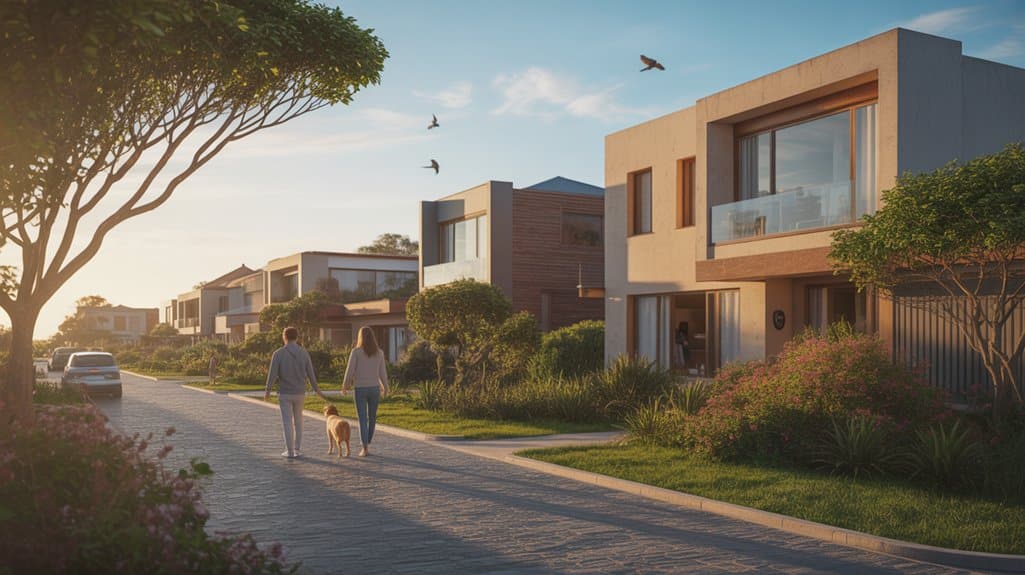
Uruguay’s housing market remains steady in 2026.
In Montevideo, prices are projected to increase 2, 4% annually, providing modest growth with minimal volatility.
Punta del Este attracts luxury buyers, with high-end property values rising over 10% driven by foreign investment and evolving lifestyle preferences.
Green and wellness-focused properties are gaining market traction.
Transparent ownership regulations and a reliable legal framework support market confidence.
Key Takeaways
- Market stability and consistent annual price growth of 2, 4% sustain buyer confidence in Montevideo.
- The luxury sector in Punta del Este records price gains exceeding 10%, driven by demand from U.S. and European investors.
- Equal ownership rights and tax incentives for foreign investors maintain demand across all property categories.
- Sustainable and wellness-focused properties attract buyers, supported by Uruguay’s renewable energy infrastructure and smart technology integration.
- Financing options for residents (up to 80% loan-to-value ratios) and transparent legal frameworks reduce investment risk.
Why 2026 Market Stability Matters for Uruguay Real-Estate Buyers

Market stability represents a critical foundation for real estate purchasing decisions. In 2026, steady market conditions enable buyers to develop long-term investment plans without exposure to sudden price volatility. Price consistency strengthens buyer confidence and reduces perceived investment risk.
Central bank rate reductions lower mortgage costs, expanding homeownership accessibility across income levels. International investors from Argentina, Brazil, and Europe regard Uruguay as a secure investment destination, reinforcing market equilibrium. Streamlined regulations permit capital flows in multiple currencies, minimizing foreign exchange complications.
These interconnected factors sustain market predictability, facilitating informed purchasing decisions for both domestic and international buyers. The recent 24.8% surge in transaction volume underscores the market’s resilience.
How Montevideo’s Stable Prices Translate to 2-4% Annual Gains in 2026
Montevideo’s annual price increase of 2, 4% reflects market stabilization. This modest growth provides a predictable environment for home buyers and renters seeking reassurance. The market consolidates primarily around apartments, with sellers and buyers establishing consistent patterns rather than volatile swings.
In 2026, nominal gains approach 3% while real growth remains near zero. Additional monetary gains largely offset rising living costs. Premium neighborhoods such as Carrasco and Punta Carretas maintain elevated valuations, while peripheral districts remain accessible entry points for new owners.
The market structure supports steady, reliable returns without unexpected disruptions. Investors can anticipate consistent performance across this stabilized pricing landscape. The overall market has seen a 4-5% price rise in USD terms, driven by renewed interest from Argentine buyers.
What’s Driving the 10%+ Luxury Surge in Punta Del Este 2026?
Montevideo’s steady price growth provides a measured counterpoint to Punta del Este’s dynamic market. Luxury properties command attention on the beachfront, driven by substantial foreign investment from the United States and Europe. International investors pursue seafront villas aggressively, with prices reaching 12% above the city average. Prestigious developments such as Cipriani Ocean Resort and the Fendi Château enhance the market’s exclusivity, while scarce land availability reinforces the appeal of each new project. Remote work capabilities enable residents to maintain year-round occupancy, transforming Punta del Este from a seasonal destination into a permanent residence. Security features, modern amenities, and panoramic ocean views combine to generate the 10%+ price surge. This convergence attracts global investment capital and affluent buyers seeking an upscale lifestyle in a secure setting. Foreign investors constitute roughly 75% of luxury property purchases, underscoring the market’s international appeal.
Sustainable & Wellness Home Trends Shaping Uruguay Real Estate in 2026
Uruguay’s housing market is experiencing growth as buyers increasingly prioritize homes that balance environmental responsibility with personal well-being. Sustainable architecture integrates with wellness amenities to create healthier living environments. Eco-friendly materials such as timber and cross-laminated timber (CLT) panels feature prominently in new construction. Biophilic design, incorporating natural elements like indoor gardens and abundant natural light, appears throughout residential spaces. Energy efficiency is standard, supported by Uruguay’s electrical grid powered by 98% renewable sources. Smart technology enables remote management of climate control, lighting, and security systems.
Investor demand for certified properties is driving developers to pursue LEED and other green building certifications to meet market expectations.
| Feature | Example |
|---|---|
| Solar panels | Roof-mounted power generation |
| Water reclamation | Recycled water for gardens and pools |
| Natural ventilation | Large windows and open floor plans |
| Indoor greenery | Living walls and potted plants |
| Smart home hub | Voice-controlled lighting and climate |
These developments combine healthy living practices with environmental stewardship and technological convenience.
Why Foreign Capital Still Dominates Uruguay Real-Estate in 2026
Foreign investment continues to fuel Uruguay’s real-estate market in 2026. The country’s low corruption and stable political environment create conditions that attract international capital. Tax benefits, free-trade zones, and unrestricted profit repatriation facilitate property acquisition, while dollar-denominated pricing reduces currency risk for overseas buyers.
Key investment drivers include:
- Tax incentives and absence of capital controls appeal to a broad investor base.
- Mercosur and Mexico trade agreements provide access to markets spanning 550 million people.
- Beachfront and urban rental properties generate strong returns alongside lifestyle benefits.
These conditions sustain foreign capital’s prominence, particularly in luxury coastal markets like Punta del Este. Consistent demand in these areas supports price appreciation and market stability. The average sale-to-asking price ratio of 93-95% indicates that properties are typically sold close to their listed price, underscoring market confidence.
How to Evaluate a 2026 Uruguayan Property Investment

Market price trends in Uruguay demonstrate steady increases, particularly in Montevideo and coastal resorts. Comparing recent sales with historical data provides useful perspective. A risk assessment should evaluate rental yield, financing costs, and local economic stability. These factors are essential for determining whether a 2026 property investment aligns with investment objectives. The 11-year tax holiday further enhances the attractiveness of long-term holdings.
Market Price Trends
Uruguay’s 2026 property market displays steady price fluctuations across regions. Coastal and luxury zones significantly outpace the capital, with Montevideo experiencing 3, 5% annual growth compared to Punta del Este’s 8, 12% appreciation. Foreign investor interest and limited supply drive the stronger coastal performance.
Key market observations:
- Punta del Este leads with double-digit appreciation in beachfront properties.
- Montevideo provides stable but modest gains, with purchasing power potentially lagging inflation.
- Premium coastal areas show 6, 10%+ growth, reflecting constrained inventory.
- Transaction volume increased steadily throughout 2025, supporting market stability.
The market operates with stability and measured optimism, maturing without sudden disruptions. This environment enables informed investment decisions based on regional performance data.
Investor Risk Assessment
The assessment of property investment risk begins with identifying factors that increase or reduce purchase safety. Legal considerations are paramount: informal reservation agreements that do not transfer ownership until registration present significant exposure. Clear documentation prevents nominee arrangements and undisclosed cash transactions.
Financing structures differ substantially by buyer classification. Residents typically access financing up to 80 percent of purchase price, while non-residents generally require down payments of 50-70 percent and frequently depend on cash reserves.
Market conditions warrant careful evaluation. The absence of a centralized listing system (MLS equivalent) requires independent verification of title deeds, tax obligations, and zoning classifications. This verification process demands additional time and resources.
Risk mitigation relies on three core elements: comprehensive due diligence, engagement of a qualified notary, and establishment of a viable exit strategy. These measures reduce exposure to undisclosed costs and market volatility. Foreigners enjoy equal ownership rights as locals, with no nationality-based restrictions on property purchases.
References
- https://www.realestate-in-uruguay.com/blog/uruguay-luxury-real-estate-market-trends/
- https://valoraconsultora.com/en/reflections-on-the-real-estate-sector-in-uruguay/
- https://www.jarniascyril.com/international-real-estate/invest-in-real-estate-uruguay-market-guide/uruguay-real-estate-market-trends/
- https://www.realestate-in-uruguay.com/blog/uruguay-wellness-real-estate-forecast-2026/
- https://thelatinvestor.com/blogs/news/montevideo-good-time
- https://www.laciteuruguay.com/news/why-uruguay-is-becoming-a-top-property-investment-destination-in-2026-insights-from-la-cite-real-estate
- https://www.nicolasdemodena.com/blog/uruguay-in-2026-the-best-country-in-latin-america-to-invest-in-real-estate/
- https://www.youtube.com/watch?v=udYkmiuvmcM
- https://www.liveandinvestoverseas.com/country-hub/uruguay/invest-in-uruguay/
- https://thelatinvestor.com/blogs/news/uruguay-price-forecasts