
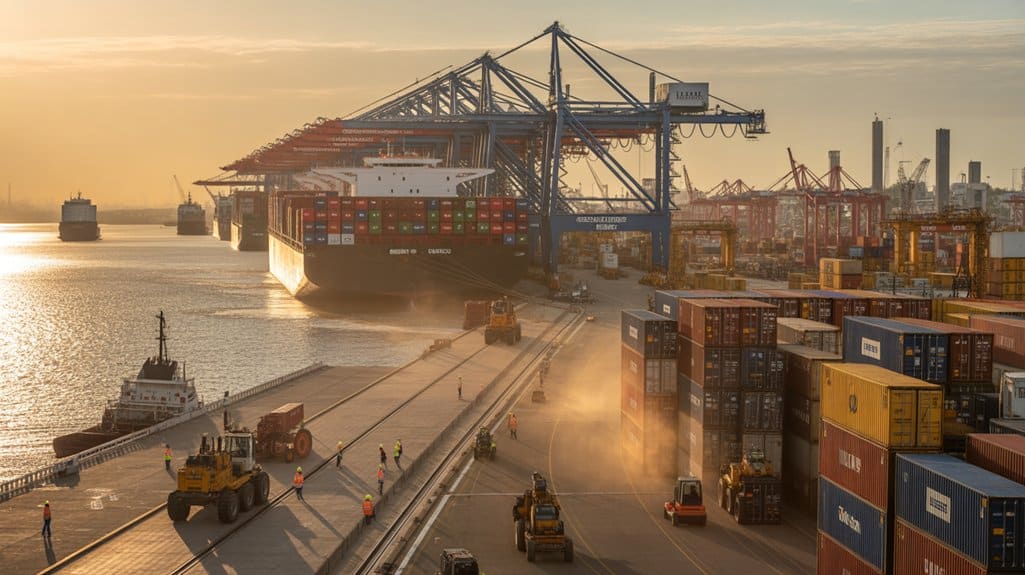
The new EU-Mercosur pact is expected to lower construction equipment costs and increase available financing for developers, potentially triggering a construction surge in Uruguay.
Infrastructure projects may include port expansion, road improvements, and urban development.
Tax incentives support ventures such as the Montevideo Residential Upgrade.
Such developments could generate employment opportunities and strengthen economic activity in the region.
Key Takeaways
- The EU-Mercosur agreement reduces machinery costs, driving construction activity and financing expansion in Uruguay.
- Infrastructure investments, including a $460 million terminal expansion and $1.1 billion rail project, increase demand for construction and housing development.
- A free-port regime and tax incentives attract foreign capital, accelerating residential and commercial building projects.
- Major developments, Modern City, Colonia, Canelones Data Center, and Green Hydrogen Plant, represent billions in UYU investment and generate construction employment.
- Projected GDP growth of approximately 5% and rising land values of 3, 5% annually support demand for new urban towers and residential properties.
Uruguay’s Port Upgrades Surge
Port Expansion Accelerates Logistics
Montevideo’s main container terminal, Cuenca del Plata, has secured a concession extension to 2080, backed by a $460 million investment programme. The upgrade will lift annual capacity beyond 2 million TEU (twenty-foot equivalent units) and widen the channel to 14 metres, enabling the largest containerships to berth. Renewable electricity will power docked vessels, establishing the first sustainable terminal of its kind in South America. The port currently handles more than 70% of Uruguay’s foreign trade. Tourism growth is evident, with 3,207,536 visitors recorded from January to November 2025. The logistics sector, valued at $4.14 billion in 2026, is projected to reach $5.33 billion by 2031, expanding at a 5.18% compound annual growth rate. The sector contributes 5% of GDP and employs over 200,000 workers. A free-port regime permits bonded storage for up to five years and supports value-adding services. Free-trade-zone activity accounts for 30% of exports and 4.2% of GDP. Montevideo’s strategic location within Mercosur establishes it as a key transshipment hub for Argentine and Brazilian cargo. Rail connectivity is improving through two major projects. A $1.1 billion initiative will double a 273-kilometre stretch to Paso de los Toros. A $200 million channel-widening project enhances connections with Paraguay and Bolivia. These upgrades are expected to reduce transit times and increase land values in interior regions by 3, 5% annually. Regional ports are expanding capacity. Nueva Palmira is upgrading facilities for grain and wood-pulp traffic. Feasibility studies are underway for Fray Bentos and La Paloma. A $1 billion passenger terminal concession at Montevideo is planned for a 30-year term. Combined with the Paraná-Paraguay waterway development, these initiatives position Uruguay as a significant logistics hub, supported by a 95% renewable-energy matrix.
Economic Surge Fuels Urban Skylines
When economic conditions improve, city skylines transform. Infrastructure investment drives construction innovation, and new towers rise along Montevideo’s coast. The EU-Mercosur pact reduces machinery costs for developers, while tax incentives maintain capital availability. Housing stock expands, creating a dynamic urban landscape.
Investment in water and transportation infrastructure supports these developments, further accelerating growth.
| Project | Investment (UYU) |
|---|---|
| Modern City, Colonia | 82.9 bn |
| Canelones Data Center | 35.2 bn |
| Green Hydrogen Plant, Paysandu | 165.9 bn |
| Montevideo Residential Upgrade | 45.0 bn |
These investments reshape the urban horizon, reflecting tomorrow’s development priorities.
References
- https://www.jarniascyril.com/international-real-estate/invest-in-real-estate-uruguay-market-guide/urban-development-projects-uruguay/
- https://www.liveandinvestoverseas.com/country-hub/uruguay/infrastructure-in-uruguay/
- https://www.globenewswire.com/news-release/2026/02/03/3231248/28124/en/Uruguay-Construction-Industry-Report-2025-Following-0-4-Contraction-in-2025-Output-is-Projected-to-Grow-by-3-5-AAGR-Between-2026-2029-Driven-by-Renewables-Manufacturing-Transport-a.html
- https://gedeth.com/es/blog/2026/02/25/uruguay-investment-opportunities-2026/
- https://thelatinvestor.com/blogs/news/uruguay-real-estate-market
- https://www.ceicdata.com/en/indicator/uruguay/m2-growth
- https://www.realestate-in-uruguay.com/blog/uruguay-agricultural-land-prices-2026-outlook/
- https://en.travel2latam.com/news-100943-uruguay-a-tourist-destination-in-2026-strategies-for-success
- https://ca.investing.com/news/economy-news/uruguay-to-continue-cutting-rates-in-2026-says-cb-chair-93CH-4379133
- https://latinarepublic.com/2026/01/09/uruguay-welcomed-over-3-2-million-tourists-in-2025-generating-1-78-billion-in-revenue/