
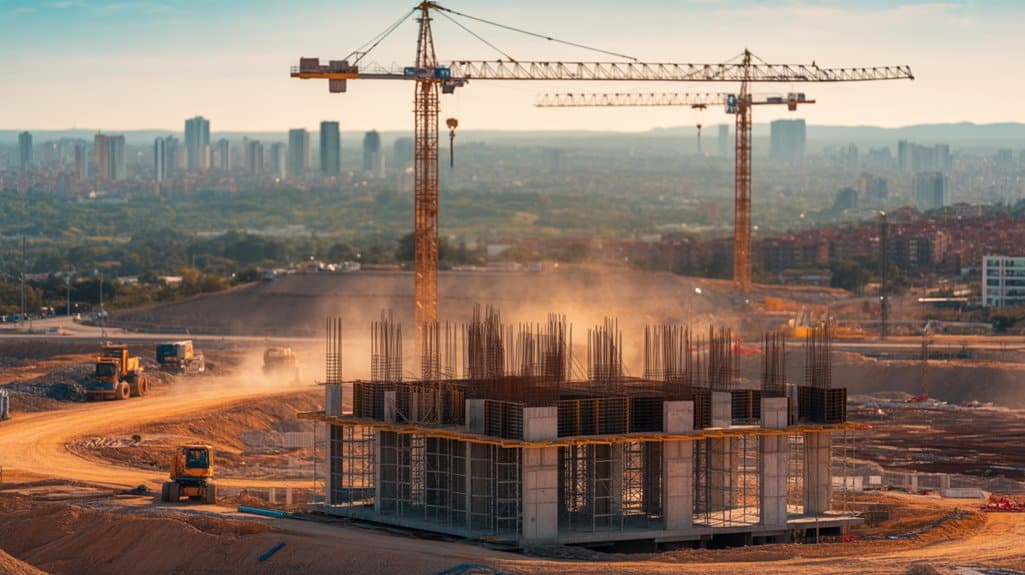
Uruguay’s building industry contracted by 2.5 percent in 2025.
Recovery prospects have strengthened through recent government policies and substantial investment initiatives.
Key infrastructure projects are expected to reshape the country’s development landscape in the coming years.
Key Takeaways
Uruguay’s construction sector contracted during 2024-2025 but is projected to expand by 3.7% in 2026, with consistent annual growth of 3.6% through 2029.
Three megaprojects valued at over $6.8 billion and green-hydrogen investments totaling $18 billion by 2040 will support sector recovery. Renewable energy, water, and transportation infrastructure represent the primary growth drivers for construction activity after 2025.
Regulatory reforms have streamlined permit procedures, introduced tax exemptions, and extended investment timelines. These measures reduce administrative delays and accelerate project implementation. Infrastructure modernization combined with a workforce of 84,000 construction workers strengthens domestic economic activity and supports sustained long-term sector growth.
Uruguay’s Construction Sector Rebounds

After contracting 0.8% in real terms during 2024, Uruguay’s construction industry has resumed growth. The sector expanded 3.7% in 2025, reversing the previous year’s decline and establishing conditions for sustained recovery through 2030. Three megaprojects representing over $6.8 billion in combined investment are transforming the country’s infrastructure landscape. Government initiatives targeting renewable energy and infrastructure modernization ensure ongoing demand for construction services. The government aims to attract UYU746.4 billion ($18 billion) by 2040 for green hydrogen initiatives that will further drive construction activity. This expansion generates direct employment, strengthens domestic consumption, and reinforces Uruguay’s standing as a regional center for architectural and engineering capabilities.
Economic Indicators Show Recovery Signs
Uruguay’s construction sector shows signs of recovery despite mixed macroeconomic conditions. The industry contracted 2.5% in 2025 following a 0.8% decline in 2024, yet forecasters project 3.7% expansion this year with sustained annual growth averaging 3.6% through 2029.
A robust pipeline supports this outlook. Total construction projects reached UYU369.1 billion ($8.9 billion) as of May 2025. Government commitments total USD 500 million for sanitation infrastructure by 2028. Long-term ambitions include a green hydrogen roadmap targeting UYU746.4 billion ($18 billion) in investments by 2040. Renewable energy projects are positioned as critical catalysts for sectoral acceleration.
Infrastructure and housing investments remain primary growth drivers. Water and transportation projects lead development activity, supported by energy sector expansion and tourism-related construction, which grew 1.9% in 2025.
Broader economic constraints temper optimism. The overall economy expanded only 1.8% in 2025, falling short of government and IMF projections. The Energy Ministry is considering downward revisions to 2026 growth forecasts, currently estimated at 2.2%, and evaluating fiscal measures including deferred spending commitments.
Manufacturing demonstrated resilience, expanding 6.2% in 2025 through increased refinery operations and food industry growth. The construction sector’s labor-intensive operations have proven resilient despite these constraints, employing approximately 84,000 workers and representing 5% of GDP and 57% of gross fixed capital formation.
Regulatory Reforms Drive Sector Growth
Several regulatory reforms have reshaped Uruguay’s construction environment in recent years. The government simplified building permit processes and established an online portal for regulatory information access. These improvements reduced administrative delays that previously hindered project timelines.
Tax incentives have been significant growth catalysts. Builders benefit from substantial exemptions on income tax, property transfers, and value-added tax. Extended project timelines provide developers with additional time to complete construction work. Decree No. 23/024, issued in January 2024, extends the investment execution window to 72 months, enabling larger-scale projects to reach completion within the promotional regime framework.
Law 18.795 introduced further incentives for affordable housing development. These regulatory changes generated substantial growth, 185 projects received approval in 2023, the highest number since the law’s implementation. Streamlined regulations expand development opportunities and facilitate increased housing supply.
References
- https://www.businesswire.com/news/home/20250710158603/en/Uruguay-Construction-Industry-Report-2025-Output-to-Expand-by-3.7-this-Year-Following-a-Decline-of-0.8-in-2024—Forecast-to-2029—ResearchAndMarkets.com
- https://www.bbvaresearch.com/wp-content/uploads/2024/06/Editorial_Uruguay_Economic-Outlook_2024.pdf
- https://www.imf.org/-/media/files/publications/cr/2025/english/1uryea2025001-source-pdf.pdf
- https://www.realestate-in-uruguay.com/blog/building-renovating-uruguay-2025-guide/
- https://www.uruguayxxi.gub.uy/en/news/ano-2025/engineering-and-infrastructure/
- https://www.oxfordeconomics.com/resource/construction-key-themes-2025-rebound-in-sight/
- https://www.riotimesonline.com/uruguays-quiet-slowdown-why-a-small-gdp-dip-matters-far-beyond-montevideo/
- https://www.globenewswire.com/news-release/2025/07/04/3110327/28124/en/Uruguay-Construction-Industry-Report-2025-Output-to-Register-an-AAGR-of-3-6-During-2026-2029-Supported-by-Investments-in-Hydrogen-Transport-and-Water-Infrastructure-Projects.html
- https://en.mercopress.com/2026/03/25/uruguay-s-economy-grew-1.8-in-2025-falling-short-of-official-forecasts
- https://www.uruguayxxi.gub.uy/uploads/informacion/05d3bff84e2f9b7cea285209ef8e2ece6094e1fd.pdf