
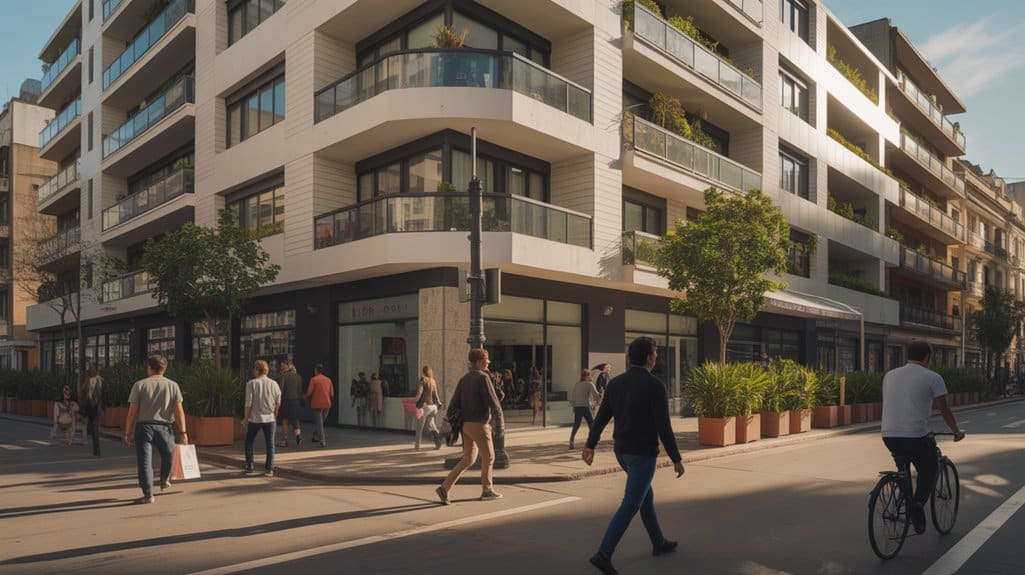
Montevideo’s rental market is heavily concentrated in apartments, particularly in the city center where one-bedroom units rent for 30,000-45,000 UYU.
Rental demand remains strong, with annual increases of approximately five to six percent.
Modern apartments featuring balconies or terraces command premium prices, and short-term rentals experience seasonal peaks.
This combination of consistent demand and higher returns positions apartments as an attractive investment vehicle for generating steady cash flow.
Key Takeaways
- Central districts command 1-bedroom rents of 30,000, 45,000 UYU ($750, $1,130), while peripheral zones range 16,000, 30,000 UYU ($315, $525).
- Short-term rentals generate average monthly revenues of $1,179 in peak months and $1,017 in shoulder seasons, with 67% annual occupancy.
- Net yields across Montevideo range from 2.8, 3.5%, reaching 4, 4.5% in premium neighborhoods like Malvín.
- Dynamic pricing sets peak-season rates around 25,400 UYU ($1,179) per night for 1-2-bedroom units.
- Well-priced long-term units maintain low vacancy rates of 4, 6%, with operating expenses reducing gross yields by 1.5, 2 percentage points.
Montevideo Real-Estate Snapshot: Why It’s Attractive for Investors

Montevideo’s real-estate market demonstrates steady calm and strong investment potential. Market stability creates a predictable environment for property valuations. Economic forecasts indicate modest growth, while inflation-adjusted prices have declined only marginally, sustaining stable values. Foreign buyers from Argentina and Brazil maintain consistent demand. New residential projects introduce modern units featuring balconies and terraces. Tax incentives and an investment-grade rating strengthen the financial landscape. Infrastructure improvements support annual property appreciation targets of 2, 4%. The rental market remains active, with a gross yield of 4.97% for apartments in Montevideo, reflecting steady demand from both locals and tourists.
Neighborhood Rents & Yields Overview (Montevideo Apartment Investment)
Montevideo’s neighborhoods display distinct rental and return patterns across the city. Central districts command higher rents, while peripheral zones offer lower entry costs and modest yields. Rental growth remains consistent at 5, 6 % annually, aligning with inflation rates and providing stable cash flow.
Rental prices by location:
- 1-bedroom central: approximately 30,000, 45,000 UYU (750, 1,130 USD)
- 1-bedroom peripheral: approximately 16,000, 30,000 UYU (315, 525 USD)
- Premium area price per m²: up to 750 UYU
Current mortgage terms:
– Average fixed rate (20 years): 5.72 %
These data points enable investors to identify neighborhoods balancing accessibility, affordability, and return potential across Montevideo’s diverse districts. The city’s overall cost of living is significantly higher than many regional capitals.
Short-Term Rental Occupancy & Seasonality Impact on Cash Flow?
Montevideo’s short-term rental market demonstrates consistent occupancy throughout the year despite the city’s limited status as a beach destination. The market maintains an average annual occupancy rate of 67%, with monthly averages of 61%. This stability reflects demand from business travelers, students, and digital nomads who book continuously across all seasons.
Revenue fluctuates modestly by season. Peak months from December to March generate approximately $1,179 per listing monthly, while shoulder seasons produce $1,017. Shoulder season performance sustains reliable cash flow patterns.
Minimum stay requirements shape booking behavior. Approximately 27.5% of listings enforce stays of 30 nights or longer, providing revenue predictability. Conversely, 61% of units permit stays of 1 to 6 nights, accommodating shorter-term bookings.
The combination of consistent year-round demand, stable monthly revenue, and flexible booking options creates predictable income patterns for property operators. Seasonal variation remains modest, reducing income volatility associated with tourism-dependent markets. 81.2% of active rentals are entire homes or apartments.
Calculate the True Net Yield for a Montevideo Apartment
Short-term rental demand in Montevideo creates a clear path to calculating actual investment returns. The true net yield emerges from subtracting operating expenses from the gross yield percentage. Typical apartments experience expense deductions of 1.5, 2 percentage points due to property taxes, maintenance, and vacancy rates. This produces a net yield range of 2.8, 3.5 percent across the city, with premium neighborhoods such as Malvín achieving 4, 4.5 percent after all costs are factored in.
Calculation steps for a Montevideo apartment
- Determine the gross yield (example: 6 percent in Malvín)
- Identify major expenses: property tax, maintenance costs, management fees
- Deduct 1.5, 2 percentage points for total expenses
- Calculate the resulting net yield to establish the true return on investment
This approach provides a transparent framework for evaluating rental property performance in Montevideo. Vacancy rates in well-priced long-term units are typically 4% to 6%.
Montevideo-Specific Pricing, Marketing & Management Tactics
Montevideo’s rental market demonstrates that pricing, marketing, and management function as integrated components. Dynamic Airbnb pricing enables property owners to target peak-season rates of UYU 25,400 (approximately $1,179) while maintaining occupancy around 57%. Central districts show tenant preference for 1, 2-bedroom units priced between UYU 25,000 and 40,000 (equivalent to $730, $910 for long-term rentals). Effective property management emphasizes short-term rental flexibility, particularly in university areas where student housing maintains consistent occupancy throughout the year. Marketing materials highlight lease-length flexibility and responsive rate adjustments during shoulder seasons (approximately $1,017). Strategic rate management during low-demand periods keeps vacancy minimal. Annual yields vary by neighborhood: La Blanqueada generates approximately 6% returns while Cordón produces 5% returns. This approach generates stable cash flow without requiring complex management systems. Peripheral neighborhoods such as Manga can achieve a gross yield of up to 13%.
References
- https://www.airroi.com/report/world/uruguay/montevideo/montevideo
- https://thelatinvestor.com/blogs/news/montevideo-rental-yields-apartment
- https://thelatinvestor.com/blogs/news/uruguay-buy-rent-out
- https://www.jarniascyril.com/international-real-estate/invest-in-real-estate-uruguay-market-guide/uruguay-real-estate-market-trends/
- https://airbtics.com/best-airbnb-markets-uruguay
- https://www.youtube.com/watch?v=RDhVgKcOsMI
- https://www.numbeo.com/cost-of-living/in/Montevideo
- https://www.globalpropertyguide.com/latin-america/uruguay/rent-yields
- https://www.realestate-in-uruguay.com/blog/latest-real-estate-developments-in-uruguay-for-2026/
- https://valoraconsultora.com/en/reflections-on-the-real-estate-sector-in-uruguay/