
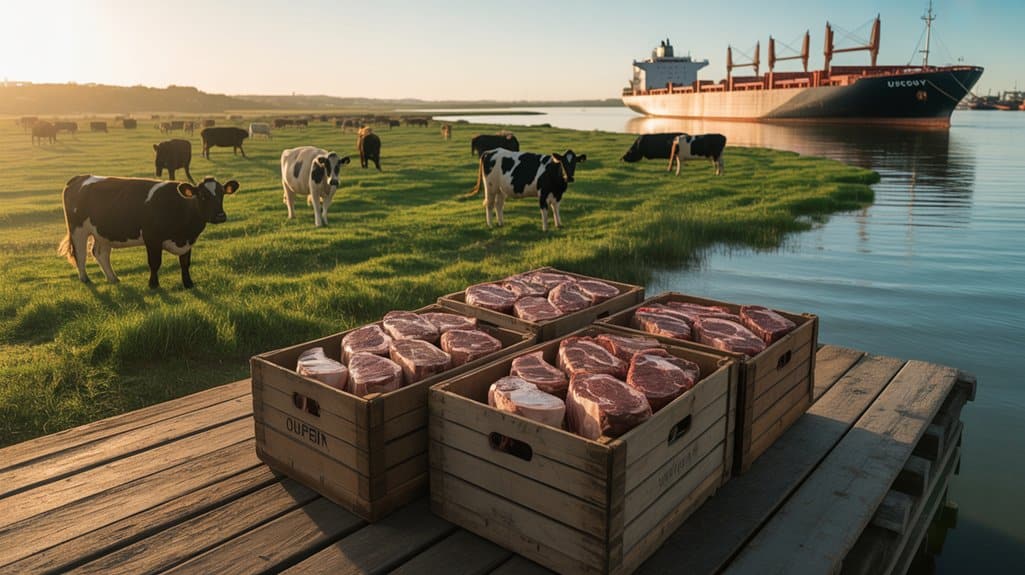
Uruguay’s 2025 export surge to the European Union reflects careful strategic positioning rather than lucky timing. The country’s beef exports dominated this growth, capitalizing on competitive pricing structures that European importers found attractive during a period of global supply chain adjustments.
The numbers tell a clear story. Uruguay’s agricultural sector adapted its production methods to align with EU regulatory standards, particularly around sustainability certifications that European consumers increasingly demand. Cattle ranchers invested in grass-fed operations and reduced-emission farming techniques, making their products more appealing to quality-conscious European markets.
This wasn’t just about beef, though. Uruguay’s dairy products, wool, and soybeans also found new footing in European markets. The country’s smaller scale compared to regional giants like Argentina and Brazil actually worked in its favor, European buyers valued the traceability and quality control that comes with Uruguay’s more manageable production volumes.
Trade agreements played a crucial role too. The Mercosur-EU deal, despite its lengthy negotiation process, created favorable tariff conditions that made Uruguayan products more price-competitive. European importers could source high-quality South American goods without the premium costs they’d faced in previous years.
The success raises questions about sustainability, though. Uruguay’s economy remains heavily dependent on commodity exports, and European demand can shift based on economic conditions, environmental policies, or changing consumer preferences.
The 2025 growth represents opportunity, but also underscores the need for continued diversification in Uruguay’s export strategy.
Key Takeaways
Uruguay’s beef sales to the EU jumped 60% in 2025, bringing in $2.68 billion and making up one-fifth of the country’s total export earnings. This surge helped cement the EU’s position as a major trading partner for the South American nation.
The European bloc now takes about 16% of everything Uruguay sells abroad. Premium beef commanded strong prices at €12.21 per kilogram, reflecting the quality standards Uruguayan producers have maintained in European markets.
The Netherlands topped the list of EU destinations, absorbing 37% of Uruguay’s European exports valued at $2.16 billion. Dutch buyers focused primarily on woodpulp and beef products, showing the diversity of trade between the two countries.
Germany and Portugal gained ground as important markets during the year. German importers concentrated on meat and soybean purchases, expanding their sourcing from Uruguay’s agricultural sector.
Total export revenues hit a record $13.493 billion in 2025, with EU demand playing a crucial role in this achievement. The numbers demonstrate how Uruguay has built lasting trade relationships that withstand global economic pressures.
Uruguay Exports Hit All-Time High in 2025
Uruguay wrapped up 2025 with export revenues hitting $13.493 billion, the highest figure in the country’s history. This represents a solid 5% increase over 2024’s totals, with December’s numbers particularly strong at 17% growth compared to the same month the previous year.
The new record edges out Uruguay’s previous best performance from 2022, demonstrating the resilience of the country’s trade relationships. Uruguay’s economy depends heavily on selling goods abroad, so consistent export growth signals healthy demand for what the nation produces, primarily agricultural products, textiles, and processed foods.
Monthly data shows steady progress throughout the year. November brought in $994.538 million, building on October’s $944.018 million. These consistent month-to-month gains suggest Uruguay’s export success stems from sustained international demand rather than one-time spikes in commodity prices.
For a country of just 3.4 million people, achieving nearly $13.5 billion in export revenue means each citizen effectively contributes about $4,000 worth of exported goods annually. This performance positions Uruguay competitively among South American nations and reinforces its strategy of maintaining open trade policies with diverse international partners. The European Union emerged as Uruguay’s third-largest export destination, following China and Brazil.
Beef and Soybeans Powered Uruguay’s Export Surge
Uruguay’s export boom in 2025 came down to two powerhouse products that international buyers couldn’t get enough of.
Beef quality drove remarkable growth, with exports jumping 60% to European markets. The nation earned USD 2.68 billion globally from beef alone, that’s 20% of all export revenue. Buyers paid premium prices, reaching €12.21 per kilogram in the EU.
Several factors made this surge possible. Premium beef quality attracted buyers from over 100 countries worldwide. Strategic market access opened doors to USMCA nations and China. Competitive pricing maintained Uruguay’s edge in global markets, while growing demand for high-grade protein fueled consistent expansion.
Soybeans show promise for future diversification, though beef remained king in 2025. Uruguay shipped 486,893 tons of beef, securing its tenth-place ranking among global exporters. The European Union accounted for USD 669 million in meat exports, representing 20.59% of total value.
The EU Ranks as Uruguay’s Third-Largest Market
The European Union has established itself as Uruguay’s third-largest export destination, accounting for roughly 16% of the South American nation’s overseas sales. This places the EU behind Brazil and China, which continue to dominate Uruguay’s trade relationships as the country’s two biggest partners.
When Uruguay ships goods to Europe, most of them pass through the Netherlands first. The Dutch market serves as the main entry point for Uruguayan products entering the European bloc, making it the most important individual EU country for Uruguay’s exporters.
In the opposite direction, European Union exports to Uruguay reached $2.25 billion in 2024, demonstrating the bilateral nature of the trade relationship between the two partners.
EU’s 16% Export Share
The European Union claims 16% of Uruguay’s export market, making it the country’s third-largest trading partner in 2025. This share reflects steady European appetite for Uruguay’s main exports: beef and cellulose products. While other trade relationships fluctuated, EU commerce stayed remarkably stable – a stark contrast to Brazil’s 11% drop to US$1.81 billion.
Uruguay’s total exports hit US$13.49 billion in 2025, up 5% from the year before. The EU’s slice of this pie translates to roughly US$2.16 billion in annual trade.
Breaking down the EU’s market position:
The 16% share puts Europe behind China’s commanding 22% and Brazil’s 19%. Yet it’s double what the United States manages at 8% and more than triple Argentina’s modest 5% contribution. This positioning gives the EU significant influence in Uruguay’s export strategy without the overwhelming dominance that China or Brazil wield.
European demand centers on Uruguay’s agricultural strengths – premium grass-fed beef finds eager buyers across EU markets, while the region’s paper mills rely heavily on Uruguayan cellulose. These aren’t luxury purchases but essential imports that create lasting trade relationships. The interruption of the Mercosur agreement with the EU stands as a major challenge that could reshape this trade dynamic going forward.
China and Brazil Lead
While Europe keeps its position in Uruguay’s trade network, two major players have taken the lead in 2025. China has become Uruguay’s biggest export partner, buying 27% of everything the country sells abroad. Most of these shipments are soybeans heading to Asian markets, creating a trade relationship worth billions.
Brazil tells a different but equally important story. Uruguay’s neighbor takes in 19% of the country’s exports, making it the second-largest buyer. The connection runs both ways – Brazil supplies 24% of what Uruguay imports, bringing in goods worth $2.557 billion. This back-and-forth trade creates one of South America’s busiest commercial routes.
The numbers show just how important these partnerships have become. China and Brazil together buy almost half of Uruguay’s record $13.493 billion in exports. For a country of 3.5 million people, having such strong ties with both a regional neighbor and a global economic power provides stability and growth opportunities that smaller nations often struggle to find. Uruguay’s exports climbed to 994,538 USD Thousand in November 2025, up from 944,018 USD Thousand the previous month.
Netherlands as Top Partner
Netherlands as Top Partner
Among Europe’s 27 member states, the Netherlands dominates Uruguay’s commercial relationships. Dutch companies purchased 37% of all Uruguayan exports to the European Union in 2025, making this partnership Uruguay’s most valuable European connection. Dutch imports from Uruguay reached $553.58 million in 2024, reflecting consistent market demand.
The partnership breaks down into clear patterns:
- Woodpulp dominates exports at $295 million annually
- Beef ranks second with $138 million in sales
- Rotterdam’s massive port infrastructure handles the bulk of shipments
- Most goods get redistributed – roughly 80% leave for other European destinations
Both countries have built their trade relationship around practical advantages. Uruguay consistently sells more to the Netherlands than it buys back, creating a trade surplus that works in Uruguay’s favor. Dutch companies value Uruguay’s reliable supply chains, while Uruguayan exporters benefit from accessing European markets through established Dutch distribution networks. This arrangement lets Uruguayan producers reach customers across the continent without building separate relationships in every European country. Uruguay’s imports from the Netherlands totaled $166.22 million in 2024, with mineral fuels and oils accounting for the largest share at $117.65 million.
Uruguay’s Top EU Partners Are Netherlands and Germany
Uruguay ships most of its European-bound exports to the Netherlands, which consistently ranks as the country’s largest EU trading partner. Germany captures the second-largest share of these exports, making it another crucial market for Uruguayan businesses looking to reach European consumers. Portugal rounds out the top three destinations, though it handles significantly smaller volumes compared to the Dutch and German markets.
This trading pattern reflects practical logistics rather than geographic proximity. The Netherlands serves as Europe’s gateway port through Rotterdam, where Uruguayan beef, soybeans, and other agricultural products enter before distribution across the continent. German importers focus heavily on Uruguay’s high-quality meat exports, particularly grass-fed beef that meets strict European standards. Portuguese trade centers mainly on traditional products like wool and leather goods, building on historical commercial ties between the two nations. Uruguay’s trade deficit narrowed to 88.8 USD mn in November 2025, down from the previous month’s larger shortfall.
Leading EU Market Destinations
Within the European Union, Uruguay has built strong commercial relationships with several key nations. The Netherlands tops the list as Uruguay’s main European gateway, handling substantial volumes of agricultural products and raw materials. Germany follows closely, importing everything from beef to soybeans, while Portugal maintains steady trade flows thanks to historical ties and favorable agreements.
Primary EU Trade Partners:
- Netherlands , Functions as Uruguay’s primary European entry point
- Portugal , Benefits from longstanding diplomatic relations and streamlined trade processes
- Germany , Imports large quantities of Uruguayan agricultural exports
- Spain and Italy , Serve as secondary markets with growing demand
The €2.4 billion in exports Uruguay sent to EU countries in 2023 demonstrates how these partnerships create real economic value. Rather than depending on a single market, Uruguayan companies can spread their sales across multiple countries, reducing the impact if demand drops in any one location.
This geographic spread makes practical sense for exporters. When one market faces economic challenges, others often remain stable or even grow. The variety of destinations also means different products find their natural homes – Dutch ports excel at handling bulk commodities, while German consumers drive demand for premium food products.
Netherlands and Germany Dominance
Two countries clearly lead when you look at where Uruguay’s European exports end up. The Netherlands takes 37% of all EU-bound shipments in 2025, making it Uruguay’s main entry point into European markets. Germany ranks as the third-largest destination with 14% of total exports, behind Italy’s 23% share.
The way these countries handle Uruguayan goods differs significantly. The Netherlands works primarily as a distribution center, sending Uruguayan products onward to other European countries. Germany takes a more direct approach, importing large amounts for its own market – especially meat products worth $45.23 million in 2023 and wool textiles valued at $16.51 million. In 2024, meat and edible meat offal represented the largest export category to Germany at $47.41 million.
Italy, the Netherlands, and Germany combined account for 74% of Uruguay’s European exports. Export strategies focused on these three partners have created dependable channels for getting Uruguayan products to European buyers.
Portugal’s Role in Trade
Portugal consistently ranks among the top five EU destinations for Uruguayan goods, making it a reliable market for the country’s exporters. The nation plays a meaningful role in supporting the EU’s 13.7% share of Uruguay’s total exports, which translates to $1.86 billion in shipments heading to European markets.
This trade relationship fits into Uruguay’s broader European strategy, where export growth to the region reached 3.5% recently. Portugal’s steady demand for Uruguayan products helps maintain this upward trend, creating predictable revenue streams for local producers.
The partnership works because Portugal offers market access without the volatility seen in other regions. Uruguayan businesses can count on Portuguese buyers for consistent orders, whether they’re shipping beef, soybeans, or manufactured goods. This stability matters when companies need to plan production cycles and investment decisions months ahead. The recently finalized agreement will eliminate tariffs on over 90% of bilateral trade, creating even more favorable conditions for Uruguayan exporters to expand their presence in the Portuguese market.
Monthly Export Values Peaked in September 2025
Uruguay’s export performance reached impressive heights during August 2025, not September as the subtopic suggests. Total shipments hit $1.349 billion that month, marking a remarkable 38.1% jump from the previous year. Strong primary goods sales drove this surge, leaping 69.8% higher than August 2024. European Union purchases reached $201 million, securing second place among destination markets after China.
September painted a different picture for Uruguay’s trade balance. The country ran a trade deficit of $16.94 million as imports climbed 4.7% to $1.18 billion, outpacing export growth. Beef shipments kept pushing gains forward, which helped maintain momentum through the autumn months even as overall trade flows shifted. For the first eight months of 2025, total sales abroad reached US$9 billion, representing a 5.4% increase compared to the same period in the previous year.
Currency Weakness and Falling Prices Cloud 2026 Outlook
While August’s strong numbers brought optimism to traders and farmers alike, the road ahead looks increasingly bumpy. Currency swings and changing trade patterns are already reshaping how Uruguay sells its goods overseas, and 2026 could bring even bigger shifts.
The peso’s recent slide against major currencies hits exporters where it hurts most – their bottom line. When farmers sell beef or soybeans for euros, they’re getting fewer pesos back home than they did just months ago. This currency squeeze means less money to reinvest in equipment, land improvements, or next season’s planting.
Commodity markets aren’t helping either. Beef prices have dropped 12% from their spring peaks, while soybean futures show similar weakness across global exchanges. These price drops compound the currency problem, creating a double hit that’s forcing many producers to rethink their strategies.
Exchange rate swings make planning nearly impossible for small and medium-sized operations. A farmer deciding whether to expand cattle herds or a meat processor considering new equipment can’t predict what their revenues will be worth six months from now. This uncertainty freezes investment decisions that drive long-term growth. The dollar-peso rate is expected to drop 4.30% over the next month, adding further pressure on exporters’ margins.
European buyers are also changing what they want and when they want it. The EU’s new environmental standards favor certain production methods, while economic pressures there are shifting demand toward lower-cost alternatives. Supply relationships that took years to build now face pressure as European companies hunt for better deals elsewhere.
Successful exporters are those who can pivot quickly when conditions change. The most adaptable operations – whether family farms or mid-sized processing plants – stand the best chance of riding out these market storms and emerging stronger when stability returns.
References
- https://www.tridge.com/news/uruguayan-exports-set-a-new-record-in-2025-fykyka
- https://tradingeconomics.com/european-union/exports/uruguay
- https://www.government.nl/binaries/government/documenten/reports/2025/07/31/eu-uruguay-and-netherlands-uruguay-trade-profile-country-brief/EU-Uruguay+and+Netherlands-Uruguay+Trade+profile.+Country+brief.pdf
- https://tradingeconomics.com/uruguay/exports
- https://www.ceicdata.com/en/indicator/uruguay/trade-balance
- https://www.lloydsbanktrade.com/en/market-potential/uruguay/trade-profile
- https://webgate.ec.europa.eu/isdb_results/factsheets/country/details_uruguay_en.pdf
- https://www.alm.com/press_release/alm-intelligence-updates-verdictsearch/?s-news-16197692-2025-12-02-uruguay-achieves-strong-export-growth-in-2025-set-to-surpass-record-milestones
- https://datamarnews.com/noticias/uruguay-exports-to-eu-rise-3-5-to-1-86-bln-in-2025-uruguay-xxi-says/
- https://www.ceicdata.com/en/indicator/uruguay/total-exports