
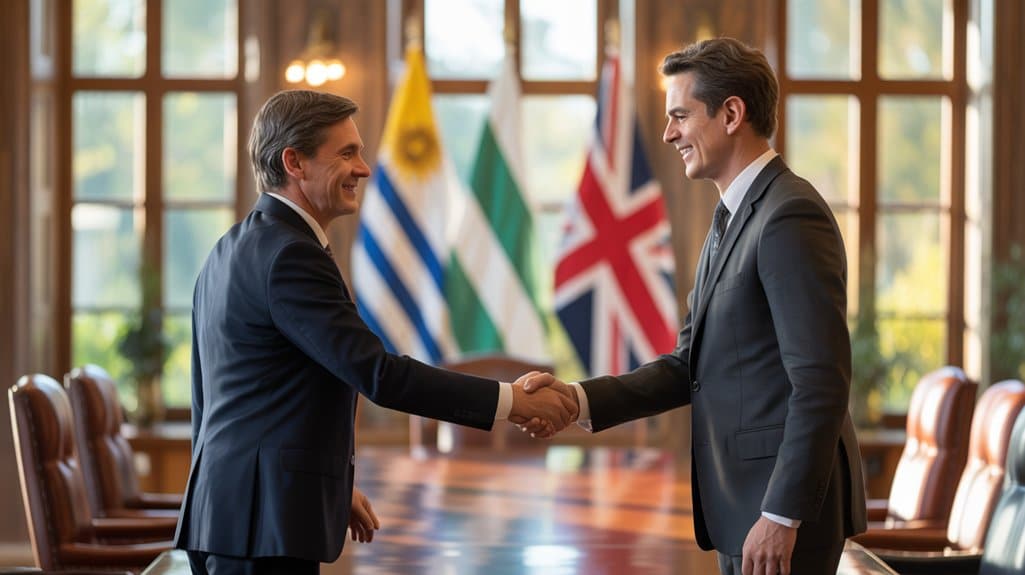
Uruguay’s Economy Minister Gabriel Oddone recently completed a strategic visit to the United Kingdom, accompanied by a delegation of 21 Uruguayan companies seeking to establish new business partnerships. The trip focused on identifying investment opportunities and strengthening commercial relationships between the two countries.
This diplomatic mission builds on centuries-old ties between Britain and Uruguay, dating back to Uruguay’s independence in the 1820s when British investment helped develop the country’s early infrastructure. The current initiative targets three specific sectors where both nations can benefit from collaboration.
Green energy represents a natural area for partnership. Uruguay generates nearly 95% of its electricity from renewable sources, primarily wind and hydroelectric power, making it one of the world’s cleanest energy producers. British companies possess advanced offshore wind technology that could help Uruguay expand its renewable capacity along its 400-mile Atlantic coastline.
Agriculture offers another promising avenue for cooperation. Uruguay exports high-quality beef, dairy products, and soybeans, while Britain imports significant quantities of agricultural goods following Brexit trade adjustments. The country’s grass-fed cattle industry and sustainable farming practices align with growing British consumer demand for responsibly produced food.
Financial services create a third pillar for expanded ties. Uruguay serves as a regional banking hub for Latin America, with a stable currency and business-friendly regulations. British financial institutions could use Uruguay as a gateway to South American markets, while Uruguayan banks might benefit from London’s expertise in international finance.
The delegation’s composition reflects these priorities, including representatives from renewable energy firms, agricultural exporters, and financial service providers. Their goal involves moving beyond traditional trade relationships toward joint ventures and technology transfers that create value for both economies.
Key Takeaways
Gabriel Oddone’s recent trip to the UK centers on strengthening economic ties between the two countries. His discussions covered economic policy, financial challenges, and opportunities in agriculture, renewable energy, and financial services.
Twenty-one Uruguayan companies joined the minister on this mission. These businesses are actively seeking investment partnerships that deliver clear economic returns while allowing government oversight of progress.
Trade talks that began in December 2022 continue moving forward. These negotiations could unlock £409 million in fresh trade opportunities and deepen economic cooperation between both nations.
British investors are particularly drawn to Uruguay’s environmental sector. Green hydrogen projects, wind farms, solar installations, and electric vehicle infrastructure top their priority list. UK Export Finance provides backing for these investments, making deals more attractive for British companies.
The numbers tell a positive story. UK-Uruguay trade hit £698 million by the third quarter of 2025. British investment is expected to reach £217 million, marking a 24.7% jump from previous levels.
How Britain Shaped Uruguay’s Economy in the 19th Century
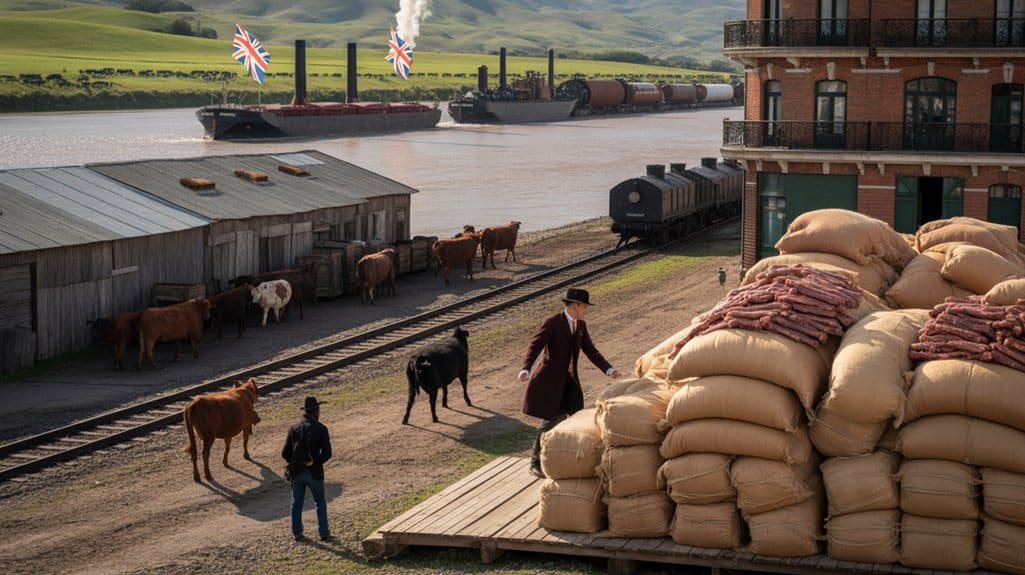
The livestock industry underwent a complete transformation as ranchers pivoted to meet British demand. Cattle and sheep breeding became laser-focused on producing animals that would appeal to British consumers, with specific breeds imported to improve meat quality and wool production.
Free trade agreements opened Uruguay’s borders to manufactured goods from Britain while simultaneously creating dedicated export channels for raw materials flowing in the opposite direction. British textiles, tools, and machinery entered Uruguayan markets with minimal tariffs, while Montevideo’s ports became staging grounds for massive shipments of wool, hides, and eventually processed meat bound for Liverpool and London.
This exchange created an economic relationship that went far beyond simple trade. British capital financed ranch expansions, British shipping companies controlled cargo routes, and British banks facilitated the credit systems that kept the cycle moving. British companies owned and operated the railway system by the eve of World War I, further cementing their control over Uruguay’s economic infrastructure. The arrangement locked Uruguay into a pattern where it supplied raw materials and imported finished products, a dynamic that influenced everything from land ownership patterns to urban development for decades to come.
Gabriel Oddone’s Visit Strengthens UK-Uruguay Ties
Gabriel Oddone’s February 2026 visit brought him to the London School of Economics, where he joined Andrés Velasco, Dean of the LSE School of Public Policy, for a detailed examination of economic policy and financial challenges facing Uruguay and neighboring countries. Their conversation covered practical issues like inflation management, export strategies, and regional trade dynamics that directly impact Uruguay’s small but resilient economy.
The visit expanded beyond academic circles when Oddone attended a breakfast meeting at Canning House with British business leaders. This gathering focused on identifying concrete trade and investment prospects, particularly in sectors where Uruguay has established expertise like agriculture, renewable energy, and financial services. The discussions aimed to build on existing commercial relationships while exploring new partnerships that could benefit both countries’ economies. Uruguay 21 planned to follow up with the business delegation to assess results from the meetings and track potential investments across different sectors.
LSE Event With Velasco
On Wednesday evening, February 11, 2026, Gabriel Oddone will join Andrés Velasco for a public conversation at the London School of Economics. Velasco, who serves as Dean of the LSE School of Public Policy, brings substantial credentials to this exchange, he ran Chile’s treasury during the 2008 global financial crisis and helped steer the country through turbulent economic waters.
The event runs from 6:30 PM to 8:00 PM and welcomes both in-person attendees and online participants. Their conversation will examine what drives economic expansion across Latin America, covering how governments implement policy changes, secure foreign investment, and build essential infrastructure like ports, roads, and energy systems.
Trade deals between countries will take center stage in their discussion. These agreements matter because they determine whether Uruguay’s beef reaches new markets or if Brazilian manufacturers can sell products more easily across borders. The two economists will explore how smaller nations like Uruguay balance their national budgets while investing in long-term projects that create jobs and improve living standards.
Both speakers understand the day-to-day realities of running a country’s finances. Oddone has navigated Uruguay’s economy through periods when commodity prices fluctuated wildly, while Velasco managed Chile’s response when global credit markets froze during the financial crisis. Their combined experience offers practical insights into how Latin American governments make tough choices about spending, taxation, and debt management. Velasco also served on the Global Oceans Commission from 2013 to 2016, bringing environmental and resource management perspectives to economic policy discussions.
Building Commercial Partnership Prospects
Gabriel Oddone’s February 2026 trip to Britain packed serious business intentions alongside the usual diplomatic ceremonies. Twenty-one Uruguayan companies joined the minister’s delegation, each hunting for concrete investment prospects rather than empty promises.
While Oddone handled state-level discussions, these enterprises conducted their own targeted meetings with British counterparts. They weren’t there for networking small talk, every conversation aimed at identifying partnerships that could generate measurable economic benefits for both countries.
Uruguay’s government intends to monitor the outcomes closely, tracking which preliminary discussions actually evolve into signed agreements. This follow-up approach distinguishes the initiative from typical trade missions that produce impressive press releases but limited tangible results.
The commercial focus aligns with Oddone’s strategic approach to Uruguay’s economic development. His previous advisory work with institutions including the World Bank gives him practical insight into identifying viable international partnerships. Oddone’s participation in high-level panel discussions at international forums, including those hosted by the IMF and OECD, has positioned him among Latin America’s influential economic voices. The British engagement represents part of his broader effort to diversify Uruguay’s trade relationships and attract foreign investment that can create jobs and boost exports.
Why the EU-Mercosur Deal Affects UK-Uruguay Trade
Britain’s departure from the European Union left the country rebuilding trade relationships that were once part of a larger bloc. The EU-Mercosur agreement, which takes effect in March 2026, grants European businesses preferential access to Uruguay’s markets alongside Argentina, Brazil, and Paraguay. British companies now face the prospect of competing against European firms that enjoy reduced tariffs and streamlined customs procedures.
Uruguay represents a strategic gateway for UK businesses eyeing South American markets. The country’s stable democratic institutions and business-friendly environment make it an attractive partner, particularly as Britain seeks to diversify its trade portfolio beyond traditional European markets. British officials recognize that waiting means watching European competitors secure long-term advantages in sectors where UK companies currently compete on equal terms.
The timing creates urgency for bilateral negotiations. European manufacturers will soon benefit from tariff reductions that could price British goods out of key Uruguayan sectors, including machinery, chemicals, and automotive parts. The agreement is projected to save EU firms over €4 billion annually in customs duties, creating a significant cost advantage over British exporters. Direct trade talks between London and Montevideo offer the most practical path to maintaining British commercial interests in the region before these competitive disadvantages become entrenched.
Post-Brexit Trade Strategy Shifts
Europe and South America’s new trade partnership leaves the United Kingdom watching from the sidelines. Brexit fundamentally altered Britain’s global commercial relationships. The nation previously enjoyed automatic market access through EU agreements but must now forge independent paths through bilateral negotiations with countries including Uruguay.
British businesses are starting from square one. Farmers face fresh competition as Mercosur countries, Argentina, Brazil, Paraguay, and Uruguay, secure preferential access to European markets that UK producers have lost. Manufacturing companies need separate agreements to match the benefits their European competitors receive automatically. Car manufacturers and clothing producers feel this squeeze most acutely, as they compete against imports entering Europe with reduced tariffs.
Britain’s new trade approach centers on building direct relationships across South America. Each bilateral agreement requires months of negotiations, significant diplomatic resources, and detailed economic planning. Uruguay’s recent ministerial visit to London exemplifies this strategy, creating partnerships outside the EU structure that Britain can no longer access. These one-on-one negotiations take longer than the broad multilateral deals the EU negotiates, but they allow Britain to tailor agreements to its specific economic needs. The EU-Mercosur agreement includes binding commitments to combat illegal logging and deforestation, setting environmental standards that shape modern trade partnerships.
Mercosur Agreement Competitive Pressures
The European Union’s trade agreement with Mercosur countries creates significant challenges for British businesses. This deal establishes a free trade zone covering over 800 million people across Europe and South America’s four founding Mercosur nations: Argentina, Brazil, Paraguay, and Uruguay.
British companies selling goods to Uruguay and its regional partners now face intensified competition from EU firms. The agreement removes or reduces tariffs on thousands of products traded between these blocs, fundamentally altering the competitive landscape.
The tariff disparities hit British exporters in three key areas. EU businesses benefit from reduced duties when selling to Mercosur markets, while UK firms continue paying standard rates. This pricing gap can make British products less competitive, particularly in price-sensitive sectors.
European companies also secure enhanced market access to South America’s substantial consumer base. Uruguay alone, despite its small population of 3.5 million, serves as a gateway to the broader regional market due to its strategic location and trade infrastructure.
Supply chains are shifting as EU buyers can now source directly from Mercosur producers at more favorable terms. British intermediaries who previously facilitated these trade relationships may find themselves bypassed entirely.
Agricultural and manufacturing sectors face the steepest challenges. Uruguay excels in beef, soybeans, and rice production – commodities where even small price differences determine market success. British firms competing in these areas must either absorb higher costs or risk losing market share to EU competitors who benefit from preferential tariff treatment under the new agreement. The deal eliminates tariffs for 93% of Mercosur exports to the EU and 91% for EU exports to Mercosur.
Bilateral Opportunities Beyond Blocs
Britain’s got a real chance here while the European Union wraps up its huge trade deal with Mercosur countries. The UK can now cut its own deals with Uruguay and other South American nations without having to check with Brussels first.
Uruguay’s economy is compact, around 3.5 million people compared to the EU’s 450 million, which makes it a perfect testing ground for direct trade talks. When you’re dealing with fewer moving parts, negotiations tend to move faster. British companies offering financial services, technology, or consulting could find eager customers among Uruguay’s growing businesses, while the UK market has always been hungry for quality beef, soybeans, and wool that Uruguay produces exceptionally well.
The timing works in both countries’ favor. The EU-Mercosur agreement covers a market of 700 million consumers, but that size brings complexity. Companies have to navigate different regulations across dozens of countries. A UK-Uruguay partnership can skip all that red tape and focus on what each side actually wants to trade. Unlike the EU deal, which requires approval from all 27 Member States for its political cooperation components, bilateral agreements can move through simpler ratification processes.
Uruguay already ships about $200 million worth of goods to Britain annually, mostly agricultural products. The country’s beef industry meets some of the world’s highest standards, 95% of cattle graze on natural grasslands without industrial feedlots. British consumers pay premium prices for that quality, and removing trade barriers could benefit both the farmers in Montevideo’s countryside and families shopping in London.
The math is straightforward: smaller agreements mean clearer rules, faster approvals, and businesses that can actually plan around the terms they’re getting.
UK Investors Target Uruguay’s Green Economy
Uruguay’s Economy Minister recently presented opportunities that caught British businesses’ attention, particularly in renewable energy. The country generates 90% of its electricity from renewable sources, placing it sixth worldwide, a track record that speaks for itself.
British firms recognize the potential for energy partnerships that could transform how both nations approach sustainability. The numbers tell a compelling story about where collaboration makes the most sense.
Three sectors stand out for UK investment:
Green hydrogen production represents the biggest opportunity. HIF Global’s US$4 billion investment demonstrates the serious money flowing into this space. The project shows how Uruguay’s abundant wind and solar resources can produce clean hydrogen for export markets.
Wind and solar infrastructure offers proven returns. Uruguay operates 43 wind farms that consistently deliver power to the grid. These installations prove the technology works reliably in local conditions, reducing risk for new investors.
Electric mobility networks create immediate partnership possibilities. The government plans to deploy over 1,000 electric buses across the country. British companies with expertise in charging infrastructure and fleet management can tap into this expanding market.
Uruguay produces more clean electricity than it uses, creating genuine export opportunities. The country maintains an investment-grade credit rating, making project financing more straightforward than in many emerging markets. British companies find regulatory approval processes relatively smooth compared to other Latin American countries. UK Export Finance provides credit insurance for UK exports to Uruguay, facilitating British businesses entering the region.
This collaboration allows both nations to accelerate their carbon reduction targets while creating employment and strengthening economic relationships across continents. The foundation exists for partnerships that deliver measurable results rather than just ambitious promises.
Post-Brexit UK Prioritizes Uruguay for Trade Growth
Brexit forced Britain to scout for fresh trading partners across the globe. Uruguay caught London’s attention as a promising candidate for deeper economic ties, letting the UK chart its own course without Brussels calling the shots.
British trade officials want barrier-free entry into South American markets. The two countries currently exchange £409 million worth of goods each year. Uruguay slaps tariffs of up to 35% on British imports through its Mercosur membership, though most UK products get hit with a 10% levy.
Scrapping these trade barriers would open doors for British companies. Drinks makers, car manufacturers, and tech companies would see the biggest wins. More than 70 British firms have already set up shop in Uruguay, including pharmaceutical giant GSK and spirits maker Diageo.
Britain wrapped up its Australia trade pact in record time, proving it can strike deals fast when it wants to. London’s trade strategy now centers on building relationships with countries that back free markets and shared economic growth. The UK is currently in preliminary discussions with Mercosur, the South American trade bloc that includes Uruguay along with Argentina, Brazil, and Paraguay.
The numbers tell the story – removing Uruguay’s import duties would slash costs for British exporters trying to break into South America’s smaller but stable markets. Unlike some of its neighbors, Uruguay maintains steady democratic institutions and business-friendly policies that appeal to UK investors looking for reliable partners in the region.
UK-Uruguay Security Partnership Grows Stronger
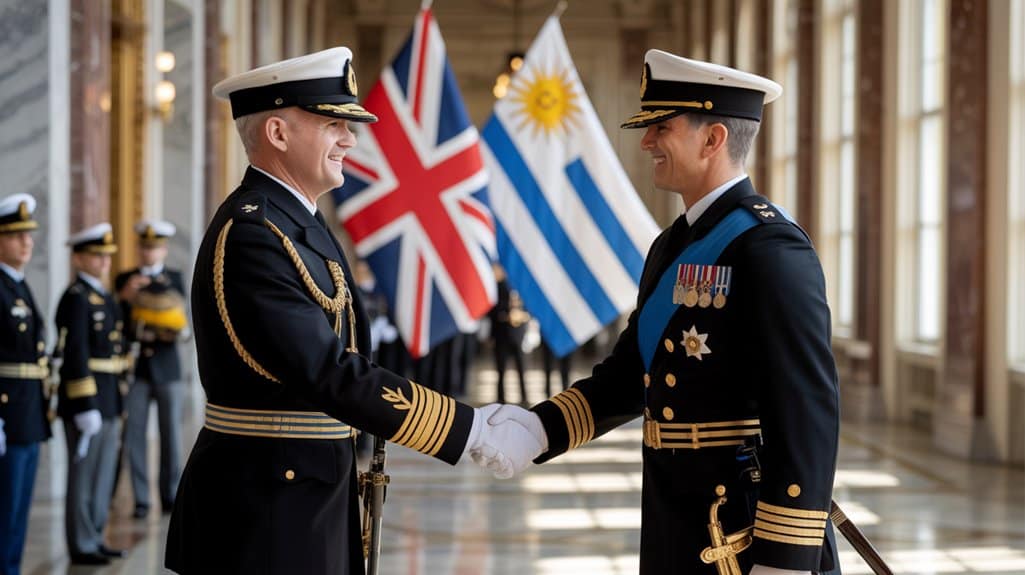
When Prime Minister Boris Johnson met President Luis Lacalle Pou in May 2022, their handshake marked the beginning of deeper defense ties between Britain and Uruguay. The meeting established formal cooperation that goes beyond diplomatic courtesy.
The partnership centers on three main areas of collaboration. British military experts now provide training to help Uruguay’s armed forces prepare for international peacekeeping deployments. Both countries exchange security intelligence that helps protect their citizens from shared threats. Uruguay also provides port access for British Antarctic research vessels, supporting scientific missions in the Southern Ocean.
Uruguay contributes more peacekeeping troops per capita to UN missions than almost any other country. The nation has deployed forces to Haiti, the Democratic Republic of Congo, and other conflict zones since the 1990s. Britain’s training support helps these troops operate more effectively in challenging environments. The UK continues to invest in educational opportunities for Uruguayan Armed Forces personnel.
High-level exchanges have strengthened the relationship beyond the initial agreement. Intelligence Coordinator Álvaro Garcé visited London for security discussions with British counterparts. Defence Minister Luis Rosadilla met with UK officials to explore ways to modernize Uruguay’s military capabilities using British expertise.
This cooperation benefits both nations practically. Uruguay gains access to advanced training methods and intelligence networks that enhance its peacekeeping effectiveness. Britain secures a reliable partner in South America and logistical support for its Antarctic operations through Montevideo’s strategic port location.
Pending Trade Agreements and 2024 Investment Targets
Economic partnerships build the foundation for Britain and Uruguay’s day-to-day relationship, extending far beyond diplomatic handshakes. Two major trade deals are making their way through negotiations right now. Britain and Uruguay launched bilateral talks in December 2022, working toward unlocking £409 million worth of new trade opportunities. At the same time, Britain reopened discussions with Mercosur, the South American trade bloc that includes Uruguay, in November 2025, with £15,175 million in potential business on the table.
British investment money flowing into Uruguay tells a story of growing confidence. By the end of 2024, UK capital in the country hit £217 million, marking a solid 24.7% increase from the year before.
| Trade Metric | Value |
|---|---|
| Total UK-Uruguay Trade (Q3 2025) | £698 million |
| UK Exports 2024 | £410 million |
| Trade Surplus | £268 million |
| UK FDI Stock | £217 million |
| UK Companies in Uruguay | 70+ |
More than 700 British companies now ship their products to Uruguay, creating economic connections that strengthen with each shipment crossing the Atlantic. Uruguay presented opportunities in clean renewable energy sectors, aligning with both countries’ focus on sustainable development.
References
- https://www.bgipu.org/activity-reports/uk-delegation-to-uruguay/
- https://en.mercopress.com/2022/04/29/uruguayan-president-was-invited-by-boris-johnson-and-will-travel-to-the-uk
- https://en.wikipedia.org/wiki/United_Kingdom, Uruguay_relations
- https://www.canninghouse.org/news/investors-look-to-uruguay-for-green-opportunities
- https://www.gov.uk/world/uruguay/news
- https://www.lse.ac.uk/school-of-public-policy/events/2025-26/in-conversation-with-gabriel-oddone-minister-of-economy-and-finance-of-uruguay
- https://en.mercopress.com/2025/06/02/uruguay-s-deputy-chief-of-staff-and-interior-minister-visited-uk
- https://www.scribd.com/document/649737176/British-Informal-Empire-in-Uruguay-in-the-Nineteenth-Century-Peter-Winn
- https://en.wikipedia.org/wiki/British_Uruguayans
- https://www.raco.cat/index.php/IllesImperis/article/download/407988/502817