
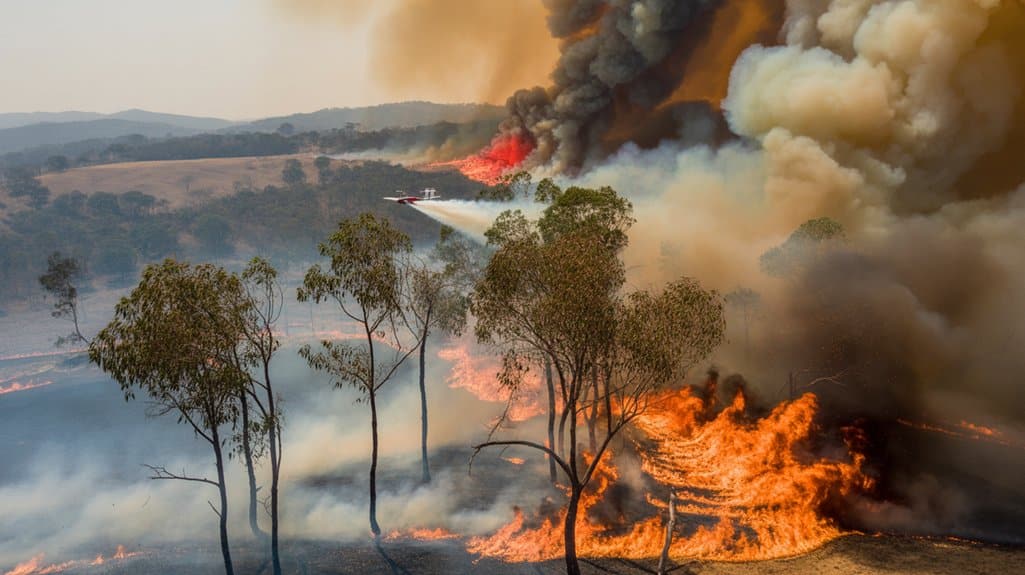
Uruguay’s landscape tells a story of dramatic change that’s making wildfires more dangerous than ever before. The country’s traditional grasslands have given way to extensive tree plantations, creating new fire hazards that didn’t exist a generation ago.
The statistics paint a concerning picture. Between 2007 and 2022, Uruguay lost over 10% of its forest cover while fire-affected areas increased by nearly 300%. This isn’t just about numbers on a page, it represents a fundamental shift in how fire behaves across the countryside.
Tree plantations burn differently than native grasslands. When eucalyptus and pine forests catch fire, they create hotter, more intense blazes that spread faster and prove harder to control. The oils in eucalyptus leaves act like natural accelerants, while pine trees can literally explode when temperatures reach critical levels.
Local fire departments report that these plantation fires require completely different fighting strategies. Where crews once dealt with grass fires that burned low and moved predictably, they now face towering walls of flame that can jump roads and firebreaks with ease.
Rural communities have started organizing their own prevention networks, clearing vegetation around homes and creating early warning systems. Fire brigades receive more training each year, and farmers coordinate controlled burns during safer weather windows.
The challenge isn’t going away anytime soon. Climate patterns show longer dry seasons and stronger winds, conditions that turn any spark into a potential disaster. Success depends on whether prevention efforts can keep pace with these mounting risks.
Key Takeaways
Converting Uruguay’s natural grasslands into tree plantations creates unexpected fire hazards. When these plantations get harvested, they leave behind bare ground that catches fire much more easily than the original grass cover.
The numbers tell a stark story about Uruguay’s fire problem. Between 2001 and 2024, flames consumed 12,000 hectares of tree cover, but the total area damaged by fires reached a staggering 430,000 hectares. This massive difference shows how fires spread far beyond forests into grasslands and agricultural areas.
The situation got much worse over time. Fire-affected areas jumped from 849,000 hectares in 1990 to 3.24 million hectares by 2005 – nearly quadrupling in just fifteen years.
Smart prevention work has shown promising results in some regions. Forest managers who built firebreaks – cleared strips of land that stop fires from spreading – and installed early warning systems saw fire incidents drop to just 2% of what they were before. These techniques prove that proper planning can dramatically reduce fire damage.
Rising temperatures and changing rainfall patterns linked to climate change pose new threats. Fire seasons may get longer and more intense, making Uruguay’s existing fire problems even harder to manage.
Uruguay’s Environmental Crisis Unfolds

Uruguay faces a growing environmental crisis where water shortages clash with major industrial projects. The 2023 drought revealed serious flaws in the country’s water management, with the Arazatí treatment plant recording dangerous salt levels for almost 150 days between 2021 and 2023. Rainfall dropped 47% below normal from October 2022 to April 2023, causing crop failures and drinking water shortages that lasted five years.
Green hydrogen projects could boost the economy but create new competition for water resources. HIF Global plans to build a $6 billion facility in Paysandú by 2026 to produce synthetic fuels, though the government hasn’t released details about their deal. Regulators blocked ENERTRAG’s project in February because the company failed to properly document its water needs, 660 cubic meters per day from rivers and underground sources.
Project Neptuno shows how development clashes with conservation efforts. The original plan would have run pipes through Santa Lucia wetlands, an area rich in wildlife and legally protected from development. Environmental groups fought the project, arguing that officials couldn’t prevent ecological damage as promised. The government scrapped those plans and switched to drawing water directly from the Santa Lucia River, though activists say the new rules remain too vague to protect the environment effectively.
Limited government oversight makes these problems worse as Uruguay risks becoming a warning for other South American countries. Economic growth slowed to 2.1% in 2025, and pension costs prevent the government from reducing debt, leaving little money to tackle climate threats that UN experts expect to worsen through 2030. Local academics stress the importance of maintaining water quality amid increasing industrial demands on the country’s water resources.
Blazes Devastate Farmland and Wildlife
Farm fires are becoming a bigger problem across Uruguay as old grasslands get turned into tree plantations. When companies harvest these trees, they leave bare ground that catches fire easily. The chemicals sprayed on these commercial forests make things worse, and all the water needed for irrigation dries out the land even more.
Uruguay has lost more than 10% of its forests to various causes, with fires now spreading from tree farms into nearby agricultural areas. Between 2001 and 2024, flames destroyed 12,000 hectares of tree cover, though other activities like logging and development caused much more damage – about 430,000 hectares total. Last year alone, 4,800 hectares of natural forest burned up, pumping 2.3 million tonnes of carbon dioxide into the atmosphere.
Fire damage has gotten much worse over time. Back in 1990, fires affected 849,000 hectares nationwide. By 2005, that number had jumped to 3.24 million hectares. Around 2000, fires were hitting about 0.07% of the country’s forest area each year, breaking up important wildlife habitats into smaller, isolated patches.
Uruguay’s remaining natural forests covered 970,000 hectares as of 2020. These areas support many different plants and animals, but they’re under serious pressure. The country’s oldest, most important forests – called primary forests – shrank from 296,000 hectares to 239,000 hectares between 1990 and 2005. That’s nearly a quarter of these irreplaceable forests gone in just 15 years, putting unique species at risk.
The grasslands and riverside forests that make up Uruguay’s savanna are in particularly bad shape. Wildlife gets trapped in smaller and smaller areas as fires and development cut up their habitat. While only 2.3% of animal species and 1.8% of plant species exist nowhere else on Earth, these native species face the biggest threats from habitat changes. Protected areas cover just 0.2% of the country under strict international standards, leaving most wildlife with nowhere safe to go. Scientists have documented 2,278 vascular plant species across Uruguay’s diverse ecosystems, making habitat preservation critical for botanical conservation.
Tree cutting makes the fire problem worse. Even though Uruguay added 601,000 hectares of new forests between 1990 and 2005 – mostly commercial plantations – the loss of original forests picked up speed. From 1990 to 2010, the country lost an average of 41,200 hectares of forest each year, creating open corridors where fires spread faster. Uruguay’s Forest Integrity Index hit just 3.61 out of 10 in 2018, ranking it 147th worldwide.
Big companies converting grasslands for paper mills are breaking up native forests into fragments, which isolates animal and plant populations and reduces genetic diversity. Fertilizer washing into streams from these operations slows down ecosystem recovery after fires. The drop in traditional wood fuel use – from 3.09 million cubic meters in 1990 to much lower levels today – shows how degraded forests have become across areas prone to burning.
Recovery and Prevention Ahead
Communities nationwide have grown tired of watching flames consume their forests and farmland. Real prevention strategies are taking root, moving beyond reactive responses to proactive community engagement. The “Prevention Saves Lives” campaign delivers practical fire safety education straight to people’s doorsteps, with special focus on Montevideo where geographic and climatic conditions create the greatest vulnerability.
Educational outreach connects with families through online videos and social media platforms, breaking down complex safety protocols into manageable daily practices. The messaging emphasizes actions anyone can take without specialized equipment or training.
Three core prevention strategies form the backbone of current efforts:
Firebreaks and vegetation management create protective buffers around agricultural plantations and residential areas. Local teams clear undergrowth and maintain these zones year-round, removing the dry material that typically fuels rapid fire spread.
Emergency preparedness training walks families through evacuation procedures specific to their neighborhoods. Sessions cover escape route identification, essential item preparation, and communication protocols during crisis situations.
Early detection systems combine human patrols with strategically positioned watchtowers across high-risk zones. Trained observers can spot smoke plumes within minutes, triggering immediate response before small fires become uncontrollable blazes.
Data confirms these approaches deliver measurable results. Areas under active management report fire incidents at just 2% of previous levels, a dramatic reduction that translates to saved lives and protected property. The National Fire Department, Ministry of Social Development, National Emergency System, and state utility company UTE have coordinated efforts to ensure comprehensive safety messaging reaches vulnerable populations. Climate projections indicate Uruguay will face increasingly severe fire seasons as temperatures rise and rainfall patterns shift. The national SOPRIF monitoring system represents a significant investment in long-term protection, providing communities with both early warning capabilities and the confidence that comes from comprehensive preparation.
References
- https://news.mongabay.com/2025/09/uruguays-green-hydrogen-plans-raise-ecological-concerns-in-argentina-at-home/
- https://newlinesmag.com/reportage/uruguays-project-neptuno-is-dead-but-questions-remain/
- https://www.alm.com/press_release/alm-intelligence-updates-verdictsearch/?s-news-16724911-2025-12-03-uruguay-government-ignores-environmental-regulations
- https://www.undp.org/sites/g/files/zskgke326/files/2025-12/uruguay-cpd-2026-2030_5-december_clean.pdf
- https://www.bbvaresearch.com/en/publicaciones/uruguay-economic-outlook-2025/
- https://www.imf.org/en/publications/wp/issues/2025/01/10/the-macroeconomic-impact-of-droughts-in-uruguay-a-general-equilibrium-analysis-using-the-560565
- https://blue-community.net/2025/01/uruguays-struggle-for-natural-resources/
- https://worldrainforests.com/deforestation/forest-information-archive/Uruguay.htm
- https://en.wikipedia.org/wiki/Environmental_issues_in_Uruguay
- https://worldrainforests.com/deforestation/2000/Uruguay.htm