
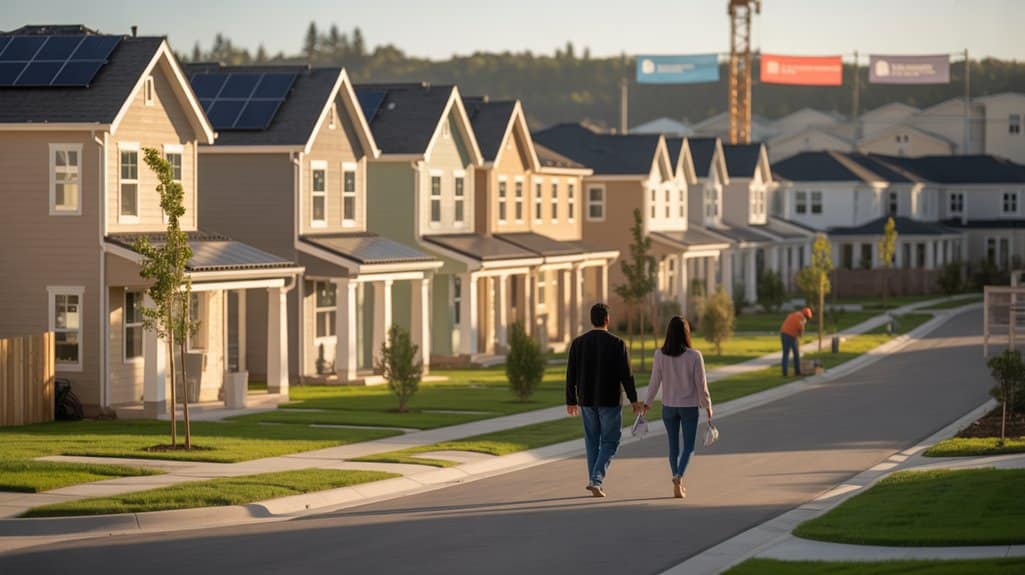
La expansión del programa “Entre Todos” cambia bastante el panorama para quienes venían postergando la compra de su vivienda. Con solo un 5 % de entrada, el Estado financia el 95 % restante, lo que elimina el obstáculo más concreto que enfrentan las familias uruguayas de ingresos bajos y medios: reunir el capital inicial.
La tasa fija del 6,5 % a 30 años es un dato que vale la pena analizar con calma. En el mercado local, la estabilidad de una cuota predecible durante tres décadas tiene un valor real, especialmente en contextos donde las variables económicas pueden moverse.
Los préstamos aplican a propiedades de hasta $ 608 millones de pesos, un rango que hoy cubre opciones concretas tanto en Montevideo como en el interior del país, desde Salto hasta Maldonado.
Algo que distingue esta edición del programa es su alcance territorial. No se limita a la capital ni a las ciudades más grandes; las zonas rurales y los centros urbanos medianos también quedan dentro del esquema, lo que abre posibilidades reales para quienes buscan establecerse fuera del área metropolitana.
Si estás evaluando si calificás y qué documentación necesitás reunir para iniciar el trámite, conviene no demorarse. Los cupos en programas de este tipo suelen tener límites, y conocer las condiciones de elegibilidad desde el principio te permite llegar bien preparado.
Key Takeaways
The Entre Todos program just got significantly more accessible, and if you’re looking to buy in Uruguay right now, this is worth your full attention. Financing up to 95% of the property value means your entry point drops to just 5% as a down payment , a real shift for families who’ve been sitting on the sidelines waiting for the right moment.
The fixed rate sits at 6.5% over 30 years, and repayments don’t kick in until after you’ve moved in, which gives you breathing room during what’s already a busy transition. Loan caps have also moved up to Gs. 608 million , roughly $970,800 , opening doors in higher-cost areas that were previously out of reach for many applicants, both in Montevideo and across the interior.
Eligibility extends to households earning up to six minimum salaries, and the program goes a step further for single parents, larger families, and applicants with disabilities, offering additional support that reflects the real diversity of Uruguayan households.
One detail that often gets overlooked but matters a great deal in practice: there are no pre-payment penalties. If your situation improves and you want to pay down the loan faster, nothing stops you. The six-month grace period before amortization begins also gives new owners time to settle in without immediate financial pressure.
For anyone seriously considering a purchase, this program removes several of the barriers that have historically made homeownership feel out of reach. The structure is sound, the terms are transparent, and the timing is favorable.
95 % Financing Model: Key Benefits

A 95% financing model is one of the most practical paths to homeownership in Uruguay, particularly for buyers who have steady income but limited savings. The structure only requires a small personal contribution upfront, which in a market like ours, where properties in Montevideo, Punta del Este, or the interior can carry significant price tags, makes a real difference in how quickly someone can act.
The Banco Hipotecario del Uruguay and MEVIR programs have long supported low down-payment structures, and when you pair those with assistance options that cover part of the initial cash requirement, the buyer’s out-of-pocket exposure stays manageable. That matters here because Uruguayan buyers often carry costs beyond the purchase price itself, including notary fees, transfer taxes, and other closing expenses that can catch people off guard.
What also works in favor of this model is the lender’s perspective. A borrower who comes in with verified income, completed financial literacy requirements, and a demonstrated ability to contribute, even modestly, presents a cleaner risk profile. Programs designed for first-generation buyers or multi-unit purchases add an extra layer of support that can turn what feels like a stretch into a realistic transaction.
The high loan-to-value ratio does open doors, but the real strength of a 95% model in the Uruguayan context is that it keeps those doors open responsibly. Buyers aren’t overextending on day one, and lenders have enough structure around the loan to feel confident moving forward. The HUD program Section 221(d)(4) also insures long-term mortgages for new construction, providing an additional safety net for lenders.
Eligibility for the 95 % Housing Loan
To qualify for this loan, your income needs to fall within a specific multiple of Uruguay’s salario mínimo nacional, and your debt-to-income ratio has to sit within an acceptable range , something the Banco Hipotecario and MEVIR programs take seriously when reviewing applications. The borrowing amount itself is capped at 95% of the property’s appraised value, and it has to align with the price limits set for each region, which vary quite a bit between Montevideo, the Costa de Oro, and the interior departments. Getting these two sides of the equation right , what you earn and what you’re borrowing , is what moves your application from consideration to approval. Young mortgages also allow financing up to 95% of the property purchase.
Income Eligibility Criteria
When looking into the 95% housing loan program here in Uruguay, the first thing worth checking is whether your household income falls within the established limits. The program works with IPREM multiples as its measuring stick: a single-person household can earn up to €12,600, while a seven-member family can reach as high as €90,000 under the most generous VPPL tier. Those numbers matter more than most applicants initially realize.
Certain groups do get a meaningful advantage in this calculation. Single parents, large families, and anyone carrying a disability rating of 33% or more qualify for an income boost of between 20% and 30%, which can make a real difference when you’re sitting right at the edge of eligibility. It’s one of those details that often goes unnoticed until it’s too late to act on it.
Regional variations also play a role, and Uruguay’s own departmental distinctions follow a similar logic. Depending on where the property sits, the applicable income multiplier shifts accordingly, so the ceiling in one area won’t necessarily match what applies in another.
Two conditions need to hold at the moment of contract signing: income must fall within the program’s limits, and the monthly rental burden cannot exceed 35% of total household earnings. That second point is the one that catches people off guard most often. Even with a fully compliant income level, crossing that 35% threshold means disqualification , no exceptions. Knowing this beforehand shapes how you approach the search and helps you target properties that genuinely fit your financial profile.
Data controller must retain the collected personal information for the duration of the housing application process.
Maximum Loan Amount Limits
Knowing how much you can borrow shapes everything about your home search, so it’s worth understanding how these limits actually work in Uruguay’s market. The Entre Todos program follows the USDA Direct loan framework, where most departments cap loans at $336,500, though high-cost zones like Montevideo and Punta del Este can push that figure up to $970,800. FHA limits climb even higher, reaching $1,209,750 for single-family homes in premium markets, while conforming caps settle at $806,500 in more affordable regions.
USDA Guaranteed Loans work differently from the rest. There’s no fixed ceiling attached to them , your lender evaluates your personal financial picture and sets the amount accordingly, which gives you meaningful room to negotiate based on your actual situation.
Uruguay’s real estate landscape varies considerably from one department to the next, and these ranges reflect that reality. A buyer in Canelones operates under different conditions than one purchasing near the Rambla in Montevideo or along the coast in Maldonado. Matching your loan type to both your income and the local market you’re targeting keeps your options open rather than locking you into a single path.
95 % Loan Mechanics: Down-Payment, Interest Rates & Repayment
Putting together even a modest amount opens the door to ownership here in Uruguay. A 5 % down payment , drawn from personal savings or approved grant programs , is all it takes to access 95 % financing. For low-income families, certain subsidies through MEVIR or the Agencia Nacional de Vivienda can cover that entry cost entirely, meaning no personal funds need to leave your account on day one.
Interest Rate
The loan runs at a fixed 4.5 % for the first ten years, which sits comfortably below what you’d typically see on the open market in Montevideo or the interior. Past that initial period, adjustments tied to a transparent index , often linked to the UR (Unidad Reajustable) , may apply, but nothing comes as a surprise. Paying ahead of schedule carries no penalty, so if circumstances allow, trimming the timeline is always a smart move. The program also includes a origination fee of 1.057 % that is deducted from the loan amount at disbursement.
Repayment
Thirty years is the standard term, with a six-month grace period before monthly amortized payments begin. There’s no balloon payment waiting at the end , a detail worth appreciating given how those structures have complicated financing in neighboring markets. After five years, refinancing becomes available, and from that point forward, steady monthly payments are what stand between you and a fully owned property.
Step-by-Step Application Process (Docs & Timeline)

Getting into Uruguay’s housing programs , whether it’s BHU, MEVIR, or one of the MVOT plans , starts with timing. These programs open their registration windows quarterly, so missing one means waiting another three months. Register online through the ministry’s portal or head directly to the nearest municipal office when that window opens; don’t leave it for the last few days.
Once you’re registered, the pre-application form is your first real commitment. Fill it out carefully, because what you declare there sets the tone for everything that follows. While you’re at it, start pulling together your documents: a valid cédula de identidad, proof of income (payslips, IRPF declarations, or a contador’s certification if you’re self-employed), birth and marriage certificates, and bank statements from the last three months. Uruguayan institutions are thorough, and arriving short on paperwork costs you time you don’t want to lose.
Book your appointment to submit those documents as soon as the slot opens up , verification typically wraps up within a week, and that clock doesn’t start until everything is handed in. Use that week to go back over your financials, because the eligibility interview comes next. Staff will walk through your income, household composition, and housing situation, and they occasionally request supplementary documents on the spot, so keep your file handy.
From there, the ministry takes over. The review runs 45 to 60 days, after which you’ll receive written notification of pre-approval. With that in hand, the path opens up to property selection and locking in your financing structure , the part where things finally start moving.
Entre Todos vs. Other Paraguayan & U.S. Housing Programs
Entre Todos stands out for its wide reach across Paraguay, giving many families access to flexible loan terms and broad eligibility requirements. U.S. housing programs tend to work differently, leaning on tax credits, subsidies, and low-interest loans that are tied to specific income thresholds. Knowing how these two models operate side by side gives you a clearer picture of what drives affordable home ownership in each country, and that context matters when you’re evaluating options.
The Paraguayan approach prioritizes accessibility, which is something worth noting if you’re comparing it to more structured U.S. frameworks. American programs are deliberately tiered, meaning your income level largely determines what you can access. That design keeps resources targeted, but it also creates gaps for families who fall just outside the qualifying range.
What both systems share is a goal of expanding home ownership, even if the paths look very different on paper. Understanding those differences helps you ask the right questions, whether you’re advising a client, exploring financing options, or simply trying to make sense of how housing policy shapes real communities.
Paraguay Program Scope
- Families earning up to six minimum salaries can qualify, which opens the door for a wide range of households that might otherwise feel priced out.
- Properties valued up to Gs. 608 million fall within the program, giving buyers a solid selection to work with across different neighborhoods and regions.
- Loans reach up to 400 million guaraníes at a fixed 6.5% rate over 30 years , the kind of long-term stability that makes monthly budgeting far more manageable.
- Repayments only begin once the family has moved in, which takes real pressure off anyone currently renting and trying to save at the same time.
The program reaches both urban centers and rural communities, generating construction activity along the way and breathing new life into projects that had been sitting idle. For many Uruguayan families, this is a concrete path toward owning a stable, affordable home , and that matters more than most people realize.
U.S. Assistance Mechanisms
The United States supports Uruguay’s housing sector in ways that genuinely open doors for buyers who might otherwise struggle to enter the market. One of the standout initiatives is the “Entre Todos” program, which offers financing of up to 95% , a figure that makes a real difference for families working with limited savings. Through diplomatic cooperation, U.S. agencies establish grant frameworks that align with local funding sources, effectively bringing down borrowing costs for low-income households. The application process is kept straightforward, which matters enormously in a market like Uruguay’s, where bureaucratic hurdles have historically kept eligible families on the sidelines.
It’s worth comparing this to existing Uruguayan schemes like Che Róga Porã, which tend to carry higher interest rates and smaller loan ceilings. The gap between the two approaches tells you a lot about why U.S.-backed mechanisms are gaining attention among buyers and developers alike. Beyond financing, the U.S. also contributes technical guidance on construction standards, which helps developers maintain quality while keeping prices accessible , something you’ll notice matters particularly in emerging neighborhoods across Montevideo and the interior.
Taken together, these mechanisms strengthen the broader ownership landscape in Uruguay, creating real pathways for individuals and families who are ready to buy but need the right conditions to make it work.
Common Application Obstacles and Practical Solutions
Sorting out paperwork early makes the whole rental process in Uruguay move far more smoothly, especially in a market where landlords in Montevideo and the interior provinces each have their own documentation expectations. The Registro Civil is your starting point for birth certificates and identity documents, and it’s worth visiting their offices in person rather than relying on third-party services that charge unnecessary fees.
- Pull together your cédula de identidad, proof of income, and any disability certifications well before you start viewing properties. A simple folder keeps everything accessible when a landlord asks for copies on the spot.
- Uruguay’s rental market increasingly requires a *garantía* , either through the Contaduría General de la Nación’s affordable guarantee scheme or a private surety. Knowing which option fits your situation saves weeks of back-and-forth.
- Request your credit history through CLEARING or EQUIFAX Uruguay before submitting applications. Spotting and correcting errors in advance prevents unnecessary rejections.
- Many municipal offices (Intendencias) across departments like Canelones, Maldonado, and Rivera offer free transport support for residents who need to reach document offices. Community centers affiliated with MIDES are also reliable for this kind of practical help.
The rental process here rewards preparation. Landlords respond well to applicants who arrive organized, and in a competitive market , particularly in Punta del Este or Pocitos , that readiness genuinely sets you apart from other candidates.
Tips to Maximize Your Home Purchase With 95 % Financing

Buying property in Uruguay with 95% financing is absolutely achievable, and the right preparation makes all the difference. Start by calculating your equity position clearly. If you already own property here, whether in Montevideo, Punta del Este, or the interior, confirm that its current market value genuinely supports a 95% loan. Uruguay’s property valuations can shift noticeably between neighborhoods, so getting a reliable appraisal from a certified tasador prevents unpleasant surprises at the escritura stage and signals to lenders that you understand your financial standing.
Your monthly budget deserves equal attention. As a general rule, keep housing costs under 28% of your pre-tax income, and maintain a separate reserve fund for unexpected expenses like maintenance, municipal taxes, or the occasional legal fee that comes with Uruguayan real estate transactions. It is also worth sitting down and comparing a 95% loan against an 80% cash-out option, because the difference in interest rates and associated costs can be more significant than most buyers expect, especially given the mix of peso and dollar-denominated mortgages available through local banks like BROU and private institutions.
Lenders here place considerable weight on employment stability and credit history. A consistent income record, ideally with formal employment documented through BPS contributions, strengthens your application considerably. Clean up any outstanding debts on your CARP report and, if you are currently renting, start saving the difference between your rent and your projected mortgage payment each month. That habit builds visible financial discipline and grows your reserves simultaneously, putting you in a noticeably stronger position when you sit across from a loan officer.
References
- https://dceo.illinois.gov/communityservices/housingassistance.html
- https://www.cookcountyil.gov/service/affordable-housing-division
- https://www.youtube.com/watch?v=iAyBqcJJibA
- https://www.dfat.gov.au/sites/default/files/paraguay-for-all-concept-note.pdf
- https://chicagoinfrastructure.org/wp-content/uploads/2016/03/Home-Buyer-Assistance-Program.pdf
- http://www.hud.gov/states/illinois
- https://www.youtube.com/watch?v=XkkwyAZT5o4
- https://occprodstoragev1.blob.core.usgovcloudapi.net/lsmeetingattachmentspublic/51fc00fe-8833-49f8-bf66-4b869edc849e.pdf
- http://www.hud.gov/hud-partners/multifamily-programs
- https://www.mainehousing.org/programs-services/homebuyer/homebuyerdetail/first-home-loan-program