
Colombia’s earned approval to export Hass avocados to Uruguay, marking the end of a lengthy regulatory process.
Uruguay’s agricultural authorities completed their assessment after evaluating Colombia’s production standards and phytosanitary protocols—the safety measures that prevent plant diseases from crossing borders.
The approval creates new opportunities for Colombian producers in a market known for its purchasing power and preference for premium imports.
Uruguay imports most of its fresh produce due to limited local growing seasons, making it an attractive destination for year-round suppliers like Colombia.
Colombian avocado production has expanded significantly in recent years, with planted area increasing from 16,000 hectares in 2016 to over 23,000 hectares by 2022.
Most of this growth centers on Hass varieties, which command higher prices in international markets compared to traditional green-skin avocados.
Uruguay’s small population of 3.4 million people might seem modest, but the country maintains one of South America’s highest per-capita incomes.
Uruguayans typically purchase imported fruits through established retail chains that prioritize consistent quality and reliable supply—exactly what Colombian exporters need to demonstrate to succeed in this market.
The timing aligns well with seasonal patterns.
Colombia’s main harvest periods could complement Uruguay’s limited local production, potentially reducing the country’s dependence on more distant suppliers while offering Colombian growers better profit margins than oversaturated markets.
Key Takeaways
Colombia’s agricultural sector gained access to a significant new market when Uruguay approved Hass avocado imports on January 12, 2026. This approval came after Colombian producers successfully navigated Uruguay’s regulatory review process, which evaluates foreign agricultural products for safety and quality standards.
Resolution 1323/2025 formally cleared the path for these exports by confirming that Colombian avocado operations meet Uruguay’s plant health requirements. These standards protect Uruguay’s domestic agriculture from potential diseases or pests that could arrive with imported produce.
The timing aligns well with Colombia’s expanding avocado industry, which exported 182,000 tons in 2025 – a 21.8% increase that reinforces the country’s position as the world’s third-largest avocado producer. This growth reflects both increased cultivation and improved export infrastructure.
Uruguay’s approval creates opportunities beyond its domestic market of 3.5 million people. The country belongs to Mercosur, a trade bloc that includes Argentina, Brazil, and Paraguay, giving Colombian exporters potential access to 270 million consumers across South America’s largest economies.
Colombian producers earned this market access by registering with SISPAP, Uruguay’s plant health monitoring system, and implementing operational protocols that track their products from farm to export. This documentation process allows Uruguayan authorities to verify that imported avocados come from approved facilities and meet established safety standards.
Uruguay Approves Colombian Avocados After Fast-Track Talks
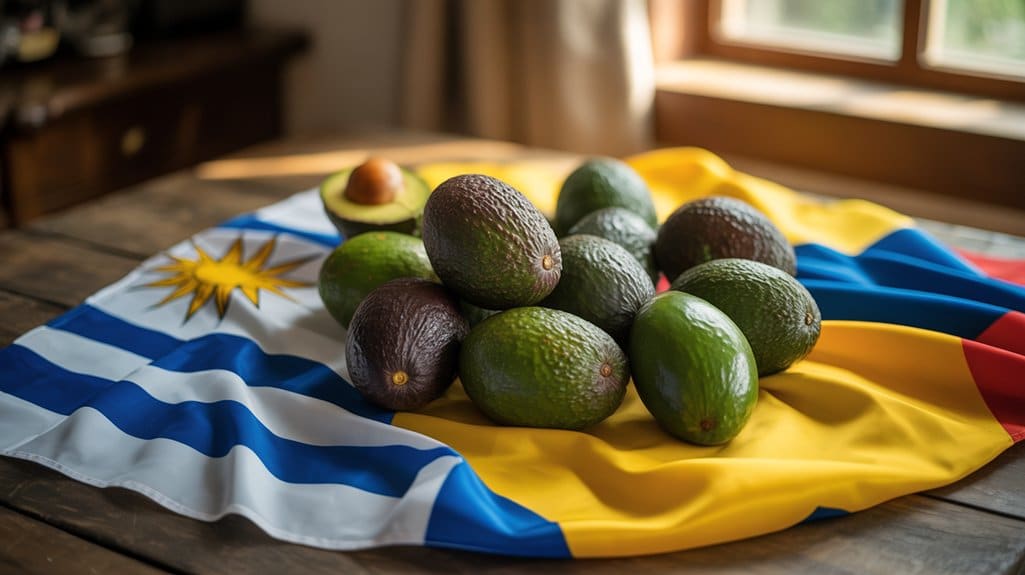
Uruguay’s agricultural authorities have given Colombian Hass avocados the green light for import following streamlined negotiations between the two nations. The General Directorate of Agricultural Service completed its review process on January 12, 2026, removing regulatory obstacles that previously blocked these shipments from entering Uruguayan territory.
Colombia’s fruit exports now satisfy Uruguay’s plant health requirements, which focus on preventing disease transmission and ensuring product safety. The Ministry of Livestock verified that Colombian producers follow proper cultivation and handling protocols. These standards protect Uruguay’s domestic agriculture while allowing safe international trade.
This approval expands Colombia’s export portfolio at a time when their avocado production continues growing. Uruguay’s market, though smaller than major destinations like the United States, offers Colombian growers geographic diversification and strengthens regional food networks. The agreement reflects broader trends toward increased agricultural cooperation within South America, where countries are reducing trade restrictions on quality produce. The approval could lead to greater consumer choice as Uruguayan buyers gain access to imported Hass avocados alongside domestic options.
Colombia’s Hass Avocado Exports Jump 21.8% in 2025
Colombia’s Hass avocado exports soared by 21.8% in 2025, reaching 182,000 tons—a significant milestone for the country’s agricultural sector. The numbers tell a story of strategic expansion beyond traditional markets, with Colombian growers successfully entering new territories throughout South America while maintaining the rigorous quality certifications that global buyers demand.
The growth stems from three key factors working together. Avocado trees planted years ago are now producing at full capacity, delivering bigger harvests than before. The government expanded the area designated for certified avocado cultivation, giving farmers more land to work with proper oversight. New packing facilities came online specifically designed to handle international shipping requirements, eliminating previous bottlenecks that limited export volumes.
This expansion represents more than just increased production—it shows Colombia building a sustainable competitive advantage in the global avocado market. The country’s tropical climate and elevation provide ideal growing conditions year-round, allowing producers to supply fresh fruit when other major exporters face seasonal limitations. Colombian avocados are now cultivated across 17 departments and over 250 municipalities, demonstrating the industry’s nationwide reach and diversified production base.
Record-Breaking Export Volume Growth
Colombia’s avocado growers have watched their orchards transform from small operations into major export businesses over the past decade. The country shipped 182,000 tons of Hass avocados internationally in 2025, representing a 25% increase from 2024 figures. This expansion stems from strategic market development and stronger trade relationships with importing countries.
The scale of this transformation becomes clear when you look at the timeline. Shipments barely reached 20,000 tons a decade ago, meaning exports have multiplied by nine times their previous volume. The sector achieved its highest annual growth rate of 26.4% in 2023, while total export revenues surpassed $300 million by 2024.
Several factors drive this upward trajectory. Orchards planted years ago now produce significantly higher yields per hectare as trees reach full maturity. Certified growing areas continue expanding across suitable regions, while additional packing facilities have secured international shipping permits. This infrastructure growth gives producers more flexibility in reaching global markets and meeting buyer specifications. Colombia now ranks as the third-largest producer of Hass avocados globally.
New Markets Drive Expansion
Breaking into new markets mattered just as much as boosting production for Colombia’s avocado industry in 2025. Uruguay joined the list of destinations when Resolution 1323/2025 gave the green light for Hass avocado imports. The approval process moved quickly, taking less than a year from the initial talks that began on May 22, 2025.
Colombian avocados already reach tables across the European Union, Saudi Arabia, Argentina, the United States, China, and several other countries. Exporters who paid attention to what each market wanted managed to navigate the ups and downs better than those who didn’t. Uruguay, like every other destination, has its own set of plant health requirements that must be met. Before any avocados can cross the border, exporters need to secure authorization from AFIDI, Colombia’s agricultural inspection agency.
This broader network of buyers means Colombian farmers aren’t putting all their eggs in one basket anymore. When one market slows down, others can pick up the slack. That kind of stability matters when you’re talking about an industry that supports nearly 80,000 people’s livelihoods. The confidence Uruguay showed in approving Colombian imports reflects the strong phytosanitary quality that ICA certification provides.
Quality Certification Standards Achieved
Colombian avocado exports surged 21.8% to 182,432 tonnes from January through November 2025, but the real story lies in the quality systems that made this growth possible. Strict certification processes transformed how the country approaches international markets.
Corpohass partnered with growers across 17 departments to meet demanding sustainability and quality requirements. This groundwork paid off—more farms and packing facilities now have clearance to ship to U.S. markets, where Colombian fruit competes head-to-head with Mexican avocados despite a 10% tariff disadvantage.
The breakthrough came in 2020 when the Colombian Avocado Board earned certification under the Hass Avocado Promotion Order. This credential gave producers the credibility they needed to market their fruit as premium produce. Colombian growers can now supply both U.S. coasts year-round, competing on quality rather than just price. Colombia’s two growing seasons—the main season from September to March and the traviesa season from March to August—enable consistent shipments throughout the year.
How Uruguay Access Opens Southern Cone Market Opportunities?

Uruguay’s position in South America creates a natural entry point for Colombian avocado producers wanting to reach the Southern Cone markets. The country belongs to Mercosur, which means Colombian exporters can now tap into this four-nation trade bloc that includes Argentina, Brazil, Paraguay, and Uruguay itself.
Mercosur membership brings concrete advantages. Trade barriers drop significantly between member countries, making it cheaper and faster to move goods across borders. Colombian avocado shipments that enter through Uruguay face lower tariffs when they continue to other Mercosur nations, compared to direct exports to those same countries.
The distribution benefits extend beyond just lower costs. Uruguay sits strategically between Argentina and Brazil, two of South America’s largest economies. This geographic position makes it an ideal staging ground for reaching urban centers like Buenos Aires, São Paulo, and Porto Alegre, where millions of consumers already include avocados in their weekly shopping.
Regional eating habits also work in Colombia’s favor. Unlike some markets where avocados remain a specialty item, Southern Cone consumers have embraced them as everyday food. Argentinians blend them into spreads, Brazilians add them to salads and smoothies, and Uruguayans use them in traditional dishes. This existing demand means Colombian producers enter markets where they don’t need to educate consumers about their product. Uruguay’s avocado imports have shown thirteen consecutive years of growth, reaching their highest volume in 2025 and signaling sustained appetite for the fruit across the country.
Strategic Gateway to Mercosur
Colombia’s approval to export Hass avocados to Uruguay opens access to far more than 3.4 million people. The country acts as a trade gateway into Mercosur, the economic bloc that includes Argentina, Brazil, Paraguay, and Uruguay itself—a combined market of over 270 million consumers.
Uruguay’s free trade zones make this particularly attractive for exporters. Companies can store goods in these zones for up to five years without paying import duties, and the simplified customs procedures cut both costs and processing time. The Port of Montevideo operates one of the most efficient free zones in South America, handling cargo that eventually reaches markets throughout the region. FTZs are strategically positioned near major ports and airports, supporting seamless connectivity to regional markets.
What makes Uruguay especially valuable is its position as a regional distribution center. Colombian avocado exporters can use these free zones not just for storage, but for repackaging and labeling products before they move on to Argentina or Brazil. Since Mercosur members apply common external tariffs to outside goods, using Uruguay as a base helps companies avoid paying multiple duties while reducing shipping distances to major population centers in the southern cone.
Regional Trade Block Benefits
Uruguay’s full Mercosur membership transforms a single export approval into access across the entire Southern Cone. When Colombian avocados enter Uruguay, they automatically gain preferential access to over 270 million consumers spanning Argentina, Brazil, Paraguay, and Uruguay. Products cleared through Uruguay face fewer barriers when crossing into neighboring markets due to the bloc’s integrated structure.
| Market Feature | Advantage | Impact |
|---|---|---|
| Tariff-free access | Zero duties within bloc | Lower consumer prices |
| Combined population | 270+ million individuals | Massive buyer base |
| Common external tariff | Up to 35% on outsiders | Competitive edge for members |
| Value-added goods | Preferential treatment | Supports processed products |
| Natural resources | Industrial demand | Diverse trade opportunities |
What started as bilateral agreements has evolved into regional opportunities. Exporters can use Uruguay’s strategic position as a gateway to penetrate broader South American markets. The country’s membership creates a ripple effect that extends far beyond its borders of 3.5 million people, offering businesses a launching pad into one of the world’s largest economic regions. Uruguay’s recent trade agreements emphasize cooperation and dialogue based on clear rules, providing greater legal certainty to businesses operating across multiple jurisdictions.
South American Distribution Logistics
Getting products across borders means little without the infrastructure to move them efficiently once they arrive. Uruguay’s location between Brazil and Argentina creates natural access points throughout the Southern Cone, streamlining regional logistics for Colombian growers.
Established avocado distribution networks already link Uruguay with Chile, Brazil, and Peru. Colombian producers can access these proven routes without building new infrastructure from scratch. Refrigerated trucks maintain precise temperatures between 39–55°F while keeping humidity levels at 85–90% to prevent fruit deterioration during overland transport.
Sea freight provides economical movement for varying shipment sizes across South America. Large operations benefit from full container loads, while smaller producers share container space to reduce costs. Comprehensive logistics services enable suppliers to obtain instant quotes and arrange seamless international shipping from production regions to final destinations. This scalable approach accommodates Colombia’s diverse agricultural landscape, which includes 773 certified farms. Rural women lead 232 of these operations, demonstrating the sector’s capacity to meet growing regional demand through inclusive participation.
What Colombia Had to Prove to Win Uruguay’s Approval?
The approval process required Colombia to jump through several hoops:
- Technical documentation had to demonstrate phytosanitary standards and pest-free status across all participating farms
- Farms needed registration as “exporting properties” within Colombia’s SISPAP tracking system
- Inspectors conducted detailed audits examining agricultural practices, pesticide applications, and post-harvest procedures
- Operations had to meet Resolution 1323/2025 specifications, which set strict temperature controls and fruit handling protocols
Colombian producers opened their doors to Uruguayan officials. They walked inspectors through their orchards, explained their growing techniques, and submitted to scrutiny of their entire supply chain. This wasn’t just paperwork – Uruguay’s agricultural ministry sent teams to verify conditions on the ground.
The process took months because Uruguay treats food safety seriously. As a small country that depends on agricultural exports, Uruguay maintains strict standards for what enters its borders. These same rigorous protocols that Colombian growers had to satisfy are what protect Uruguay’s reputation in international markets. Throughout the evaluation, Colombian exporters demonstrated their ongoing awareness of regulatory updates and compliance requirements.
How Uruguay Fits Into Colombia’s Expanding Export Footprint?
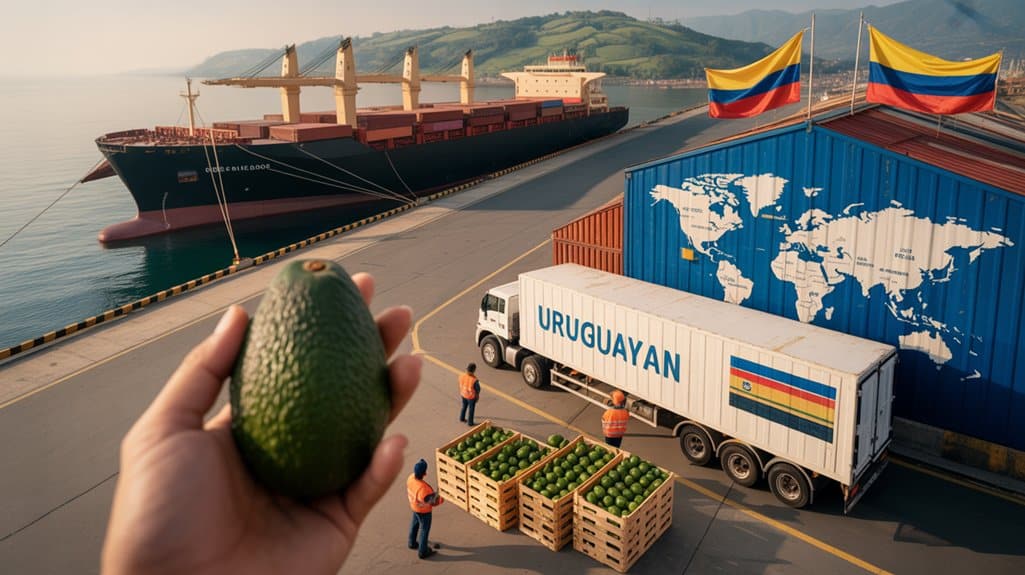
Getting Uruguay’s green light means way more than just another export destination for Colombia. Uruguay’s economy serves as Colombia’s entry point into the massive Mercosur trade bloc, which puts Colombian agricultural products in front of 270 million consumers throughout South America.
This timing couldn’t be better. The EU-Mercosur agreement that took effect in January 2026 wiped out more than 90% of tariffs between these regions, which together make up a quarter of the world’s economic output. Colombian farmers can now sell where high trade barriers previously shut them out.
Uruguay’s location makes perfect sense for Colombia’s trade strategy. While Colombia already has solid partnerships in Europe and North America, Uruguay opens up a completely different region. This geographic spread protects Colombian exporters from putting all their eggs in one basket.
The numbers back up this expansion. Avocado exports alone are expected to grow 10-15% through 2026. Latin American markets have delivered the strongest investment returns globally this year, and clear trade agreements like this one pull in more foreign investment while reducing Colombia’s reliance on any single major trading partner. The agreement establishes a transparent and predictable legal framework that provides Colombian exporters with greater certainty when entering these new markets.
Uruguay operates as South America’s trading hub, despite its small size. The country processes and ships goods throughout the region, making it an ideal partner for Colombian agricultural exports looking to reach the broader South American market efficiently.
Why Exporters Project 10-15% Annual Avocado Growth Through 2026?
Colombian exporters project 10-15% annual growth in avocado shipments through 2026, and the numbers back up their confidence. The global avocado market is set to climb from $18.5 billion in 2026 to $27.60 billion by 2031, creating real opportunities for producers who can scale up efficiently.
Production capacity drives much of this optimism. Colombia brings 30,000 hectares into full production each year through 2026, creating a substantial supply buffer. This expansion generates 25-30% more avocados than current demand requires, giving exporters room to pursue new markets aggressively without worrying about shortfalls.
Geography plays a crucial role in Colombia’s strategy. The country’s diverse growing regions enable year-round harvests, particularly during winter months when other suppliers scale back. This timing advantage helps Colombian growers fill gaps in global supply chains.
The Asia-Pacific region offers the strongest growth potential, expanding at 9.4% annually as middle-class consumers in major cities develop taste for premium produce. While North America still represents 35% of global market share, smart exporters spread their risk across multiple regions rather than depending on traditional markets alone.
Uruguay’s recent entry into avocado exports illustrates how smaller producers can find their niche in this expanding market. The country’s strategic location and growing expertise in agricultural exports position it well to serve regional demand, though its scale remains modest compared to major producers like Colombia, Peru, and Mexico.
Market fundamentals support continued growth across the sector. Rising health consciousness, growing global population, and expanding distribution networks create sustained demand that outpaces current production increases in most regions. Consumer preference for healthy fats drives demand growth by 2.1% in compound annual growth rate, reflecting broader dietary shifts toward plant-based nutrition.
References
- https://www.freshplaza.com/north-america/article/9799986/uruguay-opens-to-colombian-avocados/
- https://www.fresh-market.info/fruitsandvegetables/fruits/avocados/uruguay-is-now-allowing-the-import-of-avocados-from-colombia-258667341
- https://www.fresh-market.info/fruitsandvegetables/fruits/avocados
- https://www.tridge.com/news/colombia-is-expected-to-export-130-million-p-bhhhiv
- https://www.freshfruitportal.com/news/2026/01/05/westfalia-colombia/
- https://www.fruitnet.com/eurofruit/colombian-avocado-exports-to-reach-194000-tonnes-in-2025/270093.article
- https://www.freshfruitportal.com/news/2026/01/14/avocados-from-mexico-25b/
- https://marcasur.com/en/
- https://www.freshfruitportal.com/news/2025/04/01/one-of-the-best-colombian-avocado-seasons-for-naturipe-aligned-with-increasing-u-s-demand/
- https://www.agribusinessglobal.com/special-sections/local-perspectives-argentina-chile-colombia-and-uruguay/