
Uruguay’s government stands at a critical juncture with an $84 million shipbuilding contract that has created significant controversy.
Officials terminated their agreement with Spanish shipbuilder Cardama after the company failed to meet construction deadlines and submitted documentation that raised concerns about compliance.
The cancellation puts Uruguay in a difficult position. Cardama maintains it can fulfill the original contract terms and complete the vessels as promised.
Meanwhile, the country’s naval forces face an urgent need for modern ships to patrol territorial waters and conduct maritime operations.
This contractual dispute carries consequences that extend well beyond the immediate financial investment. Uruguay’s ability to secure reliable defense partnerships and maintain its maritime capabilities depends largely on how officials resolve this impasse.
The navy’s aging fleet requires modernization, yet the government must balance these operational needs against the risks of working with a contractor that has already missed key milestones.
The decision timeline adds pressure to an already complex situation. Government officials must weigh Cardama’s assurances against past performance issues while considering alternative options that could prove more expensive or time-consuming.
The choice they make will influence Uruguay’s naval readiness and set precedents for future defense contracts with international suppliers.
Key Takeaways
Uruguay pulled the plug on its €84 million Cardama Shipyard deal in October 2025 after uncovering serious financial problems and fake paperwork. The Spanish company had promised to build naval vessels but couldn’t deliver on basic requirements.
The shipyard missed several key milestones, most notably failing to provide proof of engine procurement by the January 14, 2026 deadline. This wasn’t just a paperwork delay – it showed Cardama couldn’t secure essential components for the vessels Uruguay needed.
Things got worse when officials discovered the €4.1 million performance bond was forged. This bond was supposed to guarantee Cardama would complete the work, but the fake documentation meant Uruguay had no real financial protection. Fraud charges followed quickly.
Despite receiving $30 million from the Uruguayan government, Cardama had only finished 20% of the construction work. The math didn’t add up, and it became clear the project was heading nowhere fast.
The contract cancellation created diplomatic tensions between Montevideo and Madrid. Uruguay now faces a significant delay in modernizing its naval fleet, with new vessels unlikely to arrive before 2028 or 2029. The country must start from scratch to find a reliable shipbuilder capable of meeting its maritime defense needs.
Why Uruguay Terminated Its $84 Million Cardama Shipbuilding Contract?
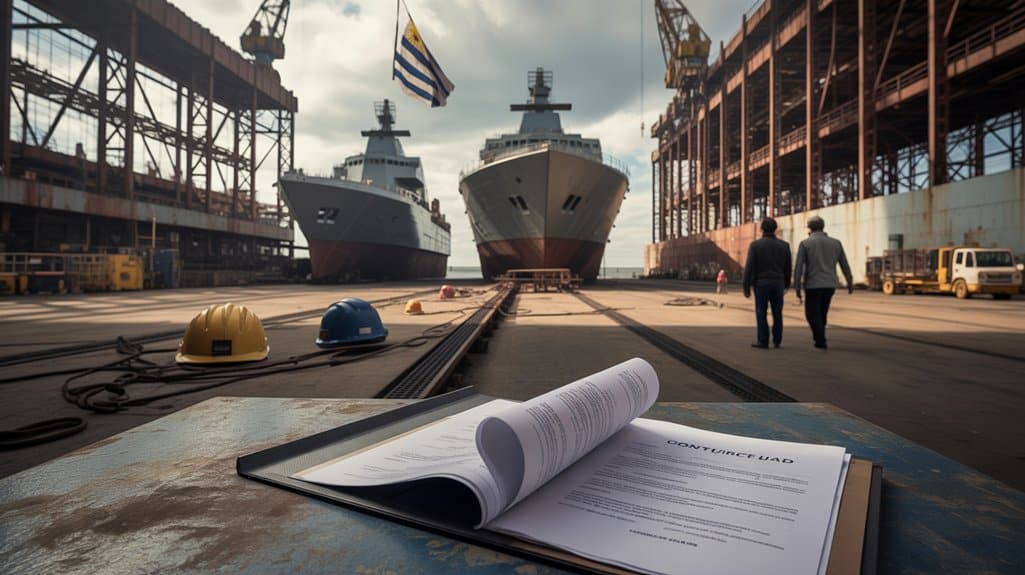
Uruguay’s government cut ties with a major naval contract in October 2025, ending a deal that had shown warning signs from day one. President Yamandú Orsi canceled the 84 million euro agreement with Cardama Shipyard after uncovering significant financial irregularities. The Spanish shipbuilder couldn’t produce a required performance bond and submitted a fraudulent guarantee from a company that was already being liquidated.
The problems ran much deeper than missed deadlines. Construction had barely reached 15% completion after years of work, while the government had already transferred around $30 million to the contractor. Essential engine parts were never even ordered. Investigators discovered falsified digital signatures on key financial paperwork, revealing what appeared to be deliberate deception rather than simple mismanagement. These findings led authorities to file both civil lawsuits and criminal charges against the shipyard. Four high-ranking Navy officers were sanctioned for irregularities in the contracting process that allowed the flawed deal to move forward.
Did Cardama Forge the Performance Bond or Just Miss Deadlines?
How did a shipbuilding agreement fall apart—was it simple delays or something more serious?
The government identified two critical problems that brought the deal to a halt. Cardama’s deadline management created immediate concerns when the shipyard failed to submit required documents within the mandatory 45-day window after signing the contract. The company repeatedly requested extensions but never provided proof that Caterpillar engines were actually available for the project, missing even the final January 14 deadline.
The €4.1 million performance bond—essentially a financial guarantee that contractors will complete their work—presented even more serious issues. Ministry of Interior experts examined the document’s digital signature and concluded it had been forged. Government officials classified this as attempted fraud against the Uruguayan state.
Cardama rejected all accusations and pointed fingers at EuroCommerce Bank, claiming the financial institution had deceived all parties involved in the transaction. Despite these denials, prosecutors opened a formal investigation into the matter. Uruguay’s government responded by freezing all payments related to the shipbuilding contract until courts reach a final decision on the case. The contract value for the two offshore patrol vessels exceeded US$92 million when the agreement was originally signed.
What Cardama Actually Built and Whether the Defense Holds Up?
After several months working on this massive €82 million contract, Cardama’s shipyard in Vigo had precious little to show for their efforts. The first vessel sat at barely 20% completion by October 2025—a red flag that raised serious questions about whether this deal would ever deliver what Uruguay needed.
The patrol boats were meant to be substantial warships: 86.75 meters long, displacing 1,700 tons, and equipped with both weapons systems and helicopter landing capabilities. Walking through the Spanish facility, though, you’d be hard-pressed to see much concrete progress on these complex specifications.
Uruguay’s defense officials started getting nervous about hitting key deadlines. The contract’s third payment hinged on Cardama finishing the keel-laying by May 2025—essentially the backbone of the ship that everything else gets built around. Lloyd’s Register, the marine classification society responsible for certifying the vessels met international standards, also became a source of mounting concern.
A meeting with Cardama’s top brass just before Easter did nothing to calm these fears. The fundamental problem kept nagging at critics: how could a company with zero experience building military vessels suddenly master the intricate engineering required for modern patrol boats? These aren’t fishing trawlers—they’re sophisticated naval platforms that demand precision manufacturing and weapons integration expertise that takes decades to develop. The shipyard’s previous failed projects only amplified doubts about their ability to execute such a complex naval contract.
Can Cardama Meet the Engine Deadline to Save the Contract?
When January 14, 2026 passed without any evidence of ready-to-install Caterpillar engines, the shipyard’s reputation suffered another major blow. Government officials granted one last extension until February 15, though they expressed serious skepticism about Cardama’s chances of success.
The engine crisis exposed deeper problems that had been building for months. Ministry records showed no down payment had been made to Caterpillar, raising questions about whether engines were actually on order. Multiple contract violations had accumulated despite the shipyard’s repeated attempts to explain the delays. These compliance failures prompted officials to freeze the third milestone payment, cutting off a crucial funding stream.
Cardama’s executives pointed fingers at Caterpillar, claiming the manufacturer caused the delays. Government investigators remained unconvinced by these explanations. They’d already released thirty million dollars to the project while fraud allegations swirled around the contract’s execution. The Attorney General’s Office had received the formal complaint from the Secretary of the Presidency and Deputy Secretary, initiating the criminal investigation.
The February deadline became Uruguay’s ultimate test of the partnership. Could Cardama suddenly deliver engines that appeared never to have been properly ordered? This final month would decide whether the troubled naval project limped forward or died completely, taking millions in taxpayer money down with it.
How the Dispute Strains Spain-Uruguay Relations and Delays Naval Modernization?
The contract collapse rippled through diplomatic circles, straining what had been a solid partnership between Spain and Uruguay. These two nations built their defense cooperation slowly over decades, creating genuine trust through shared naval exercises and technology transfers.
That relationship took a serious hit when the Cardama deal fell apart. The timing couldn’t have been worse – Spain and Uruguay had just signed new security agreements in January 2026, committing to deeper coordination on maritime safety and regional defense issues. The broken shipyard contract made those fresh promises ring hollow.
Uruguay’s naval commanders face a real problem now. Their aging patrol boats struggle to cover the country’s 400-mile coastline effectively, leaving gaps in both drug interdiction and fishing enforcement. The Cardama scandal didn’t just waste money – it set back crucial modernization plans that were already years behind schedule.
Starting over means new international tenders, fresh technical evaluations, and another lengthy procurement process. Uruguay’s navy will likely wait until 2028 or 2029 before seeing new vessels, assuming the next contract actually delivers. The Court of Auditors must finalize negotiations before any new procurement can move forward. Meanwhile, neighboring countries like Argentina and Brazil continue upgrading their fleets, leaving Uruguay further behind in regional maritime capabilities.
References
- https://en.mercopress.com/2025/10/25/uruguay-accuses-spanish-shipyard-cardama-of-fraud-company-calls-it-political-interference
- https://www.navalia.es/en/news/sectors-news/2998-spanish-shipyard-cardama-presents-guarantees-for-the-construction-of-uruguay-s-opvs
- https://www.navalia.es/en/news/sectors-news/3058-cardama-shipyard-makes-history-and-begins-the-project-of-two-opvs-patrol-boats-for-uruguay
- https://en.mercopress.com/2025/10/23/uruguay-cancels-opv-shipbuilding-deal
- https://www.plenglish.com/news/2025/12/24/uruguay-expands-complaint-in-conflict-with-cardama-shipyard/
- https://www.plenglish.com/news/2026/01/17/controversy-between-uruguayan-government-and-spanish-shipyard/
- https://www.tradingview.com/news/invezz:51f96056b094b:0-uruguay-to-cancel-92m-patrol-ship-deal-with-spain-s-cardama-over-suspected-fraud/
- https://en.mercopress.com/2025/10/27/spanish-shipbuilder-defends-himself-after-uruguay-cancels-82-million-opv-contract
- https://www.youtube.com/watch?v=42vlZmxrriE
- https://en.mercopress.com/tags/uruguayan-navy