
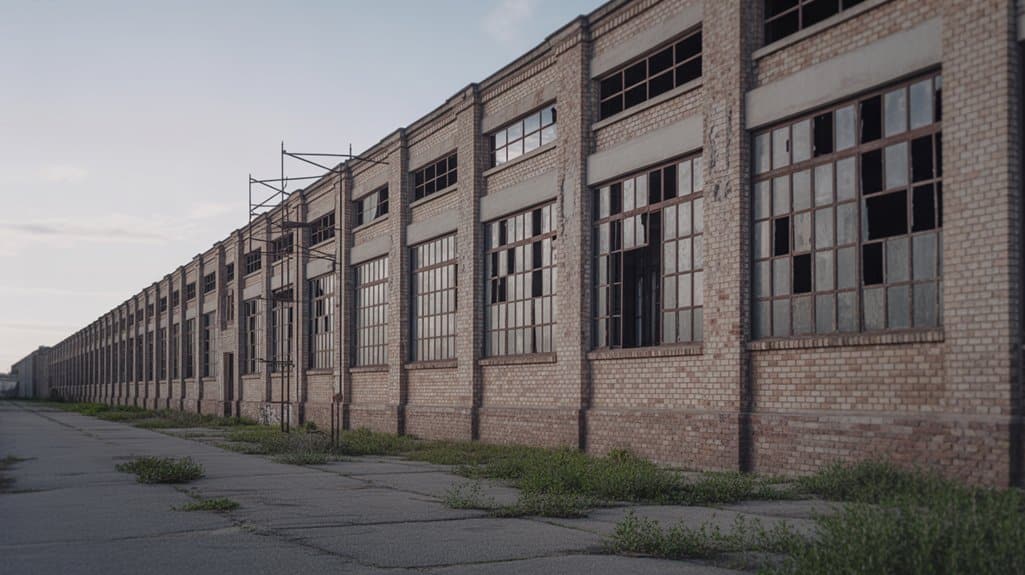
Families waiting on housing lists in Montevideo have a concrete opportunity worth paying attention to. A former factory in La Teja, sitting empty for nearly a decade, is being transformed into around 150 apartments under Uruguay’s cooperative housing model , and the structure of this project tells you a lot about how the market here actually moves.
The site sits across three merged lots at Laureles 578, and what makes it particularly interesting is the decision to retain the industrial shell, chimney included. That kind of architectural preservation adds long-term character to a property, something buyers and future residents in Montevideo increasingly value.
What really sets this apart is the financing mechanism behind it. The state covers 85% of costs through long-term loans, which is the kind of leverage that simply doesn’t exist in conventional real estate channels. For anyone navigating the Uruguayan housing market, cooperative projects like this one represent a path that bypasses many of the barriers typically associated with homeownership.
La Teja itself is a working-class neighborhood with solid bones , well-connected, historically grounded, and gradually attracting more attention from people priced out of other areas. Getting into a project here, especially one with this level of state backing, is the kind of move that tends to look smarter over time.
Key Takeaways
Espacio Bao is worth keeping an eye on if you’re looking at the La Teja neighborhood. The project takes a former factory at Laureles 578 and transforms it into roughly 150 apartments , preserving the original industrial structure while adding a ground floor and four levels above it. That kind of adaptive reuse is becoming increasingly relevant in Montevideo, where character and location often outweigh new construction.
The housing is organized through three cooperatives, which fits well within how this city has traditionally approached affordable ownership. Cooperative housing has deep roots here, and this project reflects how that model continues to grow.
Financing is where things get particularly interesting. The state covers 85% of the cost through 25-year loans at around 5% interest, with repayment beginning once you move in. For anyone serious about entering the market without heavy upfront capital, that structure is hard to beat.
Eligibility comes down to two conditions: you cannot currently own property, and your household income needs to fall within the established UR thresholds set for the program. If you meet both criteria, this represents a genuinely accessible path into homeownership in a neighborhood that’s seeing real momentum.
Where La Teja’s Bao Factory Site Sits in Montevideo

The corner of Laureles and Florentino Ameghino tells you a lot before you even check the address. Laureles 578, La Teja , three lots merged into the western Montevideo grid, and what you get is a site with real bones. This isn’t Pocitos or Punta Carretas, and that’s precisely the point. La Teja is a working-class barrio with genuine industrial heritage, the kind of neighborhood that built Montevideo from the inside out rather than the outside in. Long before it carried that name, the neighborhood was established in 1842 as Pueblo Victoria.
The ANCAP refinery sits nearby , Uruguay’s only refinery , and it still shapes how people here think about the neighborhood, what it means, who it’s for. That presence isn’t a liability; it’s context. Anyone who’s worked this market long enough knows that barrios with strong identity hold their value differently than polished districts with no particular story to tell.
The Bao Factory site fits squarely within that fabric. Streets in La Teja were laid out for residents and industry together, not for aesthetics, and that pragmatic logic is still visible in the urban structure today. For the right project, that kind of embeddedness , three connected lots, established street presence, a neighborhood that actually functions , is worth paying attention to before the rest of the market catches up.
Why Developers Chose the Bao Factory in La Teja
La Teja made sense the moment you looked past the surface. Experienced developers know that a consolidated barrio with existing infrastructure and an active community is far more valuable than a blank lot on the periphery , you’re not building from scratch, you’re building on something real. That’s not a small distinction in this market.
The old Bao factory carries the kind of identity that simply can’t be manufactured. Adaptive reuse here wasn’t a branding decision; it’s what made the financial model viable in the first place. Working with three separate lots gave planners genuine flexibility , combining reciclaje with new construction without forcing one approach to compromise the other. That kind of structural freedom is rare and worth recognizing when you find it. Coincidentally, the same “Bao” name also belongs to an unrelated open-source project, the Bao Hypervisor, showing how far a single name can travel across entirely different fields.
State financing covering 85% of the project removed the barrier that kills most socially mixed developments before they get off the ground. Still, the financing is really the final piece. The core logic was already there: families on waiting lists, a neighborhood with bones worth keeping, and an industrial shell that had been sitting idle while both went unaddressed. In Uruguay’s housing landscape, that alignment doesn’t come around often, and the developers who moved on it understood exactly what they had.
Inside the Three Lots That Make Up the Bao Project
Picking the right site matters, but what gets built on it matters more. Espacio Bao brings three lots together at Laureles 578 in Laureles into a single, coherent residential project , and that kind of lot integration is genuinely rare in Montevideo’s adaptive reuse landscape. What was once a fragmented industrial compound becomes 15 homes designed to work as one scheme, not three separate afterthoughts.
The unit mix is worth paying attention to: 2 one-bedroom units, 9 two-bedroom units, and 4 three-bedroom units, ranging from 37 to 82 square meters. That spread gives the project real flexibility, whether you’re looking at it as an end-user or an investor. Three floors, an elevator, and a low-rise footprint keep the scale grounded , something the Uruguayan market consistently rewards over ambitious builds that overstep their context.
The original industrial shell sets the boundaries here, and the project respects that. La Teja’s industrial character took shape in the early 20th century, when the installation of frigoríficos turned the area into a major commercial and industrial zone. Adaptive reuse done right isn’t about disguising what a building was; it’s about working honestly within what it can become. In a city where buyers are increasingly drawn to projects with genuine character and thoughtful construction, that restraint is less a limitation and more a selling point.
How 150 Bao Homes Will Rise From Old Factory Walls
La Teja has always been a neighborhood worth watching, and what’s happening at the old Bao factory site is exactly the kind of project that reminds you why. The plant ran for over 150 years producing soap powder and detergent before closing in 2015, and right now the space still holds rubble, concrete columns, and layers of accumulated material. That’s all about to change in a meaningful way.
The plan calls for 150 homes to be built there, organized across three separate cooperatives , a model that works particularly well in Uruguay, where cooperative housing has a long and solid track record. Rather than demolishing everything and starting fresh, the project takes an adaptive reuse approach, incorporating the existing factory shell into a new structure with a ground floor and four upper levels. Units will face both the street and the interior of the block, which is a smart layout choice for natural light and community feel.
Families can expect two-, three-, and four-bedroom options, with sizing tailored to what each cooperative actually needs. That flexibility matters when you’re housing diverse family configurations, and it’s something worth paying close attention to when evaluating a project like this.
What sets this apart aesthetically is the deliberate decision to preserve the industrial character of the original building. The raw, unfinished quality isn’t a compromise , it’s the identity. The old factory chimney will even be kept standing as a symbolic remnant of the site’s industrial past. In today’s market, buyers and cooperative members increasingly value authenticity in architecture, and this site has that in abundance.
Who Qualifies for the Bao Cooperative Housing Program
Bao’s cooperative housing program has specific entry requirements, and understanding them upfront saves a lot of time. Uruguay’s cooperative housing model has always been built around reaching people who genuinely need a structured path to homeownership, and Bao is no exception to that tradition.
To qualify, applicants need to be adults living within national territory and, critically, must not already own property. Once those basics are confirmed, income thresholds come into play, calculated in adjustable units (UR) based on household size:
- 1 person: 60 UR
- 2 persons: 66 UR
- 3 persons: 72 UR
- 4 persons: 84 UR
- 5 persons: 96 UR
Exceeding your household’s corresponding limit means automatic disqualification, with no room for appeal. The structure is intentional , Uruguay’s cooperative housing sector has a long history of prioritizing those with real need over those with options, and these income caps are what keep that principle intact. Beyond individual eligibility, cooperatives themselves face membership rules, with new construction projects requiring a minimum of 10 members and a maximum of 50.
How Uruguay’s Government Covers 85% of Construction Costs

One thing I always tell people looking at cooperative housing projects here in Uruguay is that the financing structure is genuinely different from anything you’d find through a private bank. The state covers 85% of total project costs through its housing finance institutions, which immediately changes the math for everyone involved. These aren’t short-term instruments designed to maximize returns , loans run about 25 years at interest rates close to 5%, built specifically for stability over time.
For a project like converting an old factory in La Teja into roughly 150 apartments, that framework isn’t just helpful, it’s what makes the whole thing viable from day one. Without that state-backed structure, a project of that scale simply wouldn’t get off the ground in the same way. The long repayment window and controlled interest rate keep monthly obligations manageable for cooperative members, which is exactly the point of the model.
What I find most valuable about this system, having worked with buyers and cooperatives across the country for years, is that it removes the dependency on commercial lending cycles. Private banks tighten credit, raise rates, or exit markets entirely , Uruguay’s housing finance institutions don’t operate that way. The predictability alone is worth understanding before you evaluate any cooperative project here, because it shapes everything from cost projections to realistic timelines for occupancy.
Public Financing Breakdown
Affordability here comes down to numbers that most private developers in Uruguay would walk away from without a second thought. The public subsidy covers 85% of construction costs , not handed over as a grant, but structured as ministry-backed loan financing that releases capital as the build progresses. That distinction matters more than people realize, because it keeps the state accountable to milestones rather than writing blank checks.
- Funds release progressively, tied to construction milestones
- The state carries the bulk of initial capital risk
- Cooperatives contribute the remaining 15% through labor
- Disbursement is structured, never a lump-sum transfer
- Residents repay over 25 years once construction is complete
What makes this model work in the Uruguayan context is the removal of that paralyzing upfront cost , the same barrier that keeps working families renting indefinitely rather than building equity. The repayment timeline is long by design, and the trade-off is straightforward: commit to the process now, and what you get on the other side is ownership, with no landlord and no rent check to write every month.
Repayment Terms Explained
Repayment only begins once construction is complete and families have moved into their units , not a day before. From that point, monthly payments are calculated at roughly 10% of household income, which means the amount adjusts to what each family actually earns rather than locking everyone into a fixed figure. In Uruguay’s housing system, that flexibility isn’t a bonus feature; it’s built into the foundation of how these programs work.
The repayment period runs up to 25 years, and any remaining balance at that point is absorbed by the state. No compounding penalties, no debt that outlives the loan’s purpose. For families navigating a first purchase, that ceiling matters more than most people initially realize.
Borrower protections are woven throughout: interest rates sit below market levels, installments are indexed, and the overall structure is shaped around the household’s circumstances. Whether the entry point is a cooperative or a direct purchase, the financing model adapts accordingly. That’s something worth understanding clearly before comparing these terms to conventional mortgage products in the Uruguayan market , they really aren’t the same animal.
What the Bao Project Signals for Montevideo’s Cooperative Housing Boom
The Bao project is worth paying attention to. Three cooperatives, around 150 units, and a factory that sat empty for nearly a decade , that kind of transformation doesn’t happen by accident. It happens because Montevideo’s cooperative housing model has real infrastructure behind it, and because residents pushed for it to work.
The numbers tell a clear story:
- Half of Uruguay’s cooperative homes are concentrated right here in the capital
- Co-op-owned housing more than doubled between 2011 and today
- Over 55,000 homes nationwide operate under this model
- Public funding has historically directed close to 40% of housing resources toward cooperatives
- 1,008 cooperatives are already active across the city
What makes this model genuinely attractive , and I’ve seen this firsthand over many years working in this market , is the governance structure. Residents hold actual decision-making power, not just a seat at a meeting they weren’t really invited to. That changes how people relate to where they live, and it shows in how these communities hold together over time.
Urban retention matters here too. Working families staying downtown rather than being pushed to the periphery keeps neighborhoods functional and economically balanced, which protects long-term value across the board.
Bao isn’t an isolated case. It reflects a direction the market is moving in Montevideo, and projects like it are already in the pipeline. For anyone serious about understanding where residential development is heading in this city, cooperative housing isn’t a niche , it’s a structural feature of how Uruguayans build and maintain communities.
References
- https://www.elpais.com.uy/que-pasa/la-fabrica-bao-revive-en-la-teja-haran-150-casas-una-para-la-hermana-de-cavani-y-otra-para-hijas-de-un-ex-mln
- https://en.wikipedia.org/wiki/La_Teja
- https://tulugar.com/en/market/uruguay/montevideo/la-teja
- https://punta-del-este.com/en/montevideo/la-teja.html
- https://municipiod.montevideo.gub.uy/sites/municipiod/files/LISTADO_VIVIENDAS_MDEO.pdf
- https://www.infocasas.com.uy/alquiler/inmuebles/montevideo/la-teja
- https://www.infocasas.com.uy/alquiler/apartamentos/montevideo/la-teja
- https://www.anv.gub.uy/sites/default/files/2021-08/LISTADO_DE_VIVIENDAS_2.pdf
- https://www.gub.uy/ministerio-vivienda-ordenamiento-territorial/politicas-y-gestion/espacio-bao
- https://www.infocasas.com.uy/alquiler/inmuebles/montevideo/la-teja/baratos