
Montevideo’s housing market is experiencing significant tightening. The supply of available homes continues to decline while demand from those seeking residences in walkable neighborhoods remains strong.
Vacancy rates stand at ten percent, and new-home prices have reached 117,000 pesos per square meter. Builders contend with elevated construction costs, and many local suppliers have ceased operations, restricting buyer options.
This imbalance between supply and demand drives prices upward and intensifies competition for the limited units on the market. The trajectory of this supply-demand dynamic remains uncertain.
Key Takeaways
- Vacancy rates stand at 10% in Montevideo and approximately 20% in surrounding areas, reflecting constrained housing supply.
- New home prices reached 117,000 pesos per square meter in Q2 2025, while construction costs increased 10.6% when measured in dollars.
- Demand for properties in walkable neighborhoods exceeds available listings, sustaining upward price pressure for at least the next twelve months.
- Online platforms such as Temu introduce low-priced goods to the market, intensifying competitive pressure on local retailers.
- Rising costs for groceries, transportation, and security services compound household budget constraints amid limited housing stock.
Supply Slump Spikes Prices
Local Vendors Shut Down
Canelones, Uruguay , Fenedur’s adhesive plant closure on October 31, 2025, eliminated 40 jobs and accelerated industrial shutdowns nationwide. The Confederation of Industrial Unions (CSI) confirmed the decision through the Ministry of Labor, identifying it as part of a broader crisis linked to recent departures by Verizon, Yazaki, Fanacif, and Gloria Foods.
Foreign companies have systematically withdrawn from Uruguay, raising unemployment rates. Yazaki, a Japanese auto-parts supplier, ceased operations. Fanacif, owned by Frasle Mobility, halted brake-system production. Gloria Foods ended dairy production in 2014, weakening the industrial sector.
The government’s Más Comercio program completed its 2025 cycle at the LATU Innovation Campus in Montevideo, serving eight departments. The 2026 edition will strengthen support for micro, small, and medium enterprises (MSMEs). Officials Claudia Peisino, Bruno Gili, and Fernando López emphasized the program’s importance in offsetting export losses and building inter-institutional partnerships.
Online commerce intensifies local business pressures. The Chinese platform Temu has introduced over one million packages at low prices with free delivery. Local merchants contend that Temu operates under tax advantages, prompting government consideration of a 22% VAT on such purchases to create fair market conditions.
Security challenges compound economic difficulties. The U.S. Department of State designates Montevideo as a “critical-threat” area for crime, particularly in tourist districts including Ciudad Vieja, Avenida 18 de Julio, and Mercado del Puerto. Enhanced police patrols and surveillance cameras have been deployed in Montevideo and Canelones, though violent crime persists and law-enforcement capacity remains insufficient.
Industrial closures, intensified online competition, and security concerns are constraining Montevideo’s market, threatening local vendor operations. The program achieved a 90% satisfaction rate among participants, highlighting its impact.
Rising Costs Strain Shoppers
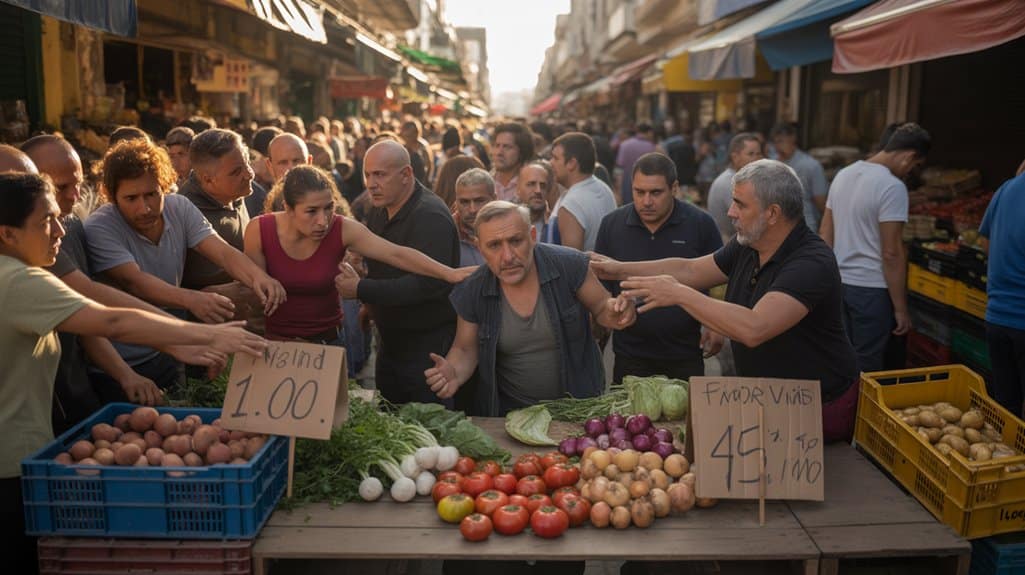
Factory closures have driven significant increases in grocery prices. Milk, eggs, and bread have become notably more expensive, while chicken and beef prices have risen sharply. Households are adjusting purchasing patterns, substituting premium cheese with local varieties and selecting bananas instead of higher-priced tomatoes. Consumer spending has shifted toward less meat and more legumes to extend limited budgets. A basic lunch now costs approximately $13, and a cappuccino represents a considerable expense for budget-conscious shoppers. Rising food costs have prompted careful meal planning and active discount-seeking. In these economic conditions, flexible purchasing strategies and informed choices have become necessary for managing household expenses. The cost of a monthly local transport ticket is $67.9, adding pressure to household budgets.
References
- https://thelatinvestor.com/blogs/news/uruguay-good-time
- https://www.freshplaza.com/north-america/article/9818111/uruguay-still-has-unresolved-issues-regarding-logistics-services-to-the-united-states/
- https://www.jarniascyril.com/international-real-estate/invest-in-real-estate-uruguay-market-guide/uruguay-real-estate-market-trends/
- https://www.bbvaresearch.com/wp-content/uploads/2025/06/Editorial-Uruguay-Economic-Outlook_2025.pdf
- https://www.investing.com/news/economy-news/uruguay-to-continue-cutting-rates-in-2026-says-cb-chair-93CH-4423222
- https://www.youtube.com/watch?v=J4IZ5GXtA8A
- https://www.nicolasdemodena.com/blog/uruguay-in-2026-the-best-country-in-latin-america-to-invest-in-real-estate/
- https://www.uruguayxxi.gub.uy/en/news/article/mas-comercio-closed-its-2025-cycle-in-montevideo-and-announced-an-enhanced-program-for-2026/
- https://www.plenglish.com/news/2025/09/18/uruguay-fenedur-another-company-to-leave-the-country/
- https://www.youtube.com/watch?v=zjIH_i4Bevo