
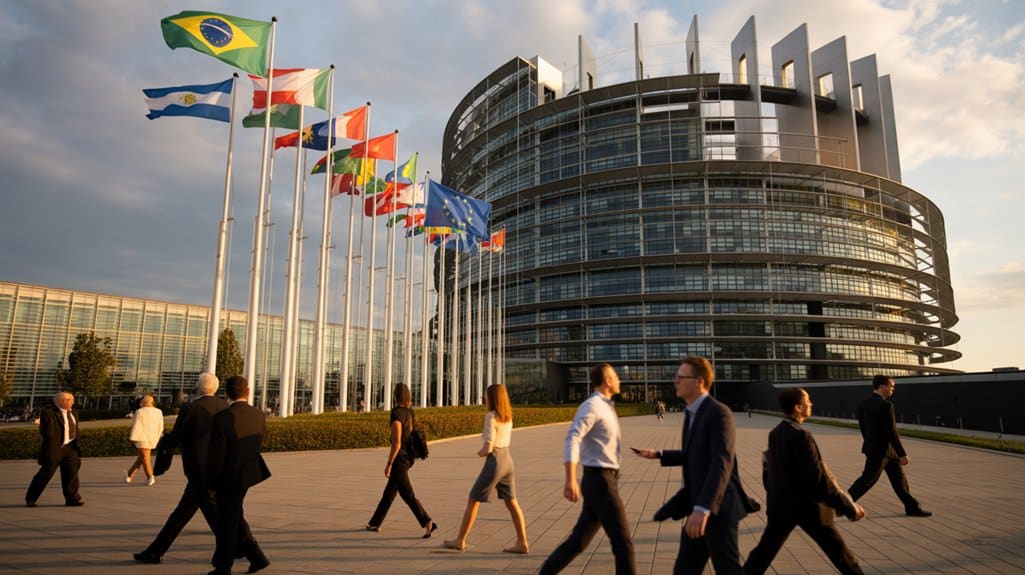
The European Parliament just pressed pause on one of the most significant trade agreements in decades. Lawmakers voted to send the EU-Mercosur deal to the Court of Justice, where it’ll undergo legal scrutiny that typically takes around two years to complete.
This trade pact would connect the European Union with Mercosur’s four founding members: Argentina, Brazil, Paraguay, and Uruguay. For Uruguay specifically, this agreement represents a major opportunity to diversify its export markets beyond traditional partners like China and Argentina. The country’s beef producers, dairy farmers, and soybean growers have been waiting over two decades for this kind of direct access to European consumers.
The legal review stems from concerns about environmental standards and competition with European farmers. French and Irish agricultural groups have particularly opposed the deal, arguing that South American producers operate under different regulatory frameworks. The Court of Justice will examine whether the agreement complies with EU treaty obligations and environmental commitments.
Uruguay’s economy, which relies heavily on agricultural exports, stands to gain considerably if the agreement moves forward. The country exports roughly $1.2 billion worth of goods annually that would benefit from reduced European tariffs. Beef exports alone could see tariff reductions from the current 7.5% to eventually zero, making Uruguayan grass-fed cattle more competitive in European markets.
Business groups across both regions are monitoring the court proceedings closely. The agreement covers approximately 780 million people and would eliminate tariffs on over 90% of traded goods between the blocs.
While the legal process unfolds, existing trade relationships continue under current World Trade Organization rules.
Key Takeaways
The European Parliament voted 334 to 324 on January 21, 2026, to suspend the EU-Mercosur trade deal and send it to the EU Court of Justice for legal examination. This narrow margin shows just how divided European lawmakers remain on the agreement.
Legal experts predict the Court of Justice review will stretch into mid or late 2028, creating a two-year window of uncertainty. The court must determine whether the deal’s structure follows EU treaty requirements, particularly rules around environmental safeguards and democratic decision-making processes.
The European Commission’s decision to break the massive agreement into smaller pieces has sparked controversy. This approach lets the Commission avoid sending certain portions to national parliaments for approval, which critics argue undermines democratic oversight of major trade policies.
European farmers have pushed hard against the deal, worried that beef, poultry, and agricultural products from South America will flood their markets at prices they can’t match. Their lobbying efforts contributed significantly to Parliament’s decision to halt progress.
For Uruguay, this delay creates real economic pressure. The country’s agricultural exporters – who depend heavily on beef and dairy sales to Europe – now face at least two more years before accessing improved market conditions. Uruguay’s farming sector had been counting on reduced tariffs and streamlined export procedures to boost competitiveness against larger South American producers like Brazil and Argentina.
The court review will focus on whether splitting the agreement violates EU democratic procedures and whether environmental protections meet treaty standards that European lawmakers demanded.
Parliament Votes to Suspend the EU-Mercosur Deal
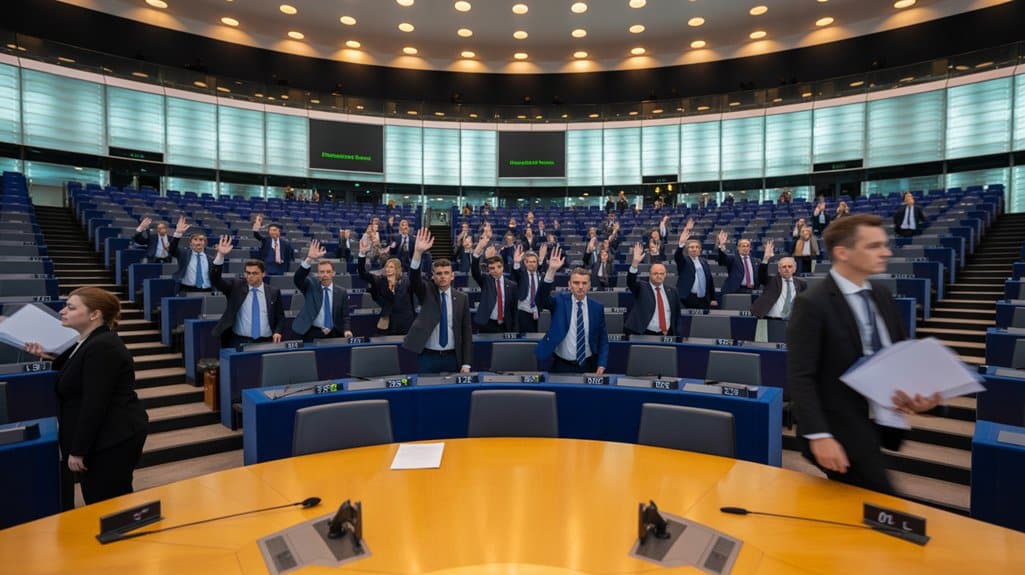
Parliament members filed into chambers on January 21, 2026, expecting routine debate on the EU-Mercosur trade agreement. What they got was one of the closest votes in recent memory. By just ten votes, 334 to 324, lawmakers decided to suspend the deal and send it to the Court of Justice for legal review.
The numbers tell the story of a deeply divided parliament. Trade agreements of this scale between Europe and South America typically pass with comfortable margins or fail decisively. This razor-thin outcome froze the ratification process entirely, meaning the agreement can’t move forward until European judges rule on several disputed legal points.
Party unity crumbled during the vote. The European Conservatives and Reformists couldn’t hold their members together, Polish and French representatives backed the suspension while their Italian and Czech counterparts voted against it. Similar splits appeared across other political groups, showing this wasn’t about traditional left-right politics but something cutting across normal party lines.
The deal, signed on 17 January, was designed to create a unified trade zone spanning more than 700 million people across two continents. For Uruguay and its Mercosur partners, Argentina, Brazil, and Paraguay, this creates immediate uncertainty. The trade deal would have eliminated most tariffs between the blocs and opened new markets for everything from Uruguayan beef to European machinery. Now those economic opportunities sit in legal limbo while judges deliberate.
How Long Before the EU-Mercosur Deal Faces a Court Ruling?
The court referral on Wednesday, January 21, 2026, triggered a timeline that usually takes around two years before the EU Court of Justice makes its final call. Judges need to untangle some pretty complicated legal questions – things like whether the agreement can start working before every country signs off on it, and whether it actually respects the EU’s power to set environmental and consumer protection rules.
This review process is expected to drag on until somewhere between mid and late 2028. During all that time, the whole ratification process gets put on ice, which means the deal just sits there waiting on both sides of the Atlantic. For Uruguay and its Mercosur partners, this creates real uncertainty about when they might actually see the benefits of expanded trade with Europe that negotiators have been working toward for over two decades. The European Parliament retains the power to annul the agreement even after the court makes its ruling.
Timeline for Court Decision
The EU-Mercosur trade deal reached completion on January 17, 2026, wrapping up years of complex negotiations. What comes next is a mandatory legal review that will keep the agreement in limbo for quite some time.
The Court of Justice of the European Union has taken on the task of analyzing whether this massive trade pact aligns with existing EU treaties. Based on similar cases, this process takes between 16 to 18 months to complete. Trade agreements of this scope and complexity have historically required around two years for full court review.
The judges need to determine if every aspect of the deal respects EU legal frameworks. When agreements involve multiple countries like Uruguay, Argentina, Brazil, and Paraguay on one side, plus all 27 EU member states on the other, the legal analysis becomes particularly thorough. European Parliament members cannot begin their own evaluation until the court issues its ruling.
Should the court find problems with the agreement’s legal foundation, negotiators would need to revise specific sections. Such amendments would push back implementation dates well beyond the current timeline. The trade deal that promised to create one of the world’s largest free trade zones now sits in legal review, despite overcoming the most challenging political negotiations in recent memory. The European Commission may pursue provisional application of parts of the agreement even while the court review continues.
Factors Affecting Ruling Speed
Several factors will shape how quickly judges move on this trade agreement. The legal complexity alone demands significant attention, courts must examine how Mercosur’s framework meshes with existing EU legislation, a process that typically requires eighteen to twenty-four months based on similar cases.
Strong opposition from France and Poland creates pressure for judges to conduct exhaustive reviews rather than rush their decisions. Agricultural lobbies have raised specific concerns about farming standards and food safety protocols, issues that historically prompt extended court deliberations when trade agreements are challenged.
The narrow parliamentary approval, just ten votes separating the 334-324 split, reveals the contentious nature of this deal. Such tight margins often signal to courts that thorough legal examination is warranted, as the political divisions suggest unresolved substantive concerns.
Uruguay and its three Mercosur partners face their own ratification hurdles through separate legislative processes. Each country’s parliament must approve the agreement independently, creating multiple potential bottlenecks that operate outside European court timelines. This means even swift European judicial approval wouldn’t guarantee immediate implementation, as South American legislative calendars and political considerations add another layer of uncertainty to the agreement’s final timeline. The agreement aims to establish a free trade area covering more than 700 million people across both continents.
Impact on Ratification Process
European Parliament’s January 21, 2026 vote brought the entire EU-Mercosur ratification process to a standstill. Parliament members cannot grant their consent until the Court of Justice completes its legal assessment, freezing all progress on the trade deal.
The agreement now enters an 18-24 month waiting period while judges determine whether it aligns with EU treaties. The European Commission’s decision to structure the deal in a way that sidesteps individual national parliament approvals has become the central issue under review.
The court’s eventual ruling won’t guarantee smooth sailing ahead. Should judges give their approval, Parliament still needs to vote on the agreement, and the tight margin that triggered this legal challenge suggests rejection remains possible. Uruguay and its three Mercosur partners, Argentina, Brazil, and Paraguay, must also complete their own ratification processes. Irish farming groups have raised concerns about cheaper imports that could undermine EU production standards. This extended delay transforms the relationship between Europe and South America’s trade bloc, leaving billions in potential commerce hanging in the balance while legal experts parse treaty language.
Why Was the Deal Referred to Europe’s Highest Court?

Why did lawmakers decide to bring this trade agreement before judges? European Parliament members spotted red flags in how this deal was being pushed through and whether it actually follows the rules.
The biggest worry centers on something called “split decision process.” The European Commission basically chopped up the trade agreement into smaller pieces, which meant national parliaments couldn’t vote on the whole thing. Think of it like buying a car but only getting to approve the purchase of individual parts – the wheels, the engine, the seats – without ever voting on whether you actually want the entire vehicle. Many representatives believe this approach violates European law.
Another concern involves what’s known as the “rebalancing mechanism.” This provision would let Mercosur countries – that’s Brazil, Argentina, Paraguay, and my own Uruguay – take retaliatory action if new European laws end up hurting our exports. Picture this: if Europe suddenly decides to ban a certain type of beef production that Uruguay specializes in, we could respond by limiting European imports in return. European lawmakers worry this arrangement might handcuff their ability to make independent policy decisions down the road.
The third issue deals with fundamental compatibility. Parliament members want the courts to examine whether this agreement clashes with core European principles before anyone signs on the dotted line. It’s like getting a legal opinion before signing a contract to make sure you’re not accidentally agreeing to something that contradicts your company’s basic operating rules. The agreement’s definition of the precautionary principle is weaker than EU’s standard, raising concerns about whether Europe could adequately protect against uncertain environmental and health risks.
This judicial review process protects democratic oversight in what could reshape trade relationships between Europe and South America for decades.
Why Farmers Are Fighting the EU-Mercosur Deal
European farmers see this trade deal as a direct threat to their survival, and the numbers tell a stark story. South American producers grow beef, poultry, rice, and soybeans at significantly lower costs because labor is cheaper and environmental regulations are less stringent. In Uruguay specifically, cattle ranching operates on vast grasslands with minimal input costs compared to Europe’s intensive farming systems.
The pesticide issue creates genuine competitive imbalances. Uruguay and other Mercosur countries use chemicals like atrazine and glyphosate in quantities that would violate EU standards. European farmers must follow stricter environmental rules while competing against imports produced under looser regulations.
Small European operations face the greatest risk. Official EU statistics show that half of all farms have vanished in the past 25 years, consolidated into larger enterprises. The Mercosur agreement could push more family farms over the edge since they lack the scale to absorb price pressures from cheaper imports.
Ireland illustrates the squeeze perfectly. The government wants to reduce cattle herds by 200,000 head to meet climate commitments while simultaneously opening markets to South American beef. Irish farmers find themselves caught between environmental demands at home and trade liberalization abroad.
Road blockades in Spain involved hundreds of farmers who demonstrated against the deal. France, Poland, Austria, and Hungary have all expressed formal opposition through their agricultural ministries. These countries recognize that their farmers cannot match Mercosur production costs without abandoning the environmental and welfare standards that European consumers increasingly demand. France saw its agricultural production value plummet to €77.1 billion in 2024 due to poor harvests, highlighting the sector’s vulnerability as the trade agreement moves forward.
Why Splitting the Agreement Into Parts Sparked Controversy
The European Commission chose to break apart the EU-Mercosur agreement, creating separate tracks for different components. This move allowed trade provisions to advance through a streamlined approval process that bypasses national parliaments across member states.
The strategy fundamentally changes how such agreements get ratified. Trade-only deals fall under exclusive EU competency, meaning the European Parliament and Council can approve them without requiring ratification from countries like France or Belgium. Mixed agreements covering trade plus other areas need approval from every national parliament – a process that can take years and often fails when individual countries vote no.
Opposition groups called this approach procedurally questionable. They pointed out that citizens lose their voice when national parliaments get cut out of major trade decisions. In countries where the deal faces strong resistance, particularly from farming communities concerned about beef imports, this procedural change removes a key democratic checkpoint. Civil society organizations have emphasized concerns about lack of transparency throughout the negotiation and ratification process.
The Commission defended the split as legally sound and practically necessary. Officials noted that similar separation approaches have been used before, though rarely for agreements of this scale and political sensitivity.
Bypassing National Parliament Votes
The controversy erupted when three EU countries took a firm stance against the agreement. France, Ireland, and Austria publicly declared they wouldn’t put the comprehensive deal before their national parliaments for ratification.
This created a domino effect across the European Union’s decision-making process. The European Commission’s response was to divide the agreement into separate parts, effectively sidestepping the need for all 27 member countries to vote on trade-related sections. Under this arrangement, only the non-trade elements would still need approval from national governments.
The strategy was designed to unlock market opportunities for nearly 780 million people across both regions. The deal would eliminate tariffs for 93% of Mercosur exports to the EU and 91% for EU exports to Mercosur over the coming years. Critics saw this tactical split as an attempt to silence legitimate concerns about environmental protection and workers’ rights – issues that directly affect millions of citizens who expected their elected representatives to have a say in the final decision.
Legality of Deal Structure
Legality of Deal Structure
European officials made a calculated decision about handling this massive trade deal by breaking it into separate pieces. The trade components would need approval only from the European Parliament, while political and cooperation elements would go to national parliaments for votes. This splitting strategy created significant legal questions about democratic process and fairness.
| Element | Approval Needed |
|---|---|
| Trade pillar | European Parliament only |
| Political cooperation | National parliaments |
| Association remnants | Mixed ratification |
Critics pointed out that this approach essentially sidesteps democratic oversight. When you separate the components, officials can avoid potential national vetoes on trade matters – something that directly affects citizens’ economic lives. The European Commission put forward this framework in 2023, drawing on past precedents to allow provisional implementation before all approvals were complete.
Legal experts raised concerns about whether this division violates the intent of comprehensive agreements. When trade deals get split up, national parliaments lose their chance to evaluate the full package and how different elements might interact. Citizens end up with less representation in decisions that shape their economic future, since their national representatives can’t weigh in on trade aspects that might conflict with domestic policies or values. Unresolved issues regarding judicial recourse connected to the agreement’s enforcement further complicate the implementation framework.
The precedent-setting nature of this approach means future trade agreements could follow the same pattern, potentially reducing democratic input on international economic commitments that bind countries for decades.
What Happens if the Court Rejects the Deal?

When Europe’s highest court decides against the trade deal, everything stops in its tracks. The court’s decision reshapes trade dynamics completely, forcing leaders back to the drawing board. This ruling isn’t just a pause, it’s a full reset.
Trade provisions vanish immediately. No tariff cuts happen, keeping current rates like 35% on cars firmly in place. Billions stay unspent as the $4 billion in expected savings and €6.3 billion agriculture fund never activate. Negotiations start fresh, giving countries demanding stronger environmental and labor protections their chance to redesign the agreement.
For citizens valuing sovereignty and fair standards, this outcome means their voices mattered. France, Italy, and Austria gain strength in opposing provisions they felt threatened their farmers and workers. This shift changes how future deals get structured between the EU and Latin American partners.
The rejection particularly affects Uruguay’s relationship with European markets. Uruguay’s beef exports, which currently face high EU tariffs, would continue operating under existing trade barriers. The country’s agricultural sector, representing roughly 70% of its export earnings, loses access to preferential treatment that could have boosted competitiveness against other South American producers.
Uruguay’s government would need to reassess its trade strategy. The small nation of 3.5 million people relies heavily on agricultural exports, making European market access crucial for economic growth. Without the deal, Uruguay faces continued disadvantages compared to countries that already have preferential EU access. EU farmers avoid the threat of farm closures that increasing volumes of imported beef, sugar, and poultry would have triggered under the agreement.
References
- https://www.euronews.com/my-europe/2026/01/21/european-parliament-freezes-mercosur-deal-referring-it-to-eu-court-of-justice
- https://www.europarl.europa.eu/news/en/agenda/plenary-news/2026-01-19/5/eu-mercosur-request-for-court-of-justice-opinions-and-motion-of-censure
- https://www.youtube.com/watch?v=NUqPUG5M71k
- https://www.lemonde.fr/en/economy/article/2026/01/22/european-parliament-throws-eu-mercosur-agreement-into-uncertainty_6749668_19.html
- https://www.youtube.com/watch?v=CD3Y2SQ3vdE
- https://www.youtube.com/watch?v=t4-3lzGawV4
- https://en.wikipedia.org/wiki/EU, Mercosur_Partnership_Agreement
- https://www.france24.com/en/europe/20260121-eu-parliament-votes-to-challenge-mercosur-trade-deal
- https://www.squirepattonboggs.com/insights/publications/eu-mercosur-trade-agreement-signed-starting-ratification-process/
- https://latinamericareports.com/mercosur-trade-pact-hit-by-legal-setback-after-eu-lawmakers-move/13340/