

Uruguay’s meat industry reached unprecedented heights in 2025, with exports totaling $2.68 billion, a 33% increase from 2024 figures. This performance stands out because it occurred during a period when global beef prices generally declined.
The country’s success stems from its grass-fed cattle production system, which produces beef that commands premium prices in international markets. Uruguay’s cattle graze year-round on natural pastures, creating meat with distinct flavor profiles and nutritional characteristics that buyers in China, the United States, and Europe specifically seek out.
Market data shows Uruguay’s beef prices increased even as competitors faced downward pressure. The nation exported roughly 400,000 tons of beef in 2025, meaning the average price per ton reached approximately $6,700, well above regional averages.
Several factors contributed to this outcome. Uruguay maintains strict animal health protocols and has remained free from foot-and-mouth disease since 2001, giving it access to premium markets that exclude other South American producers. The country’s traceability system tracks every animal from birth to slaughter, meeting the highest international food safety standards.
China represents Uruguay’s largest beef market, accounting for about 60% of total exports. Strong demand from Chinese consumers for high-quality protein, combined with Uruguay’s established reputation for consistency, helped drive the record sales figures.
Uruguay’s beef industry benefits from optimal natural conditions. The country’s temperate climate and abundant rainfall create ideal grazing conditions without requiring intensive farming methods.
This natural advantage, combined with generations of cattle-raising expertise, allows producers to deliver consistent quality at scale.
Key Takeaways
Uruguay’s beef industry delivered exceptional results in 2025, with exports climbing to $2.68 billion, a 33% jump that now represents one-fifth of the country’s total export earnings. This surge wasn’t just about higher prices; actual meat shipments rose to 548,000 tonnes, reflecting genuine demand for Uruguay’s grass-fed cattle and its hard-earned reputation for disease-free livestock.
The numbers tell a compelling story about Uruguay’s positioning in global markets. While beef prices fell worldwide, Uruguayan producers managed to secure an average of $5,000 per ton, a 19% premium increase. This price advantage stems from the country’s unique production methods and strict health standards that international buyers are willing to pay extra for.
Three major markets dominated Uruguay’s meat trade, with the US, China, and European Union together absorbing 82% of all exports. Trade tensions worked in Uruguay’s favor when the US imposed tariffs on Brazilian beef, creating fresh opportunities for Uruguayan suppliers to fill the gap.
China’s role shifted dramatically during the year. The Asian giant’s share of Uruguay’s meat exports dropped from 63% to 29% after implementing antidumping duties. European buyers stepped up to capitalize on this shift, increasing their purchases by 52% as they sought out Uruguay’s premium grass-fed beef for their quality-conscious consumers.
Uruguay’s Beef Exports Hit Record $2.68 Billion in 2025
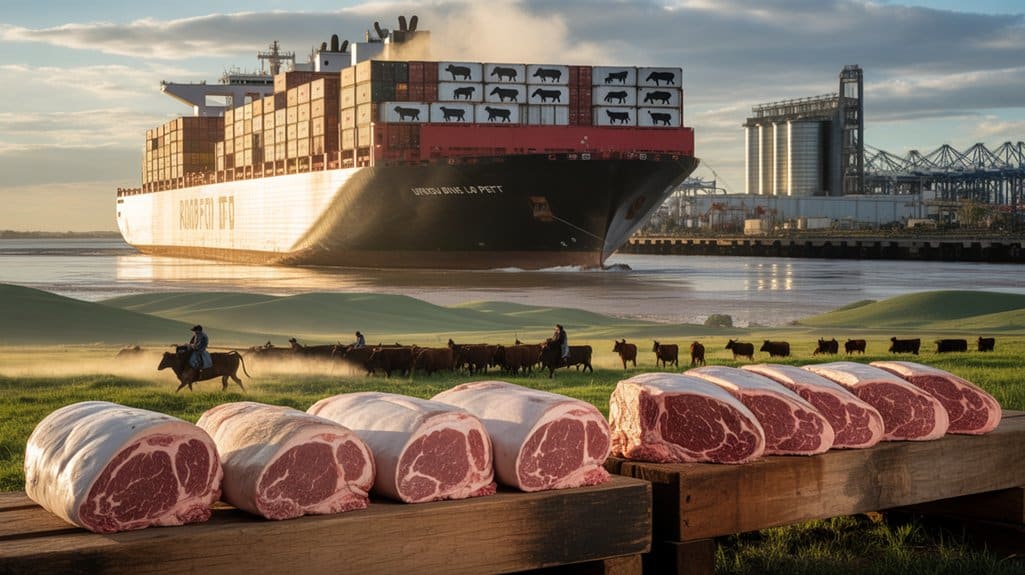
Uruguay’s beef industry posted record-breaking numbers in 2025, with exports reaching $2.68 billion. This represents a 33% increase from 2024 and accounts for one-fifth of the country’s total export earnings.
Export volumes climbed to 390,334 metric tons, marking an 11.2% rise from the previous year. December shipments alone totaled 33,364 metric tons, up 23.6% compared to the same month in 2024.
Several factors explain Uruguay’s growing export performance. The country’s cattle graze exclusively on natural pastures, producing beef that commands premium prices in international markets. Uruguay maintains a clean animal health record, with no cases of major livestock diseases like foot-and-mouth disease or BSE. This status allows Uruguayan beef to enter strict markets including the United States and European Union without trade restrictions.
The country’s comprehensive livestock tracking system also strengthens its position. Every animal carries electronic identification from birth to slaughter, creating complete supply chain visibility that international buyers increasingly demand. This traceability, combined with consistent quality standards, has helped establish Uruguay as a reliable supplier in global beef markets. Beef constituted 83.41% of total meat export value in 2025, with other exported products including offal, lamb, and animal feed products.
Why Beef Prices Rose 19% Despite Global Declines
While global beef prices generally declined in 2025, Uruguay bucked the trend with a solid 19% price increase. This happened because several major factors aligned in the country’s favor.
Supply problems plagued the world’s biggest beef producers. Brazil, Australia, and the USA all faced production constraints that reduced the amount of beef available on international markets. When there’s less meat to go around, prices naturally rise for what remains.
Trade policy changes created new opportunities for Uruguay. Brazil got hit with a 50% US tariff that made their beef much more expensive for American buyers. This policy shift opened up space for Uruguayan producers to step in and fill the gap.
European buyers drove demand higher, with purchases jumping 52%. Premium markets were willing to pay $11,600-12,000 per ton for quality beef. Uruguay positioned itself to capture this high-end demand by focusing more on grass-fed and organic products that command better prices than conventional beef.
The strategy paid off. Uruguay’s average export value hit $5,000 per ton – the best performance in a decade. The country reduced its dependence on China’s weakening market by winning over American and European buyers who were struggling to find reliable beef supplies elsewhere. Total meat export revenue reached around US$3.328 billion, marking a 4% increase from 2022’s previous record.
These market conditions allowed Uruguay to capitalize on its reputation for producing quality beef just when global shortages made that quality especially valuable to international buyers.
Export Volumes Reached 390,000 Tonnes on December Surge
Uruguay’s beef export success in 2025 goes beyond just higher prices. The country moved 390,334 metric tons of beef overseas, an 11.2% increase from the year before. These numbers show how well Uruguay holds its ground in competitive international markets.
December’s performance stood out even with a 5.2% drop from November. The month delivered 33,364 metric tons, 23.6% more than December 2024. American buyers drove much of this growth, taking 13,354 metric tons, which represents a 61.3% jump from the same month last year.
The National Customs Directorate’s figures reveal these shipments pushed yearly volumes to their second-highest point on record. Only 2021’s exceptional 424,000 tons surpassed this achievement. Container traffic by sea also grew 4.7% through November, hitting 33,436 TEUs.
Strong volume growth paired with better prices brought in USD 2.68 billion in beef sales, a 33% boost that underscores Uruguay’s expanding presence in global meat markets. Despite these gains, agricultural groups have raised concerns about financial pressures threatening the sector’s long-term viability.
Top Markets: US, China, and EU Bought 82% of Exports
Three powerhouse markets drove Uruguay’s meat export boom in 2025, snapping up 82% of the country’s total sales. The United States took the biggest bite, purchasing nearly one-third of all exports, while China and the European Union rounded out this dominant trio.
Each market brought its own appetite to the table. American buyers consistently favored premium cuts, creating steady demand that kept processing plants humming. Chinese importers focused on volume purchases, often placing large orders that helped Uruguayan producers plan their operations months ahead. EU countries, meanwhile, maintained strict quality standards that pushed local ranchers to upgrade their practices.
The Netherlands emerged as a standout performer within the European bloc, becoming a major gateway for Uruguayan beef entering continental markets. Dutch importers developed strong relationships with Uruguayan suppliers, often serving as intermediaries for distribution across neighboring countries.
Trade policy shifts rippled through all three regions during the year. New bilateral agreements with the US streamlined customs procedures, cutting delivery times by an average of five days. China’s updated food safety regulations initially slowed shipments but ultimately opened doors to higher-value product categories. EU sustainability requirements pushed Uruguayan ranchers to adopt new tracking systems, though these investments paid off through access to premium market segments. The EU-Mercosur deal aims to eliminate tariffs on approximately 91% of traded goods, potentially amplifying Uruguay’s competitive advantage in European markets.
Netherlands Leads Regional Demand
As Uruguay’s beef industry reached new heights in 2025, three major markets emerged as the backbone of its export success. The Netherlands claimed the top spot among all European Union destinations, purchasing $368.75 million worth of Uruguayan beef through November. This represents nearly one-third of total beef exports, making it the clear leader in both volume and value.
Why the Netherlands Dominates European Demand:
- Acts as the primary entry point for grass-fed beef entering EU markets
- Operates as a major distribution center, sending products throughout Europe
- Prioritizes Uruguay’s traceable, high-quality production methods
- Represents 32.85% of Uruguay’s total beef shipments
Italy, Portugal, and Spain also import substantial quantities, yet none match the Netherlands’ commanding position in the European market. The Dutch preference for Uruguayan beef stems from the country’s role as Europe’s logistics hub, where quality meets efficient distribution networks that reach consumers across the continent. Uruguay’s focus on specialty cuts positions the country to capture premium market segments while expanding its presence in Asian markets alongside its traditional European strongholds.
United States Import Performance
United States Import Performance
The Netherlands found its niche in Europe, but the United States stepped up as Uruguay’s biggest beef story. American imports tell the real tale, 13,354 metric tons of fresh beef arrived in December 2025, marking a solid 61.3% increase from the year before.
This wasn’t just holiday shopping driving numbers up. The US teamed up with China and the European Union to buy 82% of everything Uruguay shipped out. When three major economies compete for the same product, prices tend to climb. Uruguay’s total beef exports hit 548,000 tonnes that year, with American purchases helping push the USMCA region past the $1 billion mark in agricultural trade.
The numbers show what happens when quality meets consistent demand. Uruguay built its reputation on grass-fed cattle and reliable supply chains. American buyers recognized this value, creating a trade relationship that benefits both countries’ economies. Meanwhile, Uruguay also exported nearly 400,000 head of live cattle, with Turkey serving as the primary destination for this segment of the market.
China’s Growing Market Share
China’s Growing Market Share
American buyers weren’t the only ones changing Uruguay’s beef landscape. China’s position tells a different story altogether.
Uruguay’s exporters watched China’s share drop dramatically from its peak of 63% down to just 29% in 2025. The numbers show why putting all your eggs in one basket can backfire. China still bought USD 940.9 million worth of Uruguayan meat, landing in second place behind the USMCA countries.
South American producers, including Uruguay, control 73.2% of China’s beef imports. That sounds impressive until you factor in the 12% import duties from an ongoing antidumping case that’s making Uruguayan beef more expensive for Chinese buyers.
July 2025 brought an 8.5% drop in volumes compared to the same month the year before. Chinese importers still prefer frozen beef blocks and offal over other cuts. The relationship remains profitable – China helped Uruguay hit its record USD 3.25 billion in total meat exports. Uruguay supplied 16,408 metric tons to China in July, maintaining steady deliveries despite the overall decline.
The real lesson here? Selling to multiple countries instead of depending on one major buyer protects Uruguay’s ranchers when trade winds shift. China’s reduced share actually strengthened Uruguay’s position by forcing diversification that pays off when individual markets face problems.
Beef Now Represents 20% of Uruguay’s Total Exports
Uruguay’s beef industry has established itself as a major economic driver, with meat and related products accounting for 20% of total exports. This significant contribution helped push total exports to a record US$13,493 million in 2025, representing a 5% increase from the previous year and exceeding the 2022 benchmark.
The sector’s growth reflects careful market expansion across multiple regions. Uruguayan producers now sell to China, Brazil, the European Union, and North America, which spreads risk and reduces reliance on individual markets. This geographic spread provides stability when demand shifts in any particular region.
Meat exports grew alongside soybeans to drive the overall export performance, establishing the livestock sector as one of Uruguay’s top revenue generators. The industry demonstrates how consistent quality and market reach can build reliable income streams for agricultural producers across the country. With Uruguay’s cattle population at 12.1 million, the nation maintains a 4:1 ratio of cattle to people, providing a substantial resource base for sustained production.
2026 Forecast: 520,000 Tonnes and Continued Growth
Looking ahead, Uruguay’s beef sector shows strong momentum with export projections reaching 520,000 tonnes in 2026. This represents the second-highest level on record and demonstrates solid growth despite global market pressures.
Production numbers tell a similar story, with total output expected to hit 635,000 tonnes, approaching historical highs. This positive outlook stems from several key developments:
- Brazil and Australia are reducing production after reaching their 2025 peaks
- Global supply shortages continue to support strong prices
- Grain-fed beef operations are expanding their market presence
- Chinese import demand stays steady at 3.75 million tonnes
The worldwide beef trade faces a slight decline, creating opportunities for Uruguay to capture market share from competitors experiencing difficulties. The country’s streamlined ranching systems give it a clear advantage in meeting international demand for high-quality beef.
Uruguay’s cattle industry benefits from its geographic advantages and established infrastructure. The nation’s grasslands provide natural feeding grounds, while its processing facilities meet international standards. These factors combine to create a reliable supply chain that can respond quickly to market changes.
The shift toward grain-fed operations reflects Uruguay’s adaptation to premium market demands. This approach allows producers to command higher prices while maintaining the quality standards that international buyers expect.
Uruguay’s export efficiency stands in stark contrast to its neighbor, with an 82% export ratio compared to Argentina’s 30%, despite producing only 20% of Argentina’s total beef volume.
References
- https://datamarnews.com/noticias/uruguay-exports-climb-5-in-2025-to-10-year-high/
- https://www.tridge.com/news/uruguayan-exports-set-a-new-record-in-2025-fykyka
- https://tradeint.com/insights/top-5-largest-beef-export-countries-in-the-world-2025/
- https://www.inac.uy/innovaportal/file/26429/1/statistical-yearbook-2024.pdf
- https://www.fas.usda.gov/regions/uruguay
- https://www.upi.com/Top_News/World-News/2025/12/16/latam-uruguay-beef-industry-performance/1351765896548/
- https://www.euromeatnews.com/Article-Oustanding-figures-for-Uruguayan-beef-exports/5191
- https://tradingeconomics.com/uruguay/exports
- https://www.ceicdata.com/en/indicator/uruguay/total-exports-to-usa
- https://datamarnews.com/noticias/uruguays-meat-exports-reach-usd-3-25-billion-in-2025-surpassing-2022-record/