
The Capitán Fuentes Martínez Air Base in Montevideo welcomes civilians to witness Uruguay’s national aviation capabilities during this year’s public demonstration.
The Uruguayan Air Force’s Squadron I will perform standard formation flights using their Embraer A-29 Super Tucano aircraft, the country’s primary training and light attack planes purchased in 2012.
Pilots from the Air Force Academy will execute basic aerial maneuvers including coordinated turns, altitude changes, and landing approaches that form part of their regular training curriculum.
These demonstrations showcase the operational readiness of Uruguay’s modest but well-maintained fleet of 15 aircraft.
The event serves multiple purposes for this small South American nation of 3.5 million people.
It allows the public to observe how their defense budget supports pilot training while demonstrating the Air Force’s role in national security and humanitarian missions.
Last year’s flood response in the Tacuarembó region highlighted how these same aircraft assist in disaster relief operations.
Spectators should arrive early since parking fills quickly at the base’s single visitor entrance on Ruta 102.
The demonstration lasts approximately 90 minutes, weather permitting, as Uruguay’s unpredictable spring conditions can force cancellations for safety reasons.
Key Takeaways
Demo team bookings work on different timelines depending on the aircraft. F-16 teams can confirm appearances with 45 days’ notice, while the newer F-35 and F-22 squadrons need 60 to 90 days to lock in their schedules.
All adults attending the demonstration must bring valid identification to the gate. Security personnel will conduct background checks that typically process within three business days of the event.
Organizers need to submit their complete event timeline seven days before opening. This allows military coordinators to review safety protocols and approve the final schedule.
Visitors from other countries should bring current passports and coordinate with the Pass and Registration Office beforehand to arrange proper sponsorship documentation.
Those driving to the demonstration site must have their license, vehicle registration, and current insurance documents available when security teams verify credentials at entry checkpoints.
Demonstration Schedule and Arrival Times
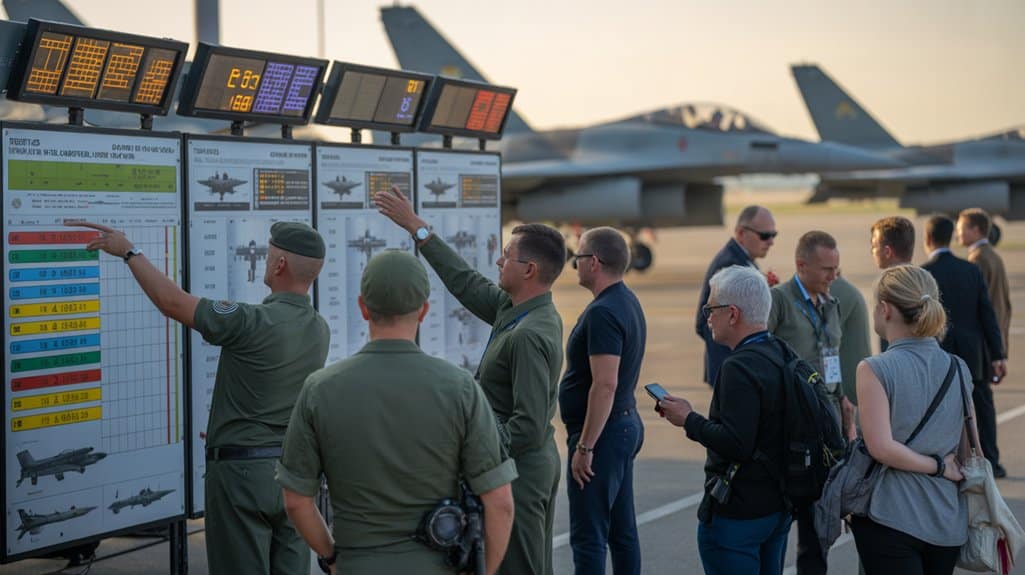
Different demonstration teams work on their own timelines for booking appearances. F-16 Demo Teams ask for 45 days advance notice, while F-35 and F-22 teams need 60 days for domestic shows and 90 days when traveling internationally. The Blue Angels send advance coordinators to inspect venues during their off-season winter months.
Event organizers submit their detailed schedules one week before opening day. This timeline gives all parties enough preparation time and helps create a well-organized experience for attendees.
Thunderbirds F-16 Formation Flying and Solo Acts
The Thunderbirds push their F-16 jets to extraordinary limits, maintaining formation just 18 inches apart while traveling at speeds exceeding 500 mph. Each pilot must have complete confidence in their teammates since even the smallest error could prove catastrophic.
These demonstrations take place as close as 150 feet above the ground, adapting real combat maneuvers for public display. The physical toll on pilots is substantial – they experience forces up to nine times normal gravity during sharp turns and vertical loops. Most people would lose consciousness under such conditions.
Maintaining this level of performance requires rigorous preparation. Pilots practice twice each day, six days weekly, developing the muscle memory and coordination essential for safe flight operations. They also learn special breathing methods that help them stay alert when extreme forces try to drain blood from their brains.
The solo performances showcase the F-16’s raw capabilities through near-vertical ascents that cover 12,000 feet in mere seconds. These climbs demonstrate both the aircraft’s power and the pilot’s ability to control tremendous forces while pulling maneuvers that would be impossible in most other aircraft. Selection for the team is extremely competitive, with 75 to 100 applications submitted for each single flying position that opens annually.
Blue Angels, Warbirds, and Other Featured Aircraft
The U.S. Navy’s Blue Angels have been flying demonstration flights since 1946, when Admiral Chester W. Nimitz established the squadron to promote naval aviation following World War II. The team started with propeller-driven aircraft before transitioning to jets over the decades.
| Aircraft | Era | Formation Type |
|---|---|---|
| F6F Hellcat | 1946 | Initial demos |
| F8F Bearcat | 1946-1949 | Diamond debut |
| F9F Panther | 1952-1954 | Jet transition |
| F-4 Phantom | 1969-1974 | Two-seat delta |
| F/A-18 Super Hornet | 2021-present | Modern precision |
The squadron’s trademark diamond formation requires pilots to maintain wingtip separation of just 18 inches during flight maneuvers. Six Navy aviators and one Marine Corps pilot make up the current team roster. Their performances demonstrate the capabilities of naval aviation while serving as a recruiting tool for the service branches. The squadron currently consists of 17 officers, including tactical jet pilots and support officers.
Must-See Maneuvers: Diamond Formation to Sonic Booms
Must-See Maneuvers: Diamond Formation to Sonic Booms
Specific aerial displays transform airshows into memorable experiences for ground spectators. The Blue Angels execute their signature diamond formation with four jets flying inverted in precise synchronization at approximately 100 feet altitude. Pilots maintain close spacing during aerial loops at speeds up to 400 knots, requiring exact coordination.
Key maneuvers include:
- Opposing Rolls involve pilots crossing flight paths while completing 720-degree rotations, often performed inverted directly overhead
- Vertical Climbs propel aircraft upward at 70-degree angles, followed by split-S crossover patterns
- High Alpha Passes demonstrate Super Hornet capabilities at reduced speeds of 130 mph, highlighting precise low-velocity handling
Sonic booms occur when aircraft exceed the speed of sound, producing distinctive pressure waves that create audible thunder-like sounds felt by spectators. These high-speed passes deliver the thrill that captivates audiences at military aviation demonstrations.
Best Viewing Locations and Photography Tips
Military aviation displays in Uruguay offer spectacular viewing opportunities, particularly at the annual Punta del Este International Air Festival and demonstrations at Captain Fuentes Martinez Air Base near Montevideo. The country’s coastal geography creates ideal conditions for airshow photography, with clear Atlantic horizons providing uncluttered backgrounds.
Prime viewing spots typically sit 200-300 meters from the flight line, where jets pass at altitudes between 50-150 meters. This distance balances safety requirements with visual impact. Spectators positioned at the center of the display area witness the most dynamic maneuvers, as pilots design their routines around this focal point.
Camera settings prove crucial for capturing fast-moving aircraft. Shutter speeds of 1/500th second or faster freeze jet engines and control surfaces in sharp detail. Continuous autofocus tracking helps maintain focus on aircraft traveling at 400-600 kilometers per hour during low-level passes. ISO settings between 200-400 work well in bright daylight conditions common during Uruguayan summer airshows.
Wind direction affects both aircraft performance and photography. Jets typically approach into the wind for better control during tight turns and vertical climbs. Photographers benefit from positioning themselves downwind of the display area, as this angle often provides better lighting and reduces exhaust distortion in images.
Early arrival secures the best positions, as premium viewing areas fill quickly. Bringing folding chairs and sun protection makes sense for events lasting 3-4 hours. Weather changes rapidly along Uruguay’s coast, so checking forecasts helps avoid sudden rain that can cancel aerial demonstrations. Modern airshows increasingly feature small uncrewed aerial systems that perform coordinated flight patterns alongside traditional manned aircraft.
Optimal Airshow Vantage Points
Your position at an airshow directly impacts what you’ll see and photograph. The sun’s angle determines whether aircraft appear brilliantly lit or lost in shadows, making location choice crucial for spectators.
Photography and visibility improve dramatically when you position yourself south or west of the runway. Aircraft catch natural light from these angles, eliminating the backlighting problems that plague viewers on the opposite sides.
Three location types consistently deliver superior experiences:
Beachfront areas like Missouri Avenue in Atlantic City combine comfort with clear sightlines. The soft sand provides natural seating while ocean winds keep temperatures manageable. Wide-open sky access means no obstructions block aerial maneuvers. Bringing chairs and umbrellas allows spectators to create personalized comfort zones throughout extended viewing sessions.
High-rise observation decks such as Vue at the Claridge’s 23rd floor offer comprehensive views impossible from ground level. The elevated perspective reveals formation patterns and flight paths that remain hidden to street-level observers.
Airport-adjacent restaurants including Hangar Bar & Grill place you within hundreds of meters of aircraft operations. Proximity allows engine sounds and pilot communications to enhance the sensory experience while maintaining access to refreshments.
East and north positions create consistent backlighting challenges as aircraft fly between spectators and the sun. This positioning forces viewers to squint while cameras struggle with exposure settings.
Weather data from Atlantic City shows prevailing winds typically blow from the southwest, meaning southern positions also benefit from favorable breeze direction. Temperature readings indicate these spots average 3-5 degrees cooler than northern locations due to air circulation patterns.
The difference between adequate and exceptional airshow viewing comes down to understanding these environmental factors before selecting your spot.
Camera Settings for Jets
Photographing military jets requires camera settings that match their high-speed performance. Set your shutter speed to 1/800th of a second or faster to eliminate motion blur when aircraft pass overhead. An aperture of f/8 provides the optimal balance between depth of field and light intake, ensuring sharp focus across the entire aircraft frame.
Bright daylight conditions allow you to maintain ISO 100, which produces the cleanest image quality without digital noise. This combination of settings works particularly well during Uruguay’s clear winter months when military exercises often take place along the Atlantic coast.
Your camera’s continuous autofocus mode tracks moving subjects more effectively than single-point focus. Lock onto the aircraft early by half-pressing the shutter button while the jet remains distant. Burst mode captures multiple frames per second, increasing your chances of getting that perfect shot as aircraft execute maneuvers. Avoid excessive burst shooting to prevent camera buffer overload, which can cause you to miss critical moments during rapid sequence maneuvers.
Switching to manual mode with auto ISO adaptation gives you consistent exposure control when cloud cover changes rapidly. Uruguay’s variable coastal weather can shift lighting conditions within seconds during airshows, making this flexibility crucial for maintaining proper exposure throughout extended photography sessions.
Tracking Fast-Moving Aircraft
Why do some photographers nail those incredible military jet shots while others can’t even get a clear frame? It comes down to mastering the tracking fundamentals that professionals rely on.
Your position determines everything. Set up at roughly 80-90% of the distance between where the aircraft appears and where it’ll disappear from view. This positioning gives you the longest possible tracking window without scrambling to keep up.
Switch your camera to continuous autofocus mode—this keeps the lens adjusting as the jet moves through your frame. Scout your location beforehand to avoid trees, buildings, or chain-link fences that’ll ruin your shot. The key is maintaining a clear sight line throughout the aircraft’s path.
Follow the jet smoothly through your viewfinder rather than trying to predict where it’s going. Your camera’s autofocus system works best when you help it by keeping the aircraft centered in your frame. Professional aviation photographers in Uruguay often practice this technique during commercial aircraft approaches at Carrasco International Airport, where predictable flight paths make it easier to develop smooth tracking skills.
Sharp military jet photography requires patience and practice with these core techniques. Modern aircraft equipped with Mode S transponders can be tracked in real-time, allowing photographers to anticipate flight paths and prepare their positions accordingly. Each successful frame builds the muscle memory needed for consistently professional results.
What to Bring and Base Entry Requirements
Before heading to the Military Zone Aviation Demonstration, you’ll want to sort out your paperwork and know what’s expected at the gates. Anyone 18 or older needs proper identification that security can verify on the spot. Your best bet is carrying a REAL ID-compliant driver’s license or US passport—expired documents simply won’t cut it with base personnel.
Drivers face additional requirements beyond basic ID checks. You’ll need your license, current vehicle registration, and proof of insurance ready for inspection. Security reserves the right to search any vehicle entering the facility, so factor this into your arrival time.
Students get streamlined access through the South Gate, while general visitors must secure sponsorship and obtain advance authorization. The Pass and Registration Office conducts mandatory background screenings that require up to three full business days to complete—rushing this process isn’t possible. The office is closed for training on the third Tuesday of each month, so plan your visit accordingly.
International attendees face the most complex entry procedures. Valid passports are non-negotiable, and sponsor arrangements become even more critical. Processing times stretch well beyond an hour, making early arrival essential for smooth access to the demonstration.
Why the 1982 Crash Changed Thunderbirds Forever
On January 18, 1982, the Thunderbirds lost four pilots in a single moment that devastated the entire Air Force community. During training at Indian Springs, a mechanical failure caused the lead aircraft’s stabilizer to jam mid-loop. The three trailing pilots maintained their tight formation and followed their leader straight into the ground.
This tragedy fundamentally changed Thunderbird operations. Pilot safety took precedence over maintaining perfect formations at all costs. New training protocols explicitly authorized pilots to break formation during emergency situations, something previously discouraged in the pursuit of precision flying.
The Air Force redefined formation discipline itself. Pilots now receive specific instruction on making independent judgment calls when safety concerns arise. Breaking formation to avoid disaster became not just acceptable but expected behavior.
The accident delivered a sobering lesson about blind obedience versus situational awareness. Those four aviators died because they followed standard protocol in extraordinary circumstances. Modern Thunderbirds honor their memory by practicing precision flying that incorporates individual decision-making, creating a safer environment for demonstration teams while maintaining the spectacular performances audiences expect.
These changes weren’t just procedural adjustments – they represented a cultural shift within military aviation demonstration teams. The balance between showmanship and survival now tilts decisively toward keeping pilots alive. Following the tragedy, the team transitioned to F-16 Fighting Falcons in 1983, which offered superior performance and reliability for the demanding maneuvers that define their demonstrations.
References
- https://www.airforce.com/thunderbirds/overview
- https://www.youtube.com/watch?v=qZYHZnDMoGg
- https://www.youtube.com/watch?v=788tS-7TDxg
- https://www.skycombatace.com/blog/planes-used-airshows
- https://www.popularmechanics.com/military/aviation/a25644519/five-fighter-jets-fly-in-formation/
- https://www.flightglobal.com/keep-it-tight-10-flight-display-teams-of-note/118474.article
- https://www.youtube.com/watch?v=jAKGu2Ki0Wc
- https://en.wikipedia.org/wiki/Aerobatic_maneuver
- https://www.war.gov/News/Feature-Stories/story/Article/1633249/guide-to-air-shows-and-demonstrations/
- https://simpleflying.com/military-aircraft-types-used-in-combat/