

Uruguay’s real estate market is undergoing significant transformation. Trade agreements have facilitated foreign investment and construction activity. Reduced construction costs have expanded market competitiveness. Luxury properties are attracting European and American capital flows. Coastal regions and Montevideo are experiencing new development projects.
Several factors drive this investment activity. Improved trade conditions create favorable conditions for international builders. Lower production costs enhance project profitability. Established demand for high-end residential properties sustains investor interest. Geographic advantages and economic stability position Uruguay as an attractive destination for foreign capital.
The sustainability of this expansion remains subject to external conditions. Trade policy changes could alter investment patterns. Construction cost fluctuations may affect project viability. Market saturation in key locations could moderate growth rates. Economic shifts in source markets may influence capital availability.
Key Takeaways
- The EU-Mercosur pact, ratified in January 2026, eliminated tariffs on European construction materials, reducing costs by 18-35% and attracting foreign investment to Uruguay.
- Foreign buyers account for 75% of beach resort sales. European and American investors increasingly target Uruguayan properties, alongside investors from Argentina and Brazil.
- European firms establishing Montevideo regional headquarters employ expat staff at six-figure salaries and maintain substantial corporate lease budgets, driving demand in the premium rental market.
- Punta del Este’s luxury segment appreciates at 12% annually, while premium Montevideo neighborhoods grow at 10%, both exceeding the national average of 5%.
- Infrastructure investments totaling $7.2 billion and tax incentives under Law 18.795 support construction activity and facilitate global capital flows into the sector.
Uruguay’s Trade-Driven Property Boom
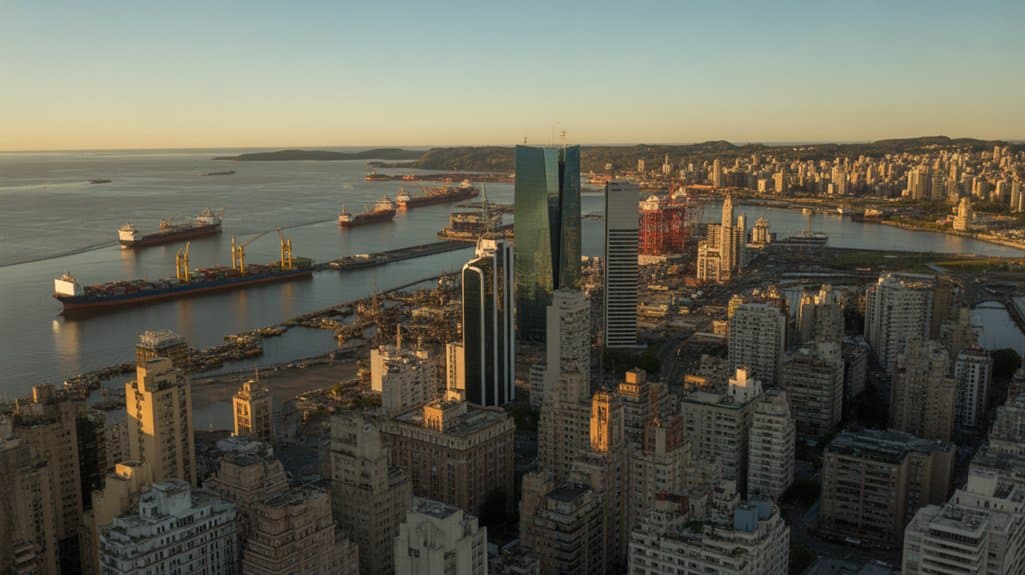
A decade of stagnant real estate returns ended with the EU-Mercosur trade pact ratification in January 2026. The agreement fundamentally restructured Uruguay’s economy and triggered immediate shifts in the property market.
European construction machinery now enters duty-free, eliminating the previous 18% cost premium. Premium building materials shed their 35% tariffs and became competitively priced. Simultaneously, hundreds of European corporations established regional headquarters in Montevideo, introducing six-figure expat salaries and corporate lease budgets that exceeded traditional tenant demand.
The implications for existing Uruguayan real estate holders are significant. A typical rental property delivering 5-7% net yield now competes directly with European-backed corporate rentals yielding 6-8%. Structural cost reductions allow developers to undercut prices while expanding margins, compounding pressure on traditional landlords. The adoption of European prefabrication techniques further reduces on-site construction labor, enhancing developer profitability on new premium developments.
Capital reallocation accelerated across key neighborhoods: Carrasco, Punta Carretas, and Zonamerica. The trade agreement’s impact extended beyond tariff reduction. It introduced a new class of high-income tenants, reduced development costs substantially, and granted European builders legal parity in bidding for state contracts valued in the billions.
Uruguay’s real estate cycle has fundamentally shifted. The trajectory of price movements no longer represents the primary variable. Rather, early positioning determines the ability to capture the economic spread created by the agreement’s structural changes.
Market Dynamics Reshape Investment Landscape
Uruguay’s real estate sector demonstrates unprecedented momentum, driven by converging forces that fundamentally alter property acquisition approaches. Market data reflects near-capacity operations, with transaction volumes reaching 27,533 units in the first seven months of 2025, a 1.3% year-over-year increase, and sales exceeding $1.17 billion in the first half.
Montevideo leads national activity at 34.4% of transactions, followed by Maldonado at 17.9%. This concentration reflects structural shifts in buyer preferences and capital allocation. Foreign purchasers dominate beach resort transactions at approximately 75% of sales. Argentines represent the largest foreign cohort, with Brazilians comprising 20% of coastal acquisitions. European buyers and U.S. investors increasingly target Uruguayan properties, drawn by institutional safeguards and economic stability. The business-friendly environment continues to reinforce Uruguay’s attractiveness as a secure investment destination for international capital.
Price appreciation varies considerably by geography and property class. Punta del Este recorded 10% annual growth, with luxury segments exceeding 12%. National averages rose 5% in USD terms over twelve months. Premium neighborhoods achieved the fastest growth at 10%, indicating concentrated capital deployment in high-end segments.
Price momentum extends into 2026. Montevideo faces forecasted appreciation of 3-5% annually through 2028, while premium coastal properties are expected to surpass these levels. The Central Bank’s reduction of the policy rate to 7.5% has expanded mortgage accessibility and removed previous financing constraints on demand.
Infrastructure investments totaling $7.2 billion support suburban valuations. These investments include $3.7 billion for road networks and $500 million for water systems. This capital deployment simultaneously constrains supply, creating persistent upward price pressure across multiple segments.
Regulatory Framework Supports Growth
Uruguay’s policy environment makes real estate investment genuinely appealing. The country welcomes foreign ownership on equal terms with domestic buyers. International investors can purchase apartments, houses, or land without restrictive procedures.
Tax incentives enhance investment returns. Law 18.795 provides income tax breaks for residential construction. Property transfer taxes are eliminated for investors and buyers alike. These provisions represent substantial financial savings. The legal framework since 2011, with recent relaxations under President Luis Lacalle Pou, has further accelerated construction activity across the country.
The regulatory framework maintains transparency and fairness. All transactions require notary approval and registry recording, which establishes legal certainty for property investments. Combined with moderate taxation and financial stability, Uruguay offers reliable conditions for real estate investors.
References
- https://www.realestate-in-uruguay.com/blog/uruguay-real-estate-eu-mercosur-construction-roi/
- https://www.realestate-in-uruguay.com/blog/uruguay-real-estate-eu-mercosur-public-procurement/
- https://www.realestate-in-uruguay.com/blog/eu-mercosur-services-uruguay-real-estate-yield/
- https://www.nicolasdemodena.com/blog/uruguay-in-2026-the-best-country-in-latin-america-to-invest-in-real-estate/
- https://www.uruguayxxi.gub.uy/en/news/article/mercosur-y-union-europea-firmaron-acuerdo-de-libre-comercio-que-potenciara-la-proyeccion-internacional-de-uruguay/
- https://aulablog.net/2026/03/11/between-giants-how-uruguay-is-expanding-its-global-trade-strategy/
- https://www.canninghouse.org/news/uruguays-long-term-commitment-to-growth
- https://www.youtube.com/watch?v=xBIyjTJfstA
- https://www.realestate-in-uruguay.com/blog/uruguays-economic-potential-real-estate-landscape-analysis/
- https://www.globalpropertyguide.com/latin-america/uruguay/price-history