
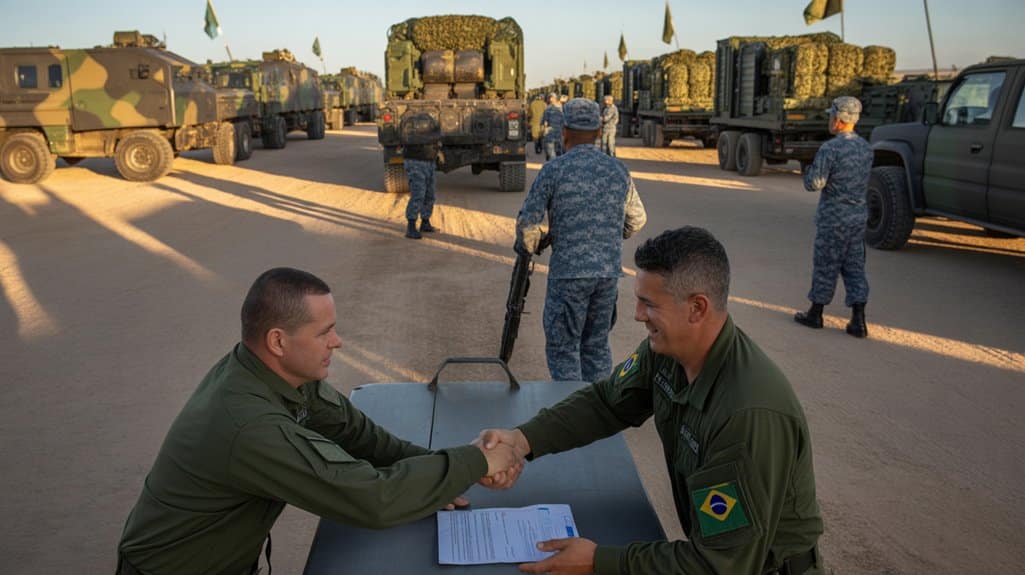
Brazil’s been stepping up its military cooperation with neighboring countries, sending two helicopters to Uruguay and artillery equipment to Paraguay as part of broader regional security efforts. This equipment sharing reflects Brazil’s strategic approach to building stronger defense ties throughout South America.
For Uruguay, these helicopter transfers couldn’t come at a better time. The country’s military has been operating with aging aircraft for years, and these Brazilian helicopters will significantly boost Uruguay’s ability to patrol its borders and respond to security threats. Uruguay’s geography makes air support essential – the country needs reliable aircraft to monitor its extensive coastline along the Atlantic Ocean and maintain surveillance over remote areas near the Brazilian and Argentine borders.
The timing of this cooperation makes sense from Brazil’s perspective too. South America faces growing challenges from drug trafficking networks that operate across national boundaries, and environmental crimes like illegal logging and mining that affect the entire region. When Uruguay has better military equipment, it can more effectively patrol areas where these criminal networks operate, which ultimately benefits Brazil’s own security.
Paraguay’s receiving artillery equipment as part of the same initiative, showing that Brazil’s taking a comprehensive approach to regional defense partnerships. These transfers work differently than traditional arms sales – Brazil’s providing equipment through government-to-government agreements that strengthen diplomatic ties while addressing real security needs.
Uruguay’s military will use these helicopters primarily for border patrol, search and rescue operations, and supporting police efforts in remote areas where ground access is difficult. The aircraft will be particularly valuable for monitoring river systems along Uruguay’s borders, where smuggling operations often concentrate their activities.
This equipment sharing represents a shift toward more integrated regional security, where larger countries like Brazil help smaller neighbors build their defensive capabilities rather than each nation trying to address security challenges alone.
Key Takeaways
Brazil has handed over two Bell Jet Ranger III helicopters to Uruguay’s navy, marking a significant step in regional defense cooperation. The aircraft will bolster Uruguay’s ability to protect its borders and respond to emergencies along its coastline.
President Lula da Silva made this possible by signing new legislation on January 12, 2026, that allows Brazil to donate military equipment to its neighbors. This legal framework opens the door for future transfers that could strengthen the entire region’s defense capabilities.
Uruguay plans to put these helicopters to work right away. The aircraft will patrol the country’s borders with Argentina and Brazil, monitor coastal waters along the Atlantic Ocean, and help with search-and-rescue operations when natural disasters strike. The navy will also use them to train personnel for international peacekeeping missions, an area where Uruguay has built a strong reputation despite its small size.
Criminal organizations don’t respect national borders, and that’s exactly what these helicopters are meant to address. Drug trafficking routes and smuggling networks often span multiple countries in South America, making it essential for nations to work together. Uruguay’s new aircraft will help close gaps in surveillance that criminals have exploited in the past.
Brazil picked up the tab for shipping the helicopters and delivered them in their current condition, without major overhauls or upgrades. This approach keeps costs manageable while still giving Uruguay valuable assets that would have been expensive to purchase new. The helicopters will immediately improve the country’s ability to respond to floods, storms, and other emergencies that regularly affect the region.
What Military Equipment Did Brazil Transfer to Uruguay and Paraguay?
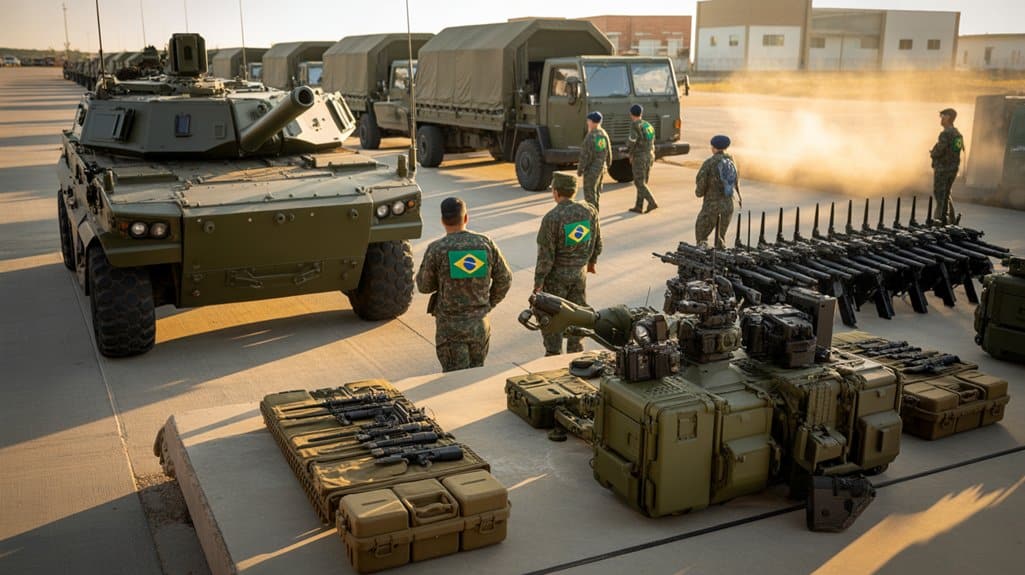
Brazil’s been sharing military gear with Paraguay and Uruguay lately, part of building stronger ties across the Southern Cone region.
Paraguay walked away with the bigger package. They got six M108 self-propelled howitzers – basically armored vehicles with big guns mounted on top that can move around the battlefield while providing heavy firepower. Brazil’s Army handed over two Bell 412 Classic helicopters from their Federal Police fleet too. Paraguay also received an aluminum floating bridge, which sounds simple but it’s actually crucial military infrastructure for getting troops and equipment across rivers when permanent bridges aren’t available.
Uruguay’s haul was smaller but still significant for their navy. They picked up two Bell Jet Ranger III helicopters that came straight from Brazil’s naval forces. For Uruguay’s National Navy, these aircraft represent a real boost since they operate with limited resources compared to larger regional militaries.
Brazil delivered everything “as-is” – no refurbishments or modifications included. They did cover shipping costs right up to each country’s border though. This kind of equipment transfer happens regularly between allied nations, but it’s particularly important for smaller militaries like Uruguay’s that can’t always afford brand-new hardware. The gear gives both countries better operational capabilities without the massive price tag of buying fresh from manufacturers. The transfers were formalized through two laws signed by President Luiz Inácio Lula da Silva and Defense Minister José Múcio Monteiro Filho.
How Did Brazil Officially Authorize the Transfers?
Brazil’s government followed a straightforward legal pathway to make these military equipment transfers official. On January 12, 2026, President Luiz Inácio Lula da Silva and Defense Minister José Múcio Monteiro Filho put their signatures on two separate laws that gave formal approval to the donations.
The process started when Brazil’s Executive Branch drafted these laws with one clear purpose: creating the legal foundation needed to send helicopters and other military equipment to Uruguay and Paraguay. This approach ensured the transfers met all constitutional requirements and followed proper diplomatic protocols between the neighboring countries. The initiative aimed to strengthen diplomatic relations and expand military cooperation throughout the region.
The dual signing by both the president and defense minister demonstrates how Brazil treated these donations as matters of both foreign policy and military cooperation. Each law addressed specific equipment categories and recipient countries, establishing clear guidelines for the transfer process.
Presidential Decree Process
The Chamber of Deputies reviewed the bill before passing it to the Senate for consideration. Both legislative bodies approved the measures and sent them back to President Lula for final approval. President Lula signed the authorization on Monday, January 12, 2026, with Defense Minister José Múcio Monteiro Filho present at the signing ceremony. The presidential signature transformed the legislative proposal into official law, giving Brazil legal authority to donate military equipment to Uruguay and Paraguay and fund the shipping costs for both countries. The Ministry of Defense’s budget will cover the transportation expenses for delivering the equipment to both recipient nations.
Legislative Framework Enacted
On January 12, 2026, President Luiz Inácio Lula da Silva and Defense Minister José Múcio Monteiro Filho signed two laws that officially authorized military equipment transfers to neighboring countries. The legislation followed Brazil’s standard democratic process, the Executive Branch proposed the transfers, the Chamber of Deputies approved them, and the Senate moved Bill No. 2911/2022 forward specifically for Paraguay’s equipment allocation.
These laws gave Brazil’s Ministry of Defense the legal backing it needed to donate military equipment to both Uruguay and Paraguay. The formal legislative approach served a dual purpose: it maintained transparency in government operations while strengthening diplomatic relationships with both countries. The Ministry of Defense’s budget covered the costs of transportation and formalization for these transfers.
Brazil’s decision to work through established democratic channels rather than executive orders demonstrates the country’s commitment to institutional processes. This approach builds trust with neighboring nations because it shows that military cooperation agreements receive proper oversight and aren’t subject to sudden policy reversals. Uruguay and Paraguay can count on these commitments since they emerged from Brazil’s complete legislative system rather than informal agreements.
The structured process also creates a clear paper trail for the transfers. Citizens in all three countries can see exactly what equipment changed hands and under what legal authority, which helps prevent the kind of opacity that sometimes surrounds military cooperation between nations.
Why Brazil Is Strengthening Defense Ties With Its Neighbors
Brazil’s defense partnerships with Uruguay and Paraguay represent a strategic shift from simple equipment sharing to comprehensive regional security cooperation. The country recognizes that organized crime networks operate across borders, making isolated national responses inadequate against sophisticated drug trafficking operations that move freely between countries.
Drug cartels have established routes through multiple South American nations, turning border regions into high-risk zones where local law enforcement lacks the resources and coordination needed to combat well-funded criminal organizations. Brazilian officials understand that criminal groups exploiting weak points in one country’s defenses ultimately threaten regional stability.
Military capability enhancement across participating nations creates a foundation for coordinated responses to security threats and natural disasters. When Paraguay faced severe flooding in 2019, regional military cooperation enabled faster deployment of rescue resources and equipment. Similar cross-border collaboration has proven effective in tracking drug shipments that previously moved undetected through remote border areas.
This approach builds on existing frameworks like the Union of South American Nations’ Defense Council, which has facilitated information sharing between military and police forces since 2008. Countries participating in these enhanced partnerships report improved intelligence gathering and more successful interdiction of criminal operations that span multiple jurisdictions. The enhanced cooperation aligns with broader regional integration efforts, as leaders from Paraguay and Uruguay recently gathered to advance multilateral agreements strengthening ties between their nations.
The emphasis on community protection reflects lessons learned from Colombia’s experience with transnational crime, where isolated efforts proved insufficient against organizations that adapted quickly to single-country enforcement strategies. Regional cooperation creates multiple pressure points that criminal networks find harder to circumvent.
Countering Transnational Crime Networks
Criminal networks have turned South America into a vast smuggling operation, creating invisible corridors that transport drugs, weapons, and contraband from remote jungle laboratories to markets on distant continents. The Primeiro Comando da Capital (PCC) and Comando Vermelho wage territorial wars over these lucrative routes that snake through the Amazon rainforest. Local communities find themselves caught in the crossfire as violence spills into their neighborhoods and towns.
Brazil has strengthened military partnerships with neighboring countries to disrupt these operations before they gain more ground. The collaborative approach makes sense , criminal organizations don’t respect borders, so law enforcement can’t either.
| Criminal Group | Main Activity | Region |
|---|---|---|
| PCC | Drug trafficking | Bolivia to Europe |
| Comando Vermelho | Smuggling networks | Amazon basin |
| South Caribbean Cartel | Cocaine transshipment | Uruguay, West Africa |
Uruguay presents a particularly striking example of how quickly transnational crime can transform a nation. My country’s murder rate climbed to 10.5 per 100,000 inhabitants in 2024 , a dramatic shift for what was once considered South America’s Switzerland. This spike coincides directly with Uruguay’s emergence as a critical transshipment point where cocaine gets packaged and rerouted toward African ports, then onward to European consumers.
The transformation happened because criminal groups recognized Uruguay’s strategic advantages: modern port facilities in Montevideo, relatively weak enforcement resources compared to Brazil or Argentina, and established shipping connections to West Africa. What started as opportunistic use of our infrastructure evolved into systematic infiltration of legitimate businesses and corruption of port officials.
Effective responses demand sustained cooperation between countries rather than isolated national efforts. Criminal networks adapt quickly to enforcement pressure, simply shifting routes when one country cracks down. Only coordinated regional strategies can match their flexibility and international reach. Brazil’s deployment of armed forces to ports represents one component of this broader collaborative framework, targeting the infrastructure criminals depend on for moving cocaine shipments.
Modernizing Allied Military Capabilities
When countries retire military equipment, it doesn’t have to end up collecting dust in warehouses. Brazil’s decision to transfer helicopters and armored vehicles to Paraguay and Uruguay demonstrates how regional allies can share resources effectively. The Bell helicopters and M108 howitzers give these smaller nations enhanced capabilities for emergency response and peacekeeping operations without the massive expense of purchasing new equipment.
Paraguay and Uruguay face similar security challenges despite their different resource levels. Paraguay has been actively seeking defense upgrades, including negotiations for Super Tucano aircraft purchases. Uruguay, working with a significantly smaller defense budget than other South American nations, benefits enormously from these equipment transfers. Both countries can now respond more effectively to natural disasters, border security issues, and international peacekeeping commitments.
President Lula’s administration sweetened these deals by covering shipping and transportation costs. This gesture removes a major financial barrier that often complicates military equipment transfers between nations. The arrangement strengthens defense cooperation throughout the Southern Cone region while ensuring that valuable military hardware continues serving its intended purpose rather than deteriorating in storage facilities. The initiative represents part of Brazil’s broader efforts to enhance regional security across South America.
Deepening South American Cooperation
When neighbors work together, everyone gets stronger. Brazil’s equipment transfers demonstrate how regional diplomacy builds trust across South America. These donations go beyond helicopters and bridges, they represent genuine commitment to South American solidarity.
The cooperation reveals three clear objectives:
- Joint crime-fighting efforts – Shared equipment enables nations to combat drug trafficking and organized crime that operates across borders
- Enhanced emergency response – Improved resources mean faster assistance when disasters hit any part of the region
- Strengthened long-term alliances – Collaborative operations forge relationships that survive individual crises
This cooperative approach reaches beyond equipment sharing. Brazil recently joined Uruguay, Chile, Colombia, Mexico, and Spain in advocating for peaceful resolutions to regional conflicts. Free nations prosper through dialogue, mutual respect, and collective action rather than isolation.
The pattern reflects a broader shift in South American relations. Countries recognize that shared challenges like drug smuggling, natural disasters, and economic instability require coordinated responses. Uruguay’s participation in these multilateral initiatives shows how smaller nations can influence regional stability through strategic partnerships with larger neighbors like Brazil.
How Uruguay Plans to Use the Brazilian Helicopters
Uruguay’s National Navy plans to add two Bell Jet Ranger III helicopters to boost its aviation operations. The aircraft will handle everything from patrolling borders to helping civilians during emergencies.
The helicopters give Uruguay’s small naval force more flexibility. Border surveillance becomes easier when crews can quickly reach remote areas along the country’s frontiers with Argentina and Brazil. These same aircraft switch roles during natural disasters, carrying medical supplies or evacuating people from flood zones.
| Mission Type | Primary Function | Beneficiaries |
|---|---|---|
| Territorial Security | Border patrol and surveillance | National defense forces |
| Emergency Response | Disaster relief and rescue | Local communities |
| Crime Prevention | Anti-trafficking operations | Regional populations |
| Peacekeeping | International UN missions | Global peace efforts |
| Civil Assistance | Medical transport and aid | Citizens nationwide |
Drug trafficking poses a persistent challenge in South America, and these helicopters strengthen Uruguay’s ability to monitor suspicious activity along its coastline and rivers. The Bell Jet Rangers can also deploy quickly when someone needs medical evacuation from rural areas where ambulances can’t reach.
Uruguay contributes troops to United Nations peacekeeping missions worldwide. The helicopters provide training opportunities for pilots who might later serve in international operations. This dual purpose – domestic security and international commitment – makes the aircraft acquisition particularly valuable for a country with limited military resources. The transfer complements ongoing efforts to enhance operational capabilities through equipment donations from international partners.
Paraguay’s Strategy for the Howitzers and Bridge Equipment
Paraguay’s getting its hands on self-propelled artillery for the first time ever. The six M108 howitzers represent a major upgrade in how the country handles defense, giving military forces 105mm tracked vehicles that can move independently across tough terrain. Drug traffickers and criminal organizations operating near Paraguay’s borders now face equipment designed to reach areas where traditional vehicles can’t go.
The deployment plan centers on making the most of what these howitzers can do. Remote border regions where criminal networks have operated with little interference will see regular M108 patrols. The tracked design means these vehicles can navigate difficult terrain that stops wheeled alternatives, cutting response times when threats emerge in hard-to-reach locations. The fully traversable gun turret enables crews to engage targets from multiple angles without repositioning the entire vehicle.
What makes this strategy work is how the new equipment connects with what Paraguay already has. The aluminum floating bridge creates river crossing points that link the M108s with EE-11 Urutu armored vehicles the military has been using for years. This combination lets forces coordinate operations across water barriers that previously split their coverage areas.
The practical impact goes beyond just having newer equipment. Paraguay’s military can now respond to security challenges across terrain types that used to limit their options, while the bridge system ensures different vehicle types can work together instead of operating in isolation.
Brazil’s Growing Role in Southern Cone Military Partnerships
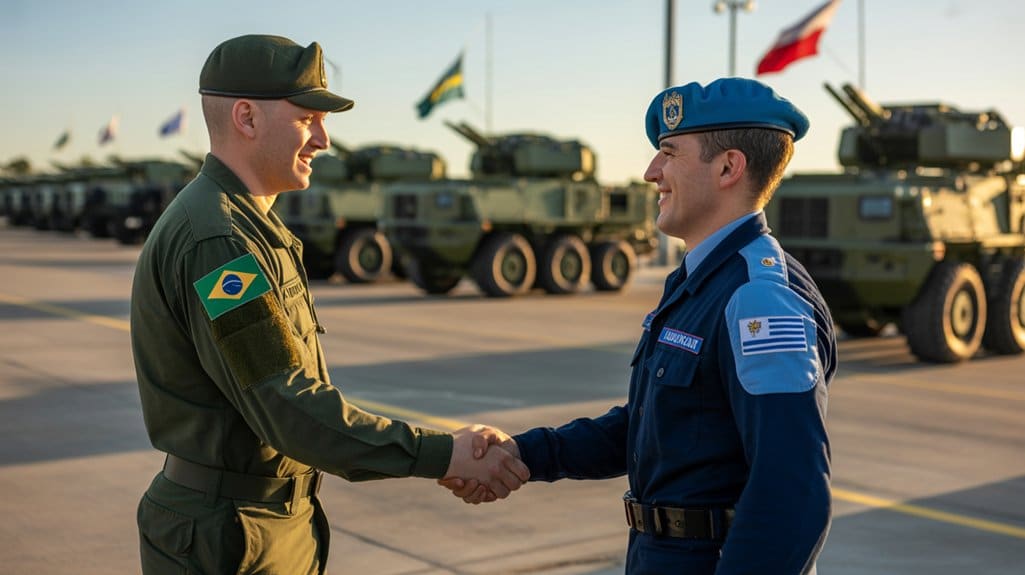
Brazil’s decision to transfer two Bell Jet Ranger III helicopters to Uruguay signals a notable shift in how South America’s largest nation approaches regional defense cooperation. The aircraft delivery goes well beyond standard diplomatic gestures, it demonstrates Brazil’s growing commitment to strengthening military ties across the Southern Cone.
On January 12, 2026, President Lula and Defense Minister José Múcio Monteiro Filho formalized this transfer through new legislation. The move targets Uruguay’s military modernization needs, particularly enhancing the country’s ability to combat organized crime and manage emergency situations. Uruguay’s armed forces have faced budget constraints that limited their equipment upgrades, making Brazil’s assistance particularly valuable for operational readiness.
Brazil’s collaborative approach now encompasses multiple Latin American nations. The country works alongside Chile, Colombia, Mexico, and Spain to promote peaceful conflict resolution and support democratic institutions throughout the region. These partnerships focus on practical cooperation rather than grand strategic proclamations, addressing shared challenges like cross-border crime and disaster response capabilities.
This helicopter transfer reflects Uruguay’s strategic importance to Brazil’s regional security interests. The two nations share extensive border areas where coordinated military capabilities help address smuggling networks and other transnational threats. Brazil’s investment in Uruguay’s defense capacity strengthens both countries’ ability to monitor and secure their shared frontier zones.
References
- https://en.mercopress.com/2026/01/16/brazil-transfers-military-equipment-to-uruguay-and-paraguay-to-bolster-regional-security
- https://agenciabrasil.ebc.com.br/en/geral/noticia/2026-01/brazil-donates-military-equipment-uruguay-paraguay
- https://www.riotimesonline.com/uruguay-strengthens-borders-with-new-aircraft-and-expanded-military-powers/
- https://en.mercopress.com/2026/01/16
- https://www.army-technology.com/news/brazil-apcs-lmvs-and-the-search-for-new-ifvs-and-mbts/
- https://www.zona-militar.com/en/category/paises-en/uruguay/
- https://militarnyi.com/en/news/uruguay-announces-tender-for-reconnaissance-drones-with-a-range-of-60-km/
- https://www.riotimesonline.com/brazil-news/rio-politics/uruguay-armed-forces-challenges-in-2022-patrol-boats-armored-vehicles-and-a-replacement-for-the-a37b/
- https://thedefensepost.com/2025/01/16/uruguay-a-29-super-tucanos/
- https://www.euronews.com/my-europe/2026/01/15/how-the-european-parliament-can-still-block-the-mercosur-deal